

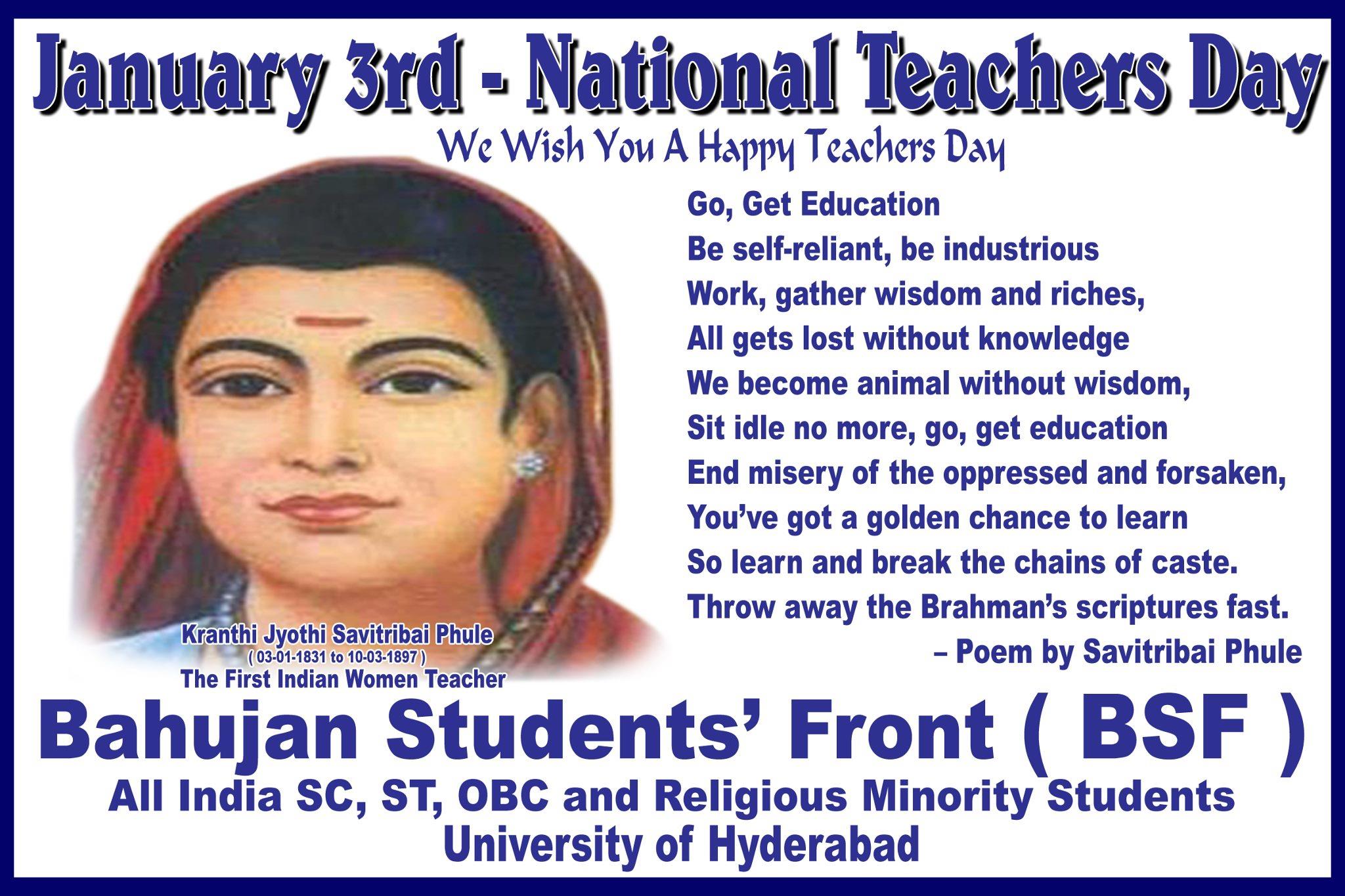
While the schools and educational institutions of the country have been observing September 5 as Teachers’ Day since 1962 on the birth anniversary of the first Vice-President and second President of independent India Dr. Sarvepalli Radhakrishnan (1888-1975), a section of Dalits, mostly students, activists and intellectuals at public universities, are increasingly denouncing its observance. They contend that the birthday of Radhakrishnan, a Brahmin, should no longer be held as Teachers’ Day because he had made no contribution to the educational uplift of lower castes and classes. Instead they exhort people to observe National Teachers’ Day on January 3, the birth anniversary of the nineteenth century social reformer, and teacher from backward caste, Savitribai Phule (1831-1897).
According to the biographer of Savitribai Phule, M. G. Mali (Krantijyoti Savitribai Phule, 2005), she was taught by her husband in a school run under the shade of a mango tree. Access to education enabled her to become aware about egalitarian movements at global level as she managed to read the biography of Thomas Clarkson (1760-1846), who fought for liberation of the Black. Later when she became a teacher, it was vehemently opposed by reactionary Brahmins who pelted stone and threw dung on her in order to “save” orthodox Hindu religion. When frustrated Brahmins were unable to deter the zeal of Phules about imparting education, they succeeded in reasoning with her father-in-law, Govinda Rao, to force them to leave home. She preferred eviction with her husband from home to giving up her mission on education. Despite the opposition, they continued to persuade parents to send their daughters to schools. As a result of their hard work, 18 schools were opened from 1848 to 1852. Her dedication to spread education, particularly among subalterns is self-evident from a few lines of her poem. ‘All gets lost without knowledge… We become animal without wisdom…So learn and break the chains of caste….Throw away the Brahman’s scriptures fast.’
Though it has been claimed that the celebration of Savitribai Phule’s birth day as Teachers Day has been held since the 1970s by the radical Dalit Panther, the intensified campaigns, particularly at public universities, have been observed in the last few years. In what follows, I will mainly discuss such activism at India’s two prestigious universities, Hyderabad Central Universities (HCU) and Jawaharlal Nehru Universities (JNU) where the assertions of Dalit politics are felt much stronger than many other places.
Bahujan Student Front (BSF)–a Dalit organisation active at HCU since its formation in 2007– has been celebrating the birth anniversary of Savitribai Phule as Teachers’ Day for a few years. In its last year’s pamphlet, the BSF offered justification for this. ‘Education was denied to the Bahujan Samaj under the barbaric brahmanical reign; despite this, Savitribai Phule made radical efforts to enlighten the mulnivasis of India by taking up education as the weapon for emancipation.’
As Dalit ideology views Brahminism as a primary contradiction and education as one of the most important means for liberation, it opposes the observance of Teachers’ Day on the birth anniversary of a Brahmin, who is alleged to have been an apologist of Hinduism / Brahminism as a scholar of comparative religion.
Similarly, S. Swaroop Sirapangi, a student of HCU with Dalit-Bahujan ideological persuasion, posted a pamphlet in 2012 on his blog that Savitribai Phule, unlike Radhakrishnan, deserved to be recognised as real educator, for she, along with her husband Jyotiba Phule, was in the forefront of spreading education, particularly for women and lower castes as early as the middle of nineteenth century. ‘As Brahmins never imparted education to others, especially to the subaltern, Savitri Bai Phule and her husband Jyotiba Phule were instrumental in taking a revolutionary step to educate the subaltern sections.’
‘As Brahmins never imparted education to others, especially to the subaltern, Savitri Bai Phule and her husband Jyotiba Phule were instrumental in taking a revolutionary step to educate the subaltern sections.
A web portal ‘Dalit Muslims Voice’ also supports Dalits’ demand. It, thus, praises Savitribai Phule as “a radical exponent of mass and female education”, “champion of women’s liberation”, “pioneer in engaged poetry”, “courageous mass leader” fighting against “upper caste atrocities”. It is to be noted that Pasmanda Muslims, Dalit and backward caste Muslims, allege that they face exploitation and humiliation at the hands of upper caste Ashraf Muslims. As a result they have forged an alliance with lower castes of Hindus and other religious communities.
In JNU too, similar campaigns have been launched by United Dalits Students Forum (UDSF) by organizing seminars, holding public meetings and taking out political processions. Over the years, the traditionally-strong left students’ organisations of JNU, which have been alleged to have ignored Dalit-Bahujan icons till recently, have now no hesitation in wearing Phule’s badge on their sleeves. In short, while smashing Brahmin gods, the Dalits are simultaneously inventing their own icons.
To understand this phenomenon, let me draw on the work of social historian Badri Narayan (Women Heroes and Dalit Assertion in North India: Culture, Identity and Politics, 2006). According to him, Dalits’ identity history attempts to iconize Dalit heroes and heroine. The purpose of this exercise is to challenge the hegemony of the upper castes in the sphere of culture and civil society. The inventions of new icons like Phule, Udadevi, Jhalkaribai, Avantibai, Pannadhai, Mahaviridevi are meant for enthusing Dalits to become “militant” to fight against the oppression and exploitation of the upper castes. As he puts it, ‘In contemporary times, as Dalits narratives are being rewritten and recreated to awaken the oppressed Dalit communities.’ (p. 158.)
Dalits’ Bitter Experience with Teachers
Dalits were denied access to education till a few centuries ago in Indian society. Under the colonial condition, a number of social reform movements were led by subaltern radicals who propagated the idea of equality in a highly stratified society. As the colonial government gradually introduced education for masses, some Dalits were able to enter schools. But unlike the experience of upper caste students, who often glorified teachers and placed them higher than gods, Dalits, on the other hand, had an experience of mistreatment, discrimination and humiliation at schools. There is a significant amount of work on the colonial period which shows such inhumanly treatment of Dalit students. Most of Dalit autobiographies, written in post-colonial period, also reflect on this grim reality. For example, Arvind Malagatti’s Government Brahmana (2007) recalls with pain how he was abused as “bastard” and was forced to undergo severe punishment. But most shockingly, the teacher inflicted pain on him without touching his body. “But we untouchable lot never had the good fortune of receiving slaps from his hands,” says the young Malagatti (p. 14). The experience of Namdeo Nimgade (In the Tiger’s Shadow: The Autobiography of An Ambedkarite, 2010) is not less painful. ‘The headmaster admitted me under the strict condition that I, being untouchable, must never enter with a handful of other untouchables on the hot veranda and listen to lessons through a window”, rues Nimgade. (p. 27)
These examples show the bitter experience of Dalit students with their upper caste teachers. As a result, Dalits nourish a negative image of upper caste and Brahminical teachers. The denunciation of Radhakrishnan as an educator for nation is informed by this very sociological and historical experiences of Dalits. Instead, the invention of the icon of a backward caste woman Savitribai may be viewed as a sign of the intensification of the process of Dalitisation of public culture.
This is a complete bakwas article! Who wants to learn chanting? and live life like a beggar on the street??
Brahmins were just keeping their tradition of chanting, which never helped a goldsmith or a carpenter!
British told you something and you believed it!