

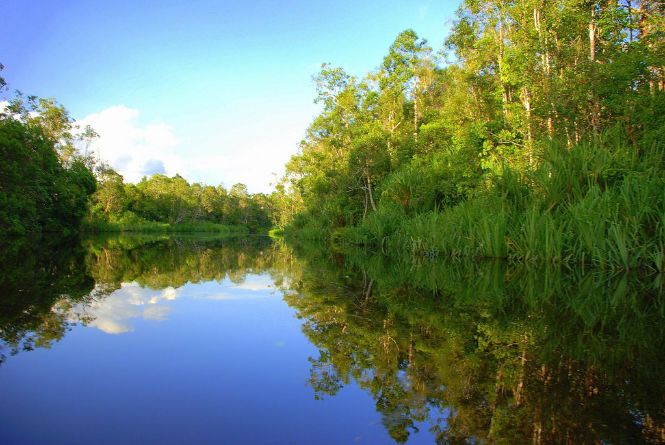
Human beings often forget that we are largely dependent on mother nature and become ignorant towards taking care of it. We have been so reluctant to the preservation of natural resources and sustainable development that we had forgotten the beauty of the earth completely.
The Covid-19 lockdown imposed throughout the world has struck a chord in every one of us and it has made us think how nature is so important for our day to day living. The tangible improvements in nature have made us believe that the earth can be saved.
It has made us see that our actions can very well impact the Earth’s sustainability. For breathing pure air to greener trees, spotting various wildlife into the cities here are some important environmental changes that we have seen for coronavirus lockdown in India. Around tens of thousands of flamingos have gathered in the city of Navi Mumbai. The birds normally migrate to the area every year, but residents have reported that this year they have seen a massive increase in their numbers.
New Delhi was ranked as the most polluted city in the world by WHO in May 2014. The usual air quality of India’s national capital according to the air quality index used to be 200. When the pollution level hit its peak, the pollution level soared to 900 and sometimes, off the measurable scale.
While 200 itself is 25 percent above unsafe level as deemed by World Health Organization, but as Delhi’s 11 million registered cars were taken off the roads and factories and construction were ground to a halt, AQI levels have regularly fallen below 20. The skies are suddenly a rare, piercing blue. Even the birdsong seems louder.
The decrease in aerosol levels was observed after just a week of reduced human activity and the data presents a 20-year low in aerosol levels for this time of year in northern India.
India has long struggled with pollution. In fact, according to the World Economic Forum, in February, India was home to six out of 10 of the world’s most polluted cities.
On March 25, when India ordered a since-extended 21-day lockdown amid the spread of the coronavirus pandemic, it created the world’s largest lockdown, encompassing 1.3 billion people. With that many people home, traffic is virtually nonexistent, factories are closed, and construction has come to a halt, leading to a noticeable reduction in smog and air pollution.
While the environment may be convalescing during the pandemic, experts don’t think this will last. But, in the meantime, the short-term effects are pretty striking, as these before-and-after pictures show. With a nationwide lockdown in place, over 90 cities, including Delhi, recorded minimal air pollution in the last few days.
Welcoming the reduction in pollution, environmentalists urged the government to treat it as a “wake-up call” and stop its “obsession” with “development” at the cost of the environment.
India is currently under the biggest lockdown with around 130 crore people asked to stay home in view of the coronavirus outbreak, which has claimed 19 lives and infected over 900 people in the country. The government has urged people to avoid unnecessary travelling, significantly reducing the traffic movement across the country.
According to the Centre-run System of Air Quality and Weather Forecasting and Research (SAFAR), the impact of the measures taken due to the coronavirus outbreak has resulted in a drop in PM2.5 (fine particulate pollutant) by 30 per cent in Delhi and by 15 per cent in Ahmedabad and Pune.
The level of Nitrogen Oxide (NOx) pollution, which can increase the risk of respiratory conditions, has also reduced. NOx pollution is mainly caused due to a high motor vehicle traffic. In Pune, NOx pollution has reduced by 43 per cent, in Mumbai, by 38 per cent and in Ahmedabad, by 50 per cent.
While the complete shutdown of India’s economy was designed to stop the spread of COVID-19, it is having an ancillary health benefit of clearing the air that millions of people were choking on, according to CNN. As vehicles stay off the road, construction is put on hold, and factories stop production, the levels of microscopic particulate matter, or PM 2.5, start to drop.
At the end of the day we can say that Lockdown was a good side towards the mother Nature. We should keep our environment healthy.



So relevant & relating to present situation, India is going through.
More power to you girl.
May you grow high.