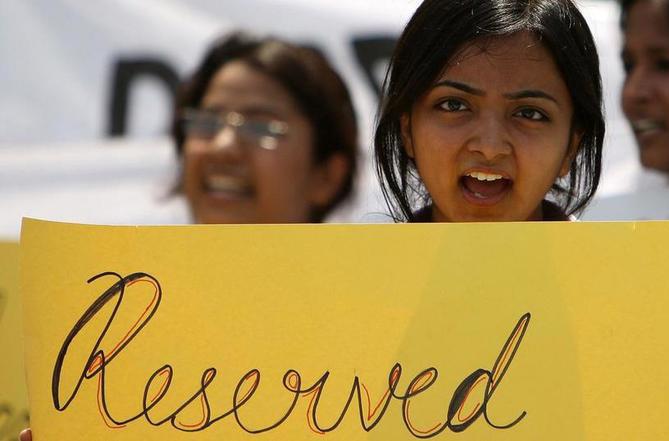
Article 14 of the Fundamental Rights of our Constitution provides ‘equality to all citizens in the eyes of the law’. Its source is “equality among equals”, meaning “equality between equals”. So, in our Indian society, a class of society has been identified as “inferior” and has been condemned for thousands of years. Reservation in the constitution is introduced to bring such a class to the mainstream. It is clear that the objective of providing reservation is to give social justice to the oppressed classes and not to be used as a tool to uplift the economically backward sections.
The Mandal Commission studied the statistics which states that about 3,745 castes in the country are backward, indicating that around 27 per cent reservation should be given to these castes. The Supreme Court passed a verdict with regard to the same. Now the Central Government which has introduced reservation amendment bill has not been able to study the same and no commission was created to study it. Out of nowhere the bill was brought up, which is constitutionally questionable. In terms of annual income, the average income of less than Rs 5 lakh is 87%in SC, 84% in ST, 82% in OBC and 72% in Forward Caste. Similarly, that with annual income of more than 10 lakhs is 7% in SC, 4 per cent in ST, 8 % in OBC and 16 % in Forward Caste. Similarly, according to the 2014 Union Public Service Commission Statistics, of the total candidates selected (0.14%), Forward Caste and OBCs are the most preferred (i.e., 0.17%) and the SC’s are the lowest (0.08%) among the selected. According to the Indian Human Development Survey, the percentage of children between 8-11 years of age belonging to forward caste in class 1 level is 68%, while statistics are lower than 56 per cent in OBC, 45 per cent in SC’s and only 40 per cent in ST’s. According to the UGC Annual Report 2017, enrollment of ST’s is only 1 per cent in the higher education sector, SCs 3 per cent, OBC 1 per cent and 95 per cent in forward caste. If we dwell deeper into representation of SC / ST / OBCs in various other fields, they are in the worst of the worst conditions.
The Congress, the SP, the BSP, the RJD, the BJD and the CPI (M) have been potrayed as the party which represents the issues of SC / ST / OBC in the parliament. But when only in two days both Houses of Parliament passed the bill almost unopposed (323 \ 3 in the Lok Sabha and 165 \ 3 in the Rajya Sabha), who will question the so called representatives of Bahujans. The reason behind not opposing the bill in parliament is well reflected in a Facebook post of Chinmaya Mahanand, a JNU research scholar who writes “Its so unfortunate that the Bjp whose half of the votes belong to sc/st/obc ( out of total 31% vote share) could take a risk in favour of savarna while the Bsp, Sp, Rjd, Bjd, Cpm… etc whose 80-99.9% vote share belong to sc/st/obc couldn’t take a risk of 0-10% savarna votes, and the Bill get passed in two days. How did this miracle happen? It happened because the Party which talks about 85% Bahujan, represents a legitimate progressive force, with it’s zero percent savarna votes, could dare to welcome the Bill by undermining the importance of its 99% Bahujan votes, then why should the others oppose who have at least few savarna votes to loose. The pressure (importance) of savarna votes that originated from Bsp amounted and prevailed over others. That’s how the Bill went almost unopposed in parliament. Had Bsp opposed this Bill at the first, things would have been different. I am deeply sad over Bsp performance.”
Nevertheless, is the Central Government planning to make a reservation as an “employment guarantee scheme”? Modi had promised 2 crore jobs every year during the 2014 election, but has failed to do so in the last five years. The country’s economy has deteriorated; many people have lost their jobs and are angry over the policies of government. This bill has been brought to appease the frustrated youth in favour of BJP. But those who argue that it does not take advantage of this, if Forward Caste has 50% of the job and admission in higher education, the government is taking 10% from existing 50% and giving back the same 10% in the name of reservation. That is why it is clear that the eligibility criterion i.e. 90 per cent of the population can avail this reservation, is being argued. Now this bill is in the Supreme Court. In the past, Andhra governments’ Muslim Reservation Bill, the Rajasthan Government’s Jat Reservation Bill and upper caste reservation bill of the Gujarat government were declared unconstitutional by the constitutional bench of the Court.Similarly, the Constitutional bench of the Supreme Court in the Indira Gandhi v/s Union of India, states that “the economic criteria is not the basic mandate for reservation in accordance with the constitution”. As such, this bill is trying to overthrow the constitutional reservation system.