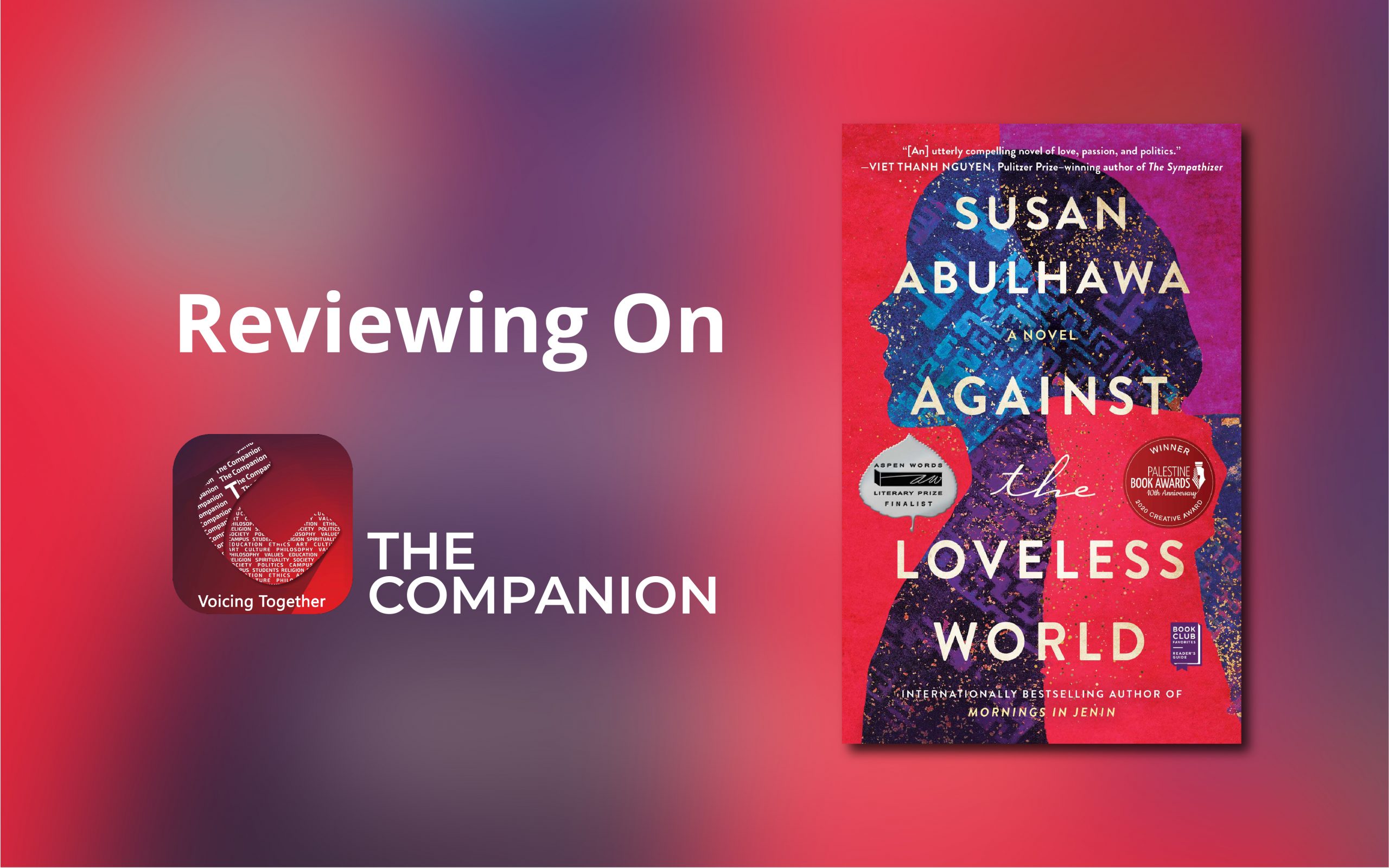
Susan Abulhawa’s much-awaited third book Against the Loveless World took the reading community by storm when it hit bookstores in August 2020. The first two books by the author, namely, Mornings in Jenin (2010) and The Blue Between Sky and Water (2015) were international bestsellers and translated into 26 languages. Praise from literary stalwarts has been heaped upon the author and her work, which Marc Lamont Hill calls “A masterpiece.” (1)
Contemporaries like Ahdaf Soueif, Michael Palin, and Teju Cole join in the praise. Fatima Bhutto “Reads it as a riot against oppression, misogyny, and shame.”(2) The book takes up important social themes of marriage and divorce, childhood, parenthood and childlessness, familial bonds, kinships, and inheritance. Other themes that make it a must-read are Arab culture, money, propriety and prostitution, occupation, and colonialism. The book is a bold attempt, almost scandalizing a reader who isn’t used to such blunt representations. It gives the reader the same courage that it squeezed away in the first place, making them go on and on. It is not at all an easy read. It shows one of the ugliest faces (of society) that we shun, that we roll our eyes over, then look down upon, then blame, then pretend to overlook, finally considering ourselves not a part of it. It is so because of the conundrums upon these mountains of mannerisms and sophistication, which have a core of dust. The book is meant to crush you, shake up your entrails with the horrors of a nightmare, only to wake up to an uglier world with beautiful masks.
It is a resounding story of a revolutionary, a rebel, a Palestinian resistance activist who, too is a woman, from the silent confines of the Cube, which is one of the most sophisticated of the Israeli prisons meant for one of its most wanted ‘terrorists’. The book offers the readers of the world an opportunity to understand important contemporary words like terrorism, colonialism, and refugee in multi-faceted ways. The book shows the readers what could happen if a bomb landed upon their house at that moment. It gives one time to prepare, to decide things beforehand, lest the world falls apart. It talks about possibilities after all is lost. The book is a clarion call to wake up those who are still alive. It also shows us what the society around us could be, that which judges without limits, without consequences of worth.
The deployment of the first-person narrative, through ‘Nahr’, (a name which is highly symbolic to the tale) is particularly what strikes the average reader- the independent female rebel, always finding her way out, as a little girl, as a woman, and as a resistance activist. Her little acts inside the prison cell are revolutionary in themselves- “I colonized the colonizer’s space of authority. I made myself free in chains and held that courtroom captive to my freedom.” (Abulhawa, Susan, 2020) (3)
The novel is a tumultuous ride as it takes the reader to several Middle-East nations, like Kuwait, Jordan and Iraq, but centring around Palestine all the time. The heartfelt visions of freedom from the Zionist entity never desert the consciousness of the characters and ultimately the readers. The story is fraught with instances of injustice meted to harmless and innocent civilians who are discarded as refugees from their homeland. Such instances take the reader on an emotional roller-coaster of deep loss, separation, rage, disgust, rebellion, bereavement and hope.
The prose is lucid and easy to understand, given the primacy of ideas and messages that need to travel through. Like a wave, the prose sometimes dives into depths of chaos and is many times poetic. Pithy, quotable lines stay with the readers long after they have closed the cover- “There isn’t enough room for the heart to move. There are no winds to rustle it.” (Abulhawa, Susan, 2020) (4)
Several themes reveal themselves through the course of the story, prominent among which is the crisis and trauma caused by an occupational regime. Memories and imagination are the driving force of the story, where everything is recounted as time is remembered, moving back and forth as if reels playing at random. Nahr’s story gives the reader an idea of what is faced by the real-life prisoners by real-life prisons, which cannot be simply reduced to social media posts to be scrolled through and forgotten in the long run. It is an unsettling read, like a hard, indigestible lump in your throat. One cannot take it in nor let it out. It does not budge. Demands to sit right over your consciousness, choking your breath and existence- perhaps like an alien soldier over a beautiful bridge, checking permits to your homeland. The story shows the forms that injustice can take. While the reader seems distant from the land of occupation, and colonialism seems like a bygone evil, the story shakes the reader to the realisation that it’s still clawing at the world around us. It is the world that has turned a blind eye to the sufferings of the refugees. It’s unforgettable.
Another important theme is that of time. The impossibility of tracking it in prison, improvising one’s own mental calendars, and losing track, all of them remarkably describe the plight of prisoners- “For a time, I marked my existence in menstrual cycles.” (Abulhawa, Susan, 2020) (5). At times the reader would like to know how Bilal, another major character, feels, or how the story outside the Cube unfolds, but that is something left to the readers’ imagination. The cliff-hanger ending leaves the reader oscillating between the real and fictional possibilities of the story.
While the book can be read by young people and adults alike, it will cast its spell upon the sensitive reader, who has an experience of life and an understanding of contemporary times from which the story is inspired. The book is ultimately food for thought, for those who want to ‘listen to departure’ (Caruth, Cathy, 1995) (6). Against the Loveless World would thus interest someone who appreciates what writers like James Baldwin and Khaled Hosseini write about.
Out of the various messages that travel to the readers through Nahr’s splayed manuscripts on the Cube’s floor, one most prominent is that human rights exploitation and injustice anywhere is a humanitarian concern for the whole world. The book is highly recommended to students of psychology and trauma studies. It is also a must-read for anyone who dreams of a better world.
References:-
1)Hill, Marc Lamont. Review excerpt on Book. Against the Loveless World, by Susan Abulhawa, Bloomsbury Press, 2015.
2)Bhutto, Fatima. Review excerpt on Book. Against the Loveless World, by Susan Abulhawa, Bloomsbury Press, 2015.
3)Abulhawa, Susan. Against the Loveless World. Bloomsbury Press, 2020. Pp 333.
4) Abulhawa, Susan. Against the Loveless World. Bloomsbury Press, 2020. Pp 339.
5) Abulhawa, Susan. Against the Loveless World. Bloomsbury Press, 2020. Pp 215.
6) Caruth, Cathy. Trauma: Explorations in Memory. The John Hopkins University Press, 1995. Introduction, pp 10.