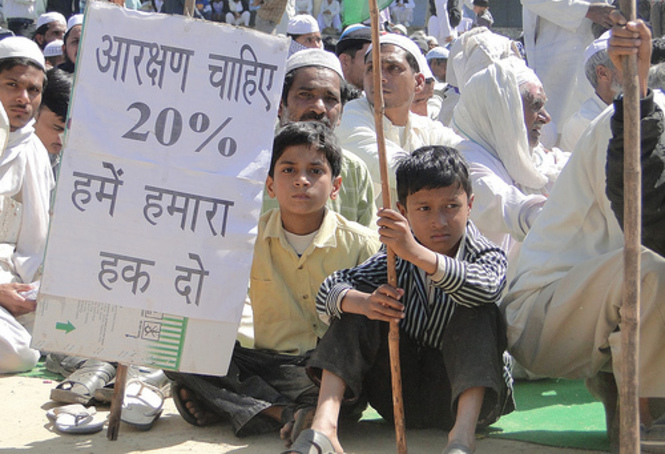
The first week of January 2019 was an important week in the political context. This was very much significant as far as the Indian politics and its role in the promotion of reservation for upper caste is concerned. Wherein, the effort has been made to pave the way for the reservation for the general category on the basis of economic backwardness. This kind of step added fuel to the fire and opened the Pandora box on the affirmative action policy. This step has thrown light on the one side of the story as far as the protective discrimination is concerned i.e. perspective from above, while it ignores the other side of the story, the reservation for the lowest section of the society i.e. perspective from below. In this context, the present paper is more concerned about the long pending demand of the Schedule Caste status for Arzal Muslims and Dalit Christians. This is an attempt to analyze the role of the state in the reservation for these ostracized communities and the underpinning socio-political dynamics on the same from the perspective from below.
To begin with, it can be argued that in common parlance Muslims have been understood as a monolithic category. It means that Muslim is one category irrespective of the social differences and diversities within. However, it is not factually true. They are sociologically divided on the caste lines, namely, Ashraf, Azlaf and Arzal. This has been substantiated by scholars like Ahmad and Ansari and the Sachar committee report. The Ashraf are similar to the Hindu upper caste; Azlaf are comparable to the Hindu backward caste; and, third category Arzal could be equivalent to the Hindu Dalit. Similarly, there is ostracized community within Christians; they are Dalit Christians. These communities are largely an emergence of conversions of the lowest section of Hindu community to Christianity and Islam.
When it comes to the affirmative action pertaining to the Muslims (Azlaf and Arzal) they largely fall within the OBC category with the backward classes of other religion. While Ashraf Muslims are outside the reservation benefit. However, putting Arzal Muslims within the OBC fold is how much inclusive in nature as far as the Arzal or Dalit Muslims are concerned, while their counter part of other religions falls within the SC status. At this juncture, it is worth discussing about the Presidential Order which guarantees the schedule caste status.
Schedule Caste status is given through the Presidential Order, 1950. Initially, the Schedule Caste status was reserved only for Hindus as ‘no person who processes a religion different from the Hindu religion shall be deemed to be a member of a Schedule Caste’ (Ahmad, 2007: 18). Later on, because of pressure from Ambedkarite and Sikh organizations, this was … amended to include Dalits who profess Buddhism and Sikhism (Sikand, 2007: 104). Hence, this category accommodated those people who are of religion which are Indic in nature and excludes those who profess the religion which are not of Indian origin such as Islam and Christianity. Several scholars and political scientists argue that the state is discriminating on the basis of religion in this regard. To substantiate this, it is worth mentioning (Ibid.,103) ‘the continued denial by the state of SC status to the Dalit Muslims and Dalit Christians despite consistent demands on the part of these communities is patently anti-democratic and anti-secular stance and a gross violation of the fundamental principles of the Indian Constitution’.
Although, they have been denied the SC status by the state, they do qualify not only on the basis of social and educational backwardness but also on the criterion of untouchability. The former criterion can be substantiated by the higher educational representation of Muslims (including Ashraf Azlaf and Arzal) as they are 4.7 percent in higher education according to the All India Survey on Higher Education (2015-16). Moreover, the Christians as whole are represented more in higher education while there is lack of extensive data which talks about the Dalit Muslims and Dalit Christians explicitly in higher education. However, Muslims as whole, are also very low in proportions to their percentage of the population in higher education. To substantiate on the later criterion, it can be argued that the caste-based discrimination exists among the Muslims. Also, it has been argued that Islam as a religion has no caste like descriptions or scriptures which adhere the untouchability practices. However, there are various studies (Ansari 1960 and Ahmad 1978) which argue that there are caste-like practices among the Muslims. Moreover, there is presence of untouchability among the same. To substantiate this, there is excerpt from the work of Trivedi et. al. which argues that ‘relatively well-off sections among Dalit Muslims report higher incidences of untouchability, and perpetrators admit to it even more so. It leaves no room for any confusion that the practice of untouchability is not confined to Hindus alone. It spreads far and wide and perhaps no Indian religious community can escape it, including the Muslims’ (2016:36).
Moreover, they are also bereft of social and cultural capital (the term given by Pierre Bourdieu). The former term is based on the social contact and network, which the upper caste people have and they use it in their own way. While, the cultural capital cab be studied in three forms: embodied ‘in the form of long-lasting disposition of mind and body; in the objectified state, in the form of cultural goods such as pictures, books dictionaries’ (Bourdieu, 1986:17) and in the institutionalized state i.e. educational qualification. This social and cultural capital is very much influential in the context of upper caste people, while the ostracized community from both religions does not have the same. Therefore, it is indispensable to focus on the abstract thing such as cultural and social capital while considering and discussing the affirmative action for the ostracized community.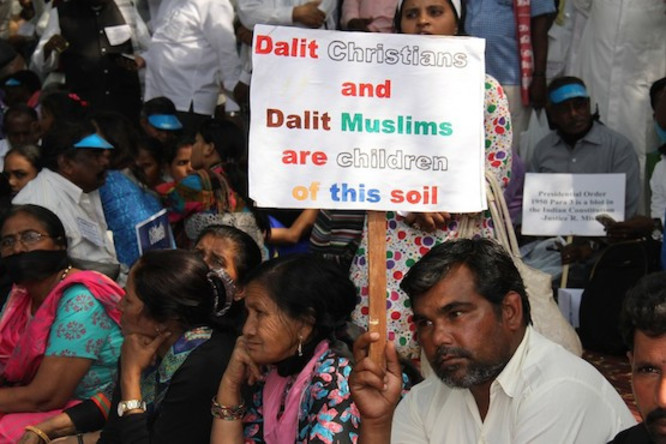
The second vantage point of discussion is about the socio-political dynamics in the context of the affirmative action. At this juncture, it is worth discussing about the political determination of the political parties in the promotion of this form of social justice. The political parties across ideology do not explicitly support this means of affirmative action, and even they are reluctant to give space in their manifesto. In this context, it is worth asking some prominent questions such as: are they afraid of political and social repercussion on inclusion of the Arzal Muslims and Dalit Christian in the Schedule Caste status? Are they (Dalit Muslims and Christian) not potential vote bank for the political parties which can decide their fate? Are they politically and socially impotent to become the pressure group which could influence the political decision in their favor? Are they united to take this benefit? Is there any intensive movement to alter this order which discriminates on the basis of religion? Moreover, it can also be argued that political parties consider Muslims as a monolithic community and they do not give emphasis on the social stratification of the same. And the discussion about the Christian rarely take places in political arena. Hence, these are some questions which have deep implicit meaning as far as the will of political parties in the matter of social justice is concerned. Therefore, on the basis of these interrogative statements, we can decipher the possible reasons behind such forgetfulness, lethargic and in-deterministic attitude of the political parties for not conferring upon these ostracized communities the SC status.
To argue succinctly, the state is discriminating on the basis of religion in the context of the reservation for the Dalit Muslims and Christians, which is contradictory to its own ethos of secularism. There is lack of political will and dereliction to the same issue because of primarily four reasons: firstly, the political parties do not support this social justice because of the possible social repercussion within the SC status. Secondly, this is because of their less numerical strength hence they are less politically important vote bank. Thirdly, these groups are not organized as in case of Muslims to become a pressure group which could force the political parties to think overt it. Fourthly, there is a lack of intensive movement and protest among the ostracized community as Maratha (they got the reservation in Maharashtra) and Pattidars (who are demanding for the reservation). Moreover, they do qualify for the same on the basis of ‘field view’ i.e. the realities based on ground. There are five ground realities namely social backwardness, educational backwardness, lack of cultural and social capital along with the economic backwardness and practice of untouchability, unlike the present provision for upper caste which provides reservation solely on the basis of economic criteria. Therefore, there is a need to accommodate them in the SC status for their social and political upliftment. This is also indispensable as Professor Kumar, a renowned sociologist, has argued that reservation is not poverty alleviation program rather it is the process of nation building.
References
Ahmad, I. (1978) Caste and Social Stratification among Muslims in India, 2nd edition, New Delhi: Manohar Publications.
Ansari, G. (1960) Muslim Caste in Uttar Pradesh: A Study of Culture Contact, Lucknow: The Ethnographic.
Bourdieu, P. (1986). The Forms of Capital. In Richardson, J. (Ed.), Handbook of Theory and Research for the Sociology of Education (pp. 241–58). New York: Greenwood.
Sikand, Y. (2007) ‘SC Status for Dalit Muslims and Christians’, in Ansari A. H. (ed.) Basic Problems of OBC and Dalit Muslims, New Delhi: Serial Publications.
Trivedi et al (2016) Does Untouchability Exist Among Muslims: Evidence from Uttar Pradesh, Economic and Political Weekly, Vol. 51, Issue, 15, (09, April, 2016), pp 32-36.