

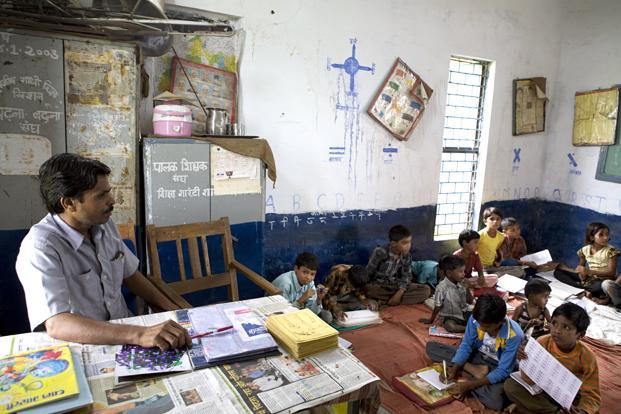
Are the shifting policies in school education weakening the public schools in India?
ASER’s latest survey report (2013) at first sight reflects an improving condition of school education in India. It shows that school enrollment in the rural part of our country is increasing every year (over 96% in 2013) with a constant decrease in the proportion of out of school children (3.5% in 2012 to 3.3% in 2013). Girls’ enrollment is showing a steady increase except in Rajasthan. There is also a potential growth in compliance with Right to Education (RTE) act especially in terms of the provision of toilets, drinking water, libraries, mid-day meals etc. Pupil-teacher ratio is also showing a significant improvement in many schools.
All these improvements are highly commendable and seem to be a good starting point. But are the above indicators enough for the systemic reform we expect in the school education system of India? Are we making efforts to measure such factors as the students’ retention, attendance and learning levels? Of course it’s very difficult to measure learning levels and there can’t be any formula for doing so, but it’s necessary to devise some method to judge these aspects. At the end of the day what matters the most is what the kid has learned in the school?
Unfortunately this year too, when it comes to the minimum learning outcomes we don’t have enough evidence to show a potential improvement.
ASER tries to measure learning levels at a minimalistic level in terms of reading and arithmetic skills. For example, can a Class V student read Class II books easily? And the reason to use this method comes from the terrible quality of school education in India since long – especially its deteriorating condition in public schools. Unfortunately this year too, when it comes to these minimum learning outcomes we don’t have enough evidence to show a potential improvement.
If we look at the reading standard at the national level it doesn’t show any significant improvement from the past many years. For example Std V student being able to read Std II level texts has remain unchanged from the last year which has been decreasing since 2009 dropping from 52.8% to 46.9% in 2012. Similar indicators like Std III student able to read Std I textbook has slightly increased but this has mainly come from private schools. The report also says that children are still struggling with basic arithmetic around the nation. No change is observed in the proportion of Std. III children who are able to solve a two-digit subtraction with borrowing. Even the gap between the arithmetic ability of school children in public and private schools are widening, public school children being on the weaker side.
The above mentioned indicators on the poor condition of learning levels should be taken seriously particularly because one of the major goals of RTE act has been to improve the quality of school education. Will it take more time to even start going on the right track or are we at the present moment just running on the wrong track? At least the increasing trend in admissions in private schools and tuitions is signal enough to show that something is drastically wrong with our education policies. For example there is a steady increase in private school enrollment and also in the proportion of children going for paid private tuitions. Adding to this ASER survey suggests that any improvement in learning outcomes is predominantly due to the private schools. Does this mean that public schools are gradually deteriorating in terms of quality education and private schools are at least maintaining the status quo? This is reflected in the gradual closing down of many public schools or private companies taking them up in certain states like Rajasthan, Maharashtra etc.
The sharing of responsibility among the public and private educational setup on the one hand and the people on the other, to provide quality education which is inclusive, accessible to everyone looks like a positive step towards a better and robust education system but does that mean:
- Shutting down public schools if they don’t perform well?
- Not focusing on improving the quality of public schools?
- Letting the public schools slip off from government to the private companies?
- Increasing trend towards private schools and paid tuitions and decreasing number of public schools?
The biggest reason being given for the deterioration is the lack of resources but is this a valid reason to watch mutely the crumbling situation of public education system in our country? At least it is an established fact that a strong public education system is crucial for any nation’s progress. Are we not denying ourselves this wisdom by our upside down policies or our callous actions and inexplicable silence?


Very good analysis of the current education scenario by Mujahidul Islam!
Why this dangerous trend of privatization of the education sector is the question being asked in the article. I attended a presentation by a Canadian teacher of the school system in Canada. There private/corporate sector are asked to help financially when needed but they do not take over the government system as education is not to be handled as a business to earn profits.