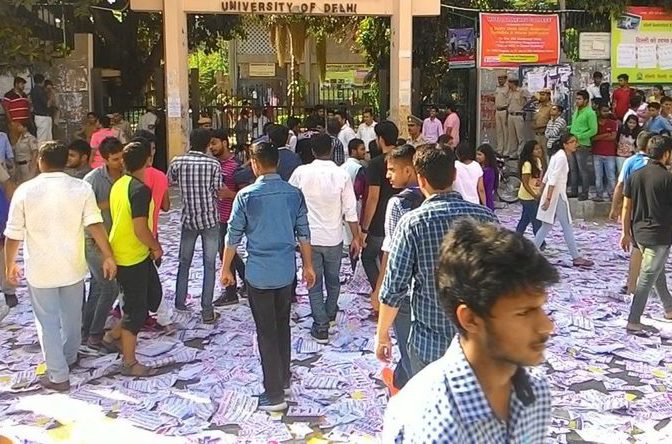
Delhi University is always a center of much anticipation from sky high cut offs to the hype around fests. Having said that it is quite evident that Delhi University Students’ Union (DUSU) elections is one of the most popular events in the student politics of India. In the first week of September, the streets of Delhi are flooded with posters, hoardings, crowd shouting with big SUVs and candidates campaigning are quite common scenes. The campus itself goes crazy and insanely crowded with a lot of people coming from outside Delhi just for campaigning for their candidates. Politics in Delhi University is difficult to define under one category with ugly political jingoism of student wing of National parties far from catering to the concerns of students to a plethora of activities and exercising democracy. But why is there a clear ‘exclusivity’ of some colleges from DUSU elections? Why some colleges mainly, ‘all women’ colleges are not under DUSU? What students who are outside DUSU missing on?
The student politics in Delhi University has many folds within it. Starting from admissions, the ‘campus’ becomes an important aspect of your student life that decides how you’ll experience Delhi University in your coming years. In 1973, South campus was established in order to expand the circle of Delhi University. However due to ‘off-campus’ scattered colleges, students from south campus find themselves distanced from the North. Thus, much of protests and centre of student politics of DU is restricted to campus colleges.
Elections
Every year, in the first week of September, elections for Delhi University Students’ Union are held and the spotlight of national student politics comes on Delhi. DUSU is an elected student body that represents concerns of students affiliated and act as a bridge between authorities and students.The union has the responsibility of organizing cultural events all around the year in colleges that come under DUSU including the very popular cultural fests in DU circle. Every year the student wing of National Political parties—National Student Union of India (NSUI) backed by Congress, Akhil Bhartiya Vidhya Parishad (ABVP) backed by Rashtriya Swayamsevak Sangh (RSS) working jointly with BJP’s official youth wing, Bharatiya Janata Yuva Morcha, All India Students’ Association (AISA) the student wing of the Communist Party of India (Marxist–Leninist) Liberation and recently formed Chhatra Yuva Sangharsh Samiti (CYSS) backed by AAP contest elections among others. As the elections approach a great show of money and muscle power is put up with thousands of flyers flooding the streets of campuses and posters put up in all over Delhi. All the candidates do not shy away in spending huge amount of money from fancy cars, jam packed crowd with big guys from outside Delhi are brought in for canvassing for the respective candidates. An estimated 40-50 whooping lacs are spent by the candidates to ensure victory. But where does all the money go? Apart from campaigning etc. a lot of demands of the students are needed to be taken care of. Private parties, alcohol, picnics, recreational activities, free meals in outlets like Dominos, Mc Donalds with separate demands from a particular ‘community’ are needed to be addressed. The societies, regional associations and communities make a major part of collective vote bank. Different techniques are used for mass polarization and appealing to students, however the true essence of revolutionary student politics adhering to norms and ethics where debates, deliberation are done and agendas are discussed is often crushed in this atmosphere. Major fights and clashes that break out in campuses, classes being cancelled are a common sight. Unlike DU, student politics in other universities like Mumbai University, BHU, IIts have a comparatively autonomous culture where there are chances of victory of an independent candidate not affiliated to any wing. However, the traction that student politics in Delhi University receives is much higher which many believe is due to presence of national level politics. But, how much does an average DU student care about DUSU? The elitism, money power and huge demands are some of the contributors that makes candidate to focus less on running an honest campaign based on the actual welfare of student community. Moreover, the students are themselves not bothered about manifestos and candidate profiles. Thus, both student community and candidates are equally accountable for the current scenario of hooliganism, violence and lack of true essence of independent student politics.This ruckus has been a major point of contestation between those colleges who are affiliated to DUSU and those who have independent student unions. Colleges like St. Stephens, Kamala Nehru College, Daulat Ram College, Lady Shri Ram College, Delhi College of Arts and Commerce are some of the colleges that do not have any part in DUSU elections and have separate in-college elections for their union with independent candidates. Most of the colleges that have pulled out from DUSU are girls college. Therefore, while non-DUSU colleges like Daulat Ram gets to see the hustle bustle of elections because of their geographical location in campus, students from off campus colleges like LSR are far away from any involvement in the process. Many freshers like me had no idea about the parties or DUSU neither we witnessed any campaigning by any candidate with party supporters driving in fancy cars or rallies with slogans. What we used to hear from our friends in DUSU colleges was DUSU elections is all about angry guys in white kurtas with numerous bulky guys rallying for votes and hullabaloo in campus! Due to this most of students found themselves quite satisfied with an independent union. I got to witness my first student union election of LSR this year in the month of March and I found it to be more compelling than what my friends told me about their colleges in DUSU. With maximum amount to be spent on posters Rs.1500 and candidates coming to us asking for reading their agendas and giving feedbacks I found there was more stress on real issues in college rather than race of showing power and influence through freebies etc. With handmade posters and number of confrontations by candidates where questions were asked to candidates based on their agendas by the student body, there was more essence of a free and fair student politics. Protests and demonstrations are a huge part of an independent student politics. How does student body in LSR show dissent? Protests against moves that are against welfare of the students in LSR have always been a centre of attraction in DU student circle.
One of the major protests that I saw was against Hostel regulations set by the authorities last year in November. While most of us including me couldn’t join the protest, we showed solidarity by posting videos of the protests on social media. ‘Kuchh salaakhein tooti hai, poora pinjra baaki hai! slogans were shouted to show dissent against the college administration’s hostel regulations.The protest of 5th November, 2018 was an example how the independent colleges raise their voices and are not dependent on DUSU for protests. One of the demands from the charter of demands of that protest was implementation of OBC reservations in hostel. In lieu of the move, administration has decided to disallow hostel vacancy for second and third years for making space for first years.The decision is not welcomed by the Hostel Union and has decided to protest against the decision. “Rise in Rage!” the hostel union has written on social media posts declaring protest against the administration.The move has been termed as ‘plain pretentious’ because students will have to take up accommodation in PGs which is not feasible for everyone and thus will further limit inclusivity in college. As others have suggested that the decision will affect culture of LSR and weaken student movement, I myself completely agree that college does give you a space where personal and socio-political relationships are developed with seniors.What exactly will happen we would only know after vacations in July, until then most of students including day scholars have showed solidarity to the movement by reposting the posts by Hostel union.
Thus, although I might not know about student movements in other non DUSU colleges and talk about how independent their student movements are, it would be fair to say that student politics of LSR is not missing out its democratic share by having a non DUSU college union. But the question remains, are we missing out an integral part of DU experience?
Evidently, DUSU does play an integral role in functioning of colleges and university as a whole whether colleges affiliate with it or not and DUSU elections have a similar or ‘real’ experience like that of state level politics. Although, there is a clear political division in DU regarding DUSU, it is hard to choose sides. Many of the students from the non DUSU colleges are active members of student political parties. While on one hand there is too much politics and outside interference, on the other hand there is a feeling of fleeing away from the democratic process and missing out the real politics. Sometimes, little because of geographical distance from North campus, more because of no say in politics of the main campus, we feel alienated because of not being able to participate in student movements in campus which somehow affects us as students from off campus colleges as well. Thus, to say that we do not want to participate in DUSU election neither they affect us will be an ignorant statement itself. Student politics in Delhi University has many points of diversity and contestations in itself, experiences of students from different colleges are different from each other because of geographical, campus location and atmosphere influences.