
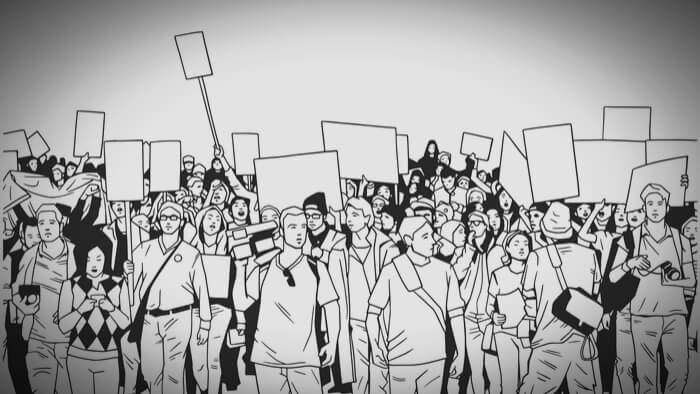
From the agitation against a 20% fee hike in hostel food in an Engineering college of Ahmedabad which ended up with the dissolution of the state government in 1974 to the protest demanding Justice for the suicide of a Dalit Scholar at Hyderabad University in 2016.
Student movements are diverse and range from protests against university administrations to revolutionary movements that contribute to the downfall of oppressive government regimes. They strongly express their voice for every issue majorly reforming, that impediments to their liberty, fundamental rights, or the core values of an idealistic society.
In between, India has seen a lot more, for instance, the Bihar Students Movement, 1974 (also called JP Movement), the Assam agitation against illegal migrants, the Anti-Mandal agitation,1990, and the uproar agitation of a week by Jadavpur University Students in 2014 against molestation in the institution, etc.
Analyzing student movements:
In reviewing these movements, it becomes evident that they represent spontaneous, grassroot efforts involving a significant number of students, all aiming to instigate or resist change. Their mission is uncomplicated: to challenge the existing norms and express their viewpoints.
Around 50% of India’s population is under the age of 25. Since the inception of institutions of higher education, they have functioned as crucibles for the creation of new ideas and ideologies, acting as catalysts for socio-political changes.
Approximately 20 million students are pursuing higher education. Hence, they are literate and aware of what is happening in and around the country. They are constantly updated about every trending event, political or social and form a well-informed opinion and perspective about government policies and legalities in light of the Constitution and broader global perspective.
In a complex social landscape, we cannot expect students to remain silent witnesses to the pervasive influence of hegemonic practices. These practices, exemplified by dominant groups wielding control over media narratives, educational curricula and political discourse, shape the collective consciousness of society. Students being active agents of change understand the urgency of dismantling these hegemonic structures that breed inequality and division and challenge the existing conditions by engaging in inclusive dialogues that bridge the gap between the governing bodies and the governed.
The fervour of youth demands expression coupled with intense emotion and finds strength in collective solidarity and unwavering idealism. Their raw authenticity challenges norms and confronts obstacles and their emotional intensity is a driving force for transformative change.
It’s vital to note that an education system that does not qualify the students to question the existing theories and government policies is useless and must be questioned for its own validity and existence. Therefore, maintaining academic integrity is essential for them, but challenging the fundamental structure and core human values of society should be avoided. Otherwise, their actions might be seen as a malady that needs to be controlled.
Brendan Dooley, Professor of Renaissance Studies at University College Cork comments that Students alone, as a social elite with specific requirements and specific connections to the institutions of power, have created episodes of protest with a lasting impact on the lives of subsequent generations of students as well as on their societies at large.
When students mobilize and engage in protest, they are not merely expressing dissent; they are shaping the course of history. These episodes of protest, catalyzed by students, have a lasting impact, leaving an indelible mark on subsequent generations of students and the larger society.
In addition, it suggests that students who bring intellectual depth to social movements are not only passionate activists but also thinkers who contribute crucial ideological elements. Their activism isn’t just a reaction; it’s a thoughtful response rooted in a deep understanding of societal issues. Through their intellectual insights, they add layers of meaning and analysis to the larger movements they are part of, making these movements more informed and effective.
Hence, by acknowledging both their intellectual contributions and their passionate activism, society can fully appreciate and harness the transformative potential that students bring.
Historical background:
If we take a look around the history, the roots of the students’ movement can be traced back to nearly 200 years ago with the formation of the Academic Association in undivided Bengal’s Hindu College under the guidance of a professor there and a reformer whose disciples later formed a young India group, which played part in the Bengal renaissance of the 19th century.
The first documented instance of student protest is against the partition of Bengal in 1905, when college students of Calcutta burned down the then-viceroy Lord Curson’s effigy.
In undivided India, the first student strike took place in King Edward Medical College, Lahore in 1920 against the academic discrimination between Indian and English pupils.
Students and their organizations also participated in freedom struggles across the country. Later, in post-independence times, all the major political parties started their student wings officially. Also, various independent student groups catering to economic or socially deprived sections and various religious organizations came up with their student wings too. Their work, efforts and stance on various issues have been etched in the memory of the nation.
Conclusion:
Hence, India has seen everything from alternative movements to redemptive and reformative social movements. All the more, it is important too from the perspective of a democracy to listen and give credence to the views of the emerging voices who will shape the future of this country. If not listened to, they will surely rise to question the justice and fairness in the action of the authority and the rarest conditions opt for a revolutionary movement. But will not settle for less.
Today, the Indian establishment is being questioned by a major portion of its youth repeatedly about the justice and fairness of its policies considering our Constitution and basic human rights. More and more students are raising their voices despite the tear gas, lathi charges and detentions. Their voices are too loud and too strong to be muted. Recently, the students of some central universities in the country’s capital faced a lot of challenges but this didn’t stop them from gathering again for the just cause. The government must listen before its social fabric is ripped apart. It must be realized that the students are not disconnected but instead backed by supportive family, friends, aware citizen and their own intellectual capacities. Let not student activism be viewed as a challenge to institutional authority. As a progressive nation, it’s essential to acknowledge and value the perspectives of these emerging voices who have contributed to society for generations, advocating for progress and dismantling unjust structures for a future based on equality and empathy achieved by challenging norms and deconstructing established narratives.