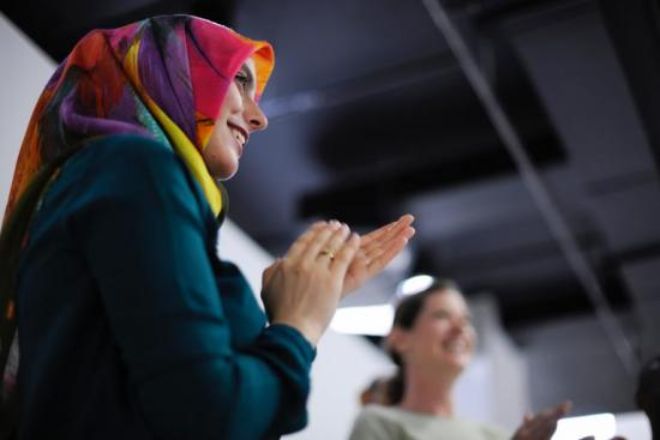
As Mariam Khan said, It’s not about the Burqa”. “When was the last time you heard a Muslim woman speak for herself without a filter? Or outside the white gaze? On her own terms? Or outside the narrative built around us by the media and governments? If Muslim women are to progress in society, if Muslim women are to be treated with respect, then it’s so important that we challenge the narrative built around us.” We as Muslim feminists find ourselves in a strange puddle of fighting Islamophobia and patriarchy at the same time.
Often we see our friends and people around us talking about issues based on many stereotypes. One of the classic examples which has been asked by so many that there is no count is – If we are to be consider ourselves feminist how can we be a believer of Islam which allows a man to marry multiple women or the notion of triple talaq? So to bifurcate the notions of patriarchy and Islamophobia is difficult. For so long women in Islam has been shown as weak, oppressed and marginalized that the stereotypical image has become rooted in daily lives of people. Ask yourself how many times you have seen a woman in burqa or hijab and have thought of her to be oppressed and being forced to do so? If the choice to wear clothes is being advocated by feminists all around, doesn’t the choice of what not to wear also apply to that?
We often call Muslim women who have career goals or independent opinions as “modern” as if we have smashed our walls of patriarchy in our religion. But what many don’t understand is we smash the walls of stereotypes built around us that see us all with the same gaze. There is nothing ‘new’ as “women empowerment” in Islam. It has always been this way. The status of women in Islam has been high and given so much dignity. The prophet’s wife , Khadijah (pbuh) was an independent woman who was one of the most successful business women in that times and married someone of her own choice.The whole jingoism of the triple talaq bill that has been passed in the Indian legislative assembly attempts to “save” women from oppression by the hands of men. Since people often accuse of biases of not considering voices of people who are at the receiving end of something, it better to see the bill from the lens of a Muslim woman who can/cannot be at the end of this issue. Although triple talaq has been banned in most of Islamic countries like Pakistan, Saudi Arabia, there have been different background stories behind each country’s decision.
Speaking for India, according to a survey conducted by CRDDP(Center for Research and Debates in Development Policy) the divorce rates in triple talaq amounts for 0.3% while the literacy rates among the Muslim women is 50% and high school dropout rates higher than any community. The bill makes instant talaq in any means like emails, SMS, call or even WhatsApp illegal. The move has got an uproar of wishes and greeting from every section of society who don’t even have the basic background knowledge of this bill.
But let’s think if the husband is sent to jail will the wife have to wait for his husband for 3 years? And who will provide for the family? According to Sachar Committee, conditions of Muslims is worse than even SCs/STs in this country. Feminists from this community coming from unprivileged backgrounds who in a way had the privilege to go out and study often find them in a strange place when they go back their home and society. These women who are otherwise “marginalized” in the mainstream society are seen as ‘privileged’ or ‘lucky’ because of the choice they had. When we address the issues of our community we are first seen as if this patriarchal structure is perpetuating not because of class and of course caste system but primarily because of Islamic view on women. Thus, to improve the condition of Muslim women in this country we need to look beyond Islamophobia and stereotypes around a typical Muslim family. Because perpetuation of evils like casteism, manual scavenging, child marriage even after laws made against them in the constitution, the Triple Talaq bill will become a mere superimposed sanction. It is extremely important to start from the base to remove social evils like these because only that will empower us as a society.