

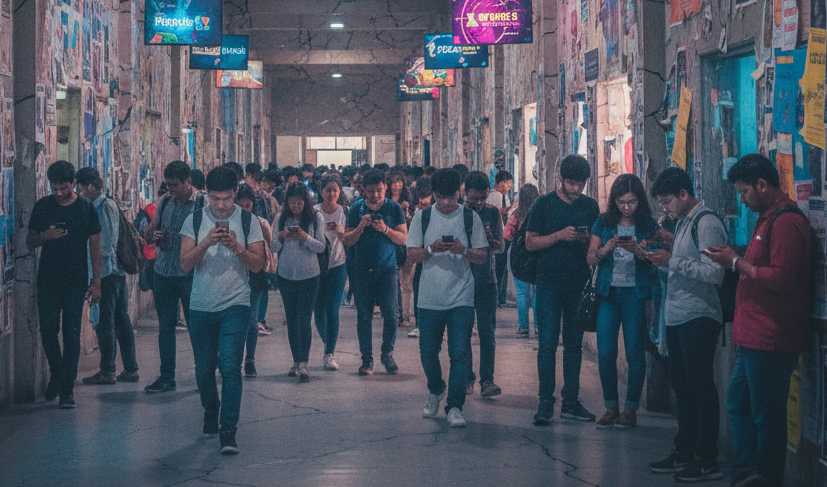
The youth of our time are growing up in a world louder, faster, and more restless than any before them. The screens in their hands connect them to every corner of the planet, yet within, they are more disconnected than ever. Each week brings new headlines of rape, harassment, intoxication, and moral collapse. What was once shocking has become routine. What once evoked outrage now scrolls past as just another notification.
Our universities, once sanctuaries of knowledge and refinement, are turning into laboratories of chaos. Cafeterias that should echo with debates on ideas now hum with talk of dating apps, explicit content, and classmates’ appearances. Spaces meant for curiosity are filled with gossip and objectification. Groups of young men laugh over pornographic jokes, rating their female peers, and turning modesty into a punchline.
Many students, both men and women, admit they feel pressured to “fit in”, to laugh at indecent jokes, tolerate comments on their bodies, and appear “modern.” Silence has become a survival strategy. Vulgarity has replaced virtue. The walls of our campuses can no longer tell the difference between confidence and corruption, between openness and obscenity.
Bollywood and OTT platforms have not just mirrored this decay; they have engineered it. Series after series, song after song, they glorify lust as love, rebellion as maturity, and disrespect as empowerment. A generation raised on such content inevitably begins to see others not as human beings but as consumable experiences. This is the tragedy of a culture where pleasure is public but pain is private.
And so, we arrive at the paradox of Gen Z, the most connected generation in history, yet the most lonely and anxious. Their humour is dark, their hearts exhausted, their dreams uncertain. They scroll endlessly in search of meaning and find only mimicry. They chase relationships for validation and end up in guilt. They indulge in alcohol or pornography, not out of evil, but emptiness, seeking temporary anaesthesia for a deeper wound.
This emptiness is no accident. It is the result of a civilisation that replaced Haya (modesty) with hype, purpose with pleasure, and discipline with desire. When Haya departs, the soul of a nation begins to decay. We no longer ask “What is right?” — only “What feels good?” That is where the moral crisis of our age truly begins.
The Cultural Machinery
Bollywood and OTT industries no longer reflect society; they shape it. Every frame, lyric, and advertisement sells an idea: rebellion means vulgarity, empowerment means exposure, and liberation means discarding restraint. This is not freedom; rather, it is indoctrination through entertainment.
From marketplaces to social media feeds, the message is constant: women’s bodies are commodities, and men are taught to view them as trophies. From perfume commercials to web series, sexuality is the language through which everything, even toothpaste and shoes, is sold. What was once vulgarity is now “confidence.” What was private is now monetised. This is not art, it is conditioning.
A 2024 survey by the Internet and Mobile Association of India revealed that 63% of youth aged 16–25 consume explicit content weekly, mostly through social media or OTT platforms. The National Crime Records Bureau (NCRB) reports a steady rise in sexual harassment within educational institutions, with more than 3,000 reported incidents in 2023. These are not just statistics; they are symptoms of a deeper collapse of moral consciousness: the erosion of Haya.
Modern capitalism thrives on desire. The marketing industry knows guilt sells less than temptation, so it manufactures a consumer who constantly craves beauty, validation, and stimulation. The body becomes an advertisement, relationships become transactions, and identity becomes a brand. The pornography industry, worth over $100 billion globally, exploits loneliness for profit and normalises addiction under the banner of freedom.
Bollywood, aligned with global media giants, amplifies this cycle, glorifying obsession as love, infidelity as maturity, and exposure as expression. “Item songs” that were once exceptions have become the rule. Young girls internalise that attention equals worth, while young boys learn to consume rather than connect. Even advertisements for education and technology use sexualised imagery to attract attention.
This is not cultural evolution but moral capitalism, a system that profits from weakening ethical existence. By reducing dignity to market value, it replaces conscience with consumption. Morality is mocked as backwardness, modesty is labelled repression, and decency becomes countercultural.
In this ecosystem, Haya, once our moral compass, is portrayed as an obstacle to progress. Yet Haya is not a limitation; it is liberation from the tyranny of desire. It shields dignity from commodification and the soul from corrosion.
The fight for Haya is therefore not just moral or religious; it is resistance against a culture that wants to sell everything, including the soul.
The Psychology of Pleasure: How the Mind is Being Rewired
Every revolution has its battlefield. For our generation, that battlefield is the brain. Modern entertainment, pornography, and digital media are not just shaping desires; they are rewiring them.
At the centre of this transformation lies dopamine, the brain’s reward messenger. Every time we scroll, like, or swipe, dopamine creates a rush of pleasure. But unlike natural joys, digital ones are engineered for repetition, not satisfaction. Dopamine doesn’t make us feel pleasure; it makes us chase it. The more we indulge, the more we crave. We keep returning, not because we’re happy, but because we’ve forgotten how to be.
Pornography hijacks this system. It floods the brain with dopamine far beyond what normal interaction can produce. Over time, the brain dulls its response, requiring more extreme content to feel the same excitement. Thus, pornography addiction behaves much like drug addiction: it numbs empathy, distorts expectations, and enslaves the mind to craving.
This neurological conditioning spills into classrooms and conversations. Cafeterias once filled with ideas now echo with gossip and objectification. The casualness with which peers discuss bodies and fantasies is not just immaturity; it’s desensitisation. The heart that once felt shame now feels nothing.
Islamic scholars diagnosed this centuries ago. Ibn al-Qayyim described such states as “diseases of the heart”, emotional, psychological, and spiritual. Modern psychology now confirms what our tradition always knew: moral corruption leads to emotional instability. When one loses Haya, one loses inner peace.
The Qur’an captures this human reality:
“Truly, man was created anxious; when evil befalls him, fretful; when good befalls him, begrudging; except for those who perform prayer.” (Surah Al-Ma’arij 70:19–22)
Islam offers a balance between body and soul. It doesn’t deny desire, it disciplines it. Pleasure is not forbidden, but placed within limits that protect dignity. When those limits collapse, through pornography, casual sex, or unchecked digital indulgence, the result is not freedom, but fragmentation.
Today’s generation faces dopamine exhaustion, constant stimulation dulls joy, and silence feels unbearable. The average young adult checks their phone over 100 times a day, not for information, but for distraction. The chase for pleasure, likes, attention, and arousal leads to spiritual burnout. As the Prophet (Pbuh) said:
“When a person commits a sin, a black dot appears on their heart. If they repent, it is polished clean. But if they persist, it spreads until it covers the entire heart.”
(Sunan Ibn Majah, 4244)
Our hearts are not hard; they are overexposed, overstimulated, and undernourished. They crave stillness but are trapped in scrolls and screens. Islam’s solution is not repression but restoration; reconnecting pleasure to purpose, emotion to ethics, and mind to meaning. Practices like prayer, fasting, reflection, and community are therapies for the overstimulated soul; timeless psychological lifelines.
Peer Influence and the Psychology of Conformity
Every young person who enters a university, whether a medical, engineering, or humanities campus, faces not only the challenge of mastering new subjects but also of surviving a powerful social ecosystem. For many, this transition marks the beginning of exposure to new ideas, new freedoms, and unfortunately, new temptations. Peer influence, masked under the garb of “fitting in,” quietly becomes one of the most decisive forces shaping a student’s character.
Inside campus cafeterias, late-night hostels, and WhatsApp groups, a certain kind of culture dominates, one where vulgar jokes, objectification of classmates, and sexualised discussions about “who’s dating whom” have become casual entertainment. What was once considered shameful is now branded as confidence; what was once private is now performed publicly for attention and validation.
A new student trying to hold on to their moral values quickly realises that silence is ridiculed, modesty is mocked, and restraint is mistaken for weakness. To be “cool” today often means to participate in conversations that degrade others, to use foul language as humour, or to laugh at indecency as if it were normal. Those who don’t join in are labelled “boring,” “backwards,” or “judgmental.” In this silent social war, many young Muslims begin to compromise, not because they believe in what they are doing, but because they fear being left out.
This pressure to belong is not just moral; it is psychological. Social psychologists call it the conformity effect: the natural human tendency to imitate the behaviour of the group, even when it contradicts one’s values or logic. The brain releases small doses of dopamine when we are accepted, and cortisol (a stress hormone) when we are rejected. So even when the heart knows something is wrong, gossiping about a classmate, drinking “just once,” or watching something indecent with friends, the fear of being the “odd one out” silences moral resistance.
But Islam redefines the meaning of courage. The Qur’an honours the believer who stands firm even when surrounded by pressure:
“And if you obey most of those upon the earth, they will mislead you away from the way of Allah.” (Qur’an 6:116)
True bravery is not in defying elders; it is in defying your own desires when everyone else is giving in to theirs. The Prophet (Pbuh) beautifully said:
“Modesty (Haya) is a branch of faith.” (Bukhari, Muslim)
From a psychological perspective, Haya functions like the soul’s immune system. Just as a healthy immune system triggers inflammation to fight infection, a spiritually alive heart feels guilt and discomfort when faced with sin. This moral “pain” is not a weakness; it is proof that the conscience is still alive. The tragedy today is that modern culture teaches young people to numb this inner alarm system. We are told to “stop feeling guilty,” “don’t overthink,” and “live your truth.” But when shame disappears, so does sensitivity; and when sensitivity dies, sin feels normal.
In the words of Ibn al-Qayyim,
“Sins are like wounds; and some wounds are slow to heal. The heart’s corruption begins with small concessions.”
Islam doesn’t call for isolation but for self-awareness, to be in society without letting society define your soul. The Prophet (pbuh) lived among people of diverse faiths and moral standards, yet his character remained like a lamp that illuminated others without dimming itself. He showed that belonging doesn’t mean blending; it means guiding.
For today’s youth, the real challenge is not academic failure, it’s moral fatigue. The constant negotiation between conscience and conformity drains emotional energy. Many Muslim students confess privately that they live in guilt: praying on some days, partying on others; reciting Qur’an in Ramadan, but struggling with pornography later. This duality eats away at self-worth.
Islam provides a liberating solution, not by shaming, but by realigning.
When a believer sincerely repents, Allah promises immediate restoration of dignity:
“Say, O My servants who have wronged themselves, do not despair of the mercy of Allah. Indeed, Allah forgives all sins.” (Qur’an 39:53)
Peer influence loses its grip when a person finds a purpose greater than popularity. When the heart tastes the peace of obedience, the thrill of rebellion begins to feel hollow. True belonging is not in a crowd that drags you down, but in a community that raises your soul.
This is where movements like the SIO have an urgent role: to create alternative circles of influence where young people can be unapologetically moral, intellectually alive, and spiritually grounded. When a student finds a brotherhood or sisterhood built on compassion, discipline, and Haya, the social need for acceptance finds its purest fulfilment.
In a world where “everyone does it,” Islam calls you to be the one who doesn’t. That is not loneliness; it’s leadership.
The Drug Web and Digital Poison
Across India’s campuses, a silent epidemic is spreading, not of viruses, but of vices. Reports from AIIMS and the Narcotics Control Bureau show a sharp surge, nearly a 30% increase in student drug use since 2020. What begins as an “exam stress reliever” or a “party mood enhancer” soon becomes a chain around the soul. Cocaine replaces caffeine, and cannabis becomes a comfort. But drugs are only one part of the web; pornography, casual relationships, and digital intoxication complete the cycle.
Together, they form a triad of destruction, numbing pain, confusing pleasure, and deepening guilt. This is not just a social or mental health issue; it’s a spiritual fracture. These addictions target the same reward pathways in the brain that are meant to give satisfaction from Ibadah (worship), brotherhood, and purpose. Every click, drink, or puff becomes a counterfeit form of peace.
Neurologically, these behaviours flood the brain with dopamine, a pleasure chemical meant to reward meaningful actions. But when overstimulated by pornography or narcotics, dopamine creates false highs, leaving the person restless when sober and craving more. The tragedy is that the same energy that could drive a student to excellence and leadership gets hijacked by shallow gratification. What was once discipline becomes dependency.
The Qur’an diagnosed this condition long ago:
“Do not follow the desires, for they will lead you away from the path of Allah.” (38:26)
The Government and the Illusion of Regulation
The government speaks loudly of “youth welfare, sanskaar, and national ethics,” yet quietly fuels the very forces destroying them. The so-called regulatory mechanisms, from OTT guidelines to narcotics laws, function more like political theatre than moral guardianship.
The censor board, which should protect cultural dignity, has become a tool of selective morality. It swings its scissors not at vulgarity but at dissent. Films that glorify obscenity, objectify women, or trivialise intoxication are passed under the banner of “creative freedom,” while those that critique government or question majoritarian politics are delayed, banned, or muted. Morality, it seems, is not about ethics anymore; it’s about political convenience.
The same hypocrisy extends to economics. The state that talks about “Bharatiya values” welcomes the world’s largest alcohol conglomerates, online betting firms, and dating app investments, all in the name of GDP. Ministers inaugurate youth festivals in the morning and attend liquor brand-sponsored award shows by night. In this moral contradiction, capitalism becomes the new god, and the government its priest.
Policies that claim to “empower youth” actually commercialise their desires, converting every instinct into a market. Stress is treated with apps, loneliness with hookups, and failure with stimulants. Even mental health campaigns are monetised; therapy is sold like a subscription while the system creating anxiety remains untouched.
The problem is not merely weak censorship; it is the death of conscience in policy-making. The law can ban a scene, but it cannot rebuild the heart. No legislation can manufacture shame, and no advertisement can sell sincerity. That responsibility lies in the moral awakening of society, and in the revival of Da’wah.
The Islamic Vision of Healing and Strength
When society commercialises desire and glorifies rebellion, the human heart begins to decay in silence. Yet Islam, long before modern psychology or neuroscience, offered a complete framework for emotional and spiritual healing. Its core principle, Haya, is not merely an instruction to cover the body, but an invitation to uncover the soul. It is a moral compass that realigns the self when everything around is spinning.
Haya guards the sanctity of intention, not just action. It reminds us that human dignity is not found in exposure but in restraint, not in craving but in contentment. It is the spiritual immune system that prevents infection of the heart. In a time when desires are algorithmically amplified, Haya brings clarity, humility, and purpose.
The Qur’an offers a timeless cure:
“Indeed, in the remembrance of Allah do hearts find rest.” (13:28)
This verse is more than a promise; it’s a psychological principle. Modern psychiatry recognises that mindfulness, structured routine, social connection, and meaning-making are the strongest predictors of mental well-being. Islam prescribed all of them 14 centuries ago.
- Salah (Prayer): Anchors the day like the body’s circadian rhythm, stabilising emotional cycles and regulating anxiety. Each prostration grounds the believer, returning scattered thoughts to divine alignment.
- Sawm (Fasting): Resets the gut-brain axis, lowers impulsivity, and nurtures patience. It teaches control over urges rather than suppression, a sustainable form of self-regulation.
- Zakat and Sadaqah (Charity): Detoxify greed and stimulate empathy. Studies show altruistic actions release oxytocin and serotonin, reinforcing the very neurochemistry of peace.
- Dhikr (Remembrance) and Istighfar (Seeking Forgiveness): Work as spiritual breathing, releasing guilt, calming inner noise, and creating a feedback loop of repentance and renewal.
- Ukhuwwah (Brotherhood): Provides belonging without intoxication, a community that heals isolation not through escapism, but through shared purpose.
In medical terms, these are divinely prescribed therapeutic interventions, integrating biological, psychological, and social well-being into one spiritual whole. Islam’s approach to mental health does not isolate the mind from the soul; it treats the nafs, the qalb, and the ‘aql together.
For medical students and young professionals, this vision holds profound relevance. The high-pressure environment of studies, clinical duties, and peer competition often leaves little room for reflection. Many cope by adopting the same destructive habits the system normalises, caffeine highs, relationship chaos, or silent burnout. But Islam redefines success: it shifts the centre of life from performance to purpose.
When guilt, anxiety, or exhaustion set in, Islam does not condemn; it calls to return. Through Istighfar, the believer transforms failure into fuel; through Sabr, pain into patience; and through Tawakkul (trust in Allah), uncertainty into serenity.
This holistic vision is not theoretical; it is deeply practical. It teaches that the same heart that feels despair can be healed through structured spirituality and community. The same student drowning in distraction can rediscover meaning through disciplined remembrance. And the same society collapsing under moral fatigue can be revived, not by slogans or censorship, but by the quiet revival of Haya, faith, and responsibility.
The Road Ahead:
We stand today at a decisive crossroads between two futures:
One dictated by algorithms, and another guided by revelation.
One that sells dopamine as happiness, and another that restores meaning as peace.
Our youth are not apathetic; they are searching. Beneath the layers of sarcasm, memes, and detachment lies a generation suffocating under the weight of performance, loneliness, and guilt. They crave real conversation, not curated content; real purpose, not performative platforms.
Haya, in its truest form, is freedom from exploitation. It is the courage to say no when the world normalises vulgarity, and the grace to say yes to dignity even when it is mocked. It protects both the viewer and the viewed. It restores the balance between beauty and virtue, reminding us that what is sacred is never for sale.
Our campaign seeks to awaken this consciousness in campuses across India. Through workshops, dialogue circles, art contests, mental health sessions, and peer-support groups, we aim to make modesty a shared value, not out of fear, but out of love. Because Haya is not the enemy of expression; it is the ethics of expression.
We must reclaim aesthetics to create art that uplifts, not objectifies; media that heals, not harms; humour that enlightens, not humiliates. Every filmmaker, influencer, and student has the power to become a mujaddid of culture: reviving what is beautiful, meaningful, and pure.
As the Qur’an reminds us:
“And We have certainly honoured the children of Adam.” (17:70)
To dishonour oneself or others for pleasure is to betray that divine honour. Every click, every post, every song that reduces humanity to desire chips away at that sacred trust. Our duty is to rebuild a world where honour is not a costume, but a conviction.
For if the culture of Haya can be revived, it can heal far more than modesty; it can restore mental health, rebuild social trust, and revive spiritual balance. It can give our youth what no algorithm can provide: peace rooted in purpose.
We envision campuses where laughter is free of vulgarity, friendship free of objectification, and creativity free of corruption. We dream of media that inspires rather than intoxicates, of art that heals rather than humiliates.
The path ahead will not be easy. It demands courage to stand apart, patience to persist, and compassion to rebuild. But every revolution begins with a return; a return to truth, to dignity, to Allah.
As the Qur’an reminds us:
“Indeed, Allah will not change the condition of a people until they change what is within themselves.”
(Surah Ar-Ra’d, 13:11)
Let this be that change; within hearts, within campuses, within culture. Let this be the generation that reclaims Haya not as a forgotten virtue, but as a living force, shaping how we speak, create, love, and lead.
Because when Haya lives, humanity breathes.
And when the youth rise with Haya, the future rises with them.