

I remember my math classes at school when the teacher, after explaining the concepts and solving a few problems on the board, as an example, would ask us to complete the exercises ourselves. The idea was to understand and internalize the concept, familiarise oneself with the answering process, and inculcate an ability to replicate and utilize the same in appropriate circumstances. This required logical precision and the application of intelligence by an alert mind. Correct answers were mentioned at the end of the book for cross-checking and self-examination, and after solving the problems, we were supposed to check and verify our answers.
Obviously, not all of us were ready for this hard work… and how could we? The tedious and cumbersome process that we were expected to follow involved understanding the concept, applying formulas, following the process, discovering the answers, checking the answers, being happy at success and moving on to other problems, or lamenting over failure, deliberating over mistakes, and repeating the process. And hence, many students, despite clear instructions from the teacher and twinges of conscience, would opt for the obvious shortcut, i.e., to look up the answers at the back in the first place and ‘invent’ the process thereafter.
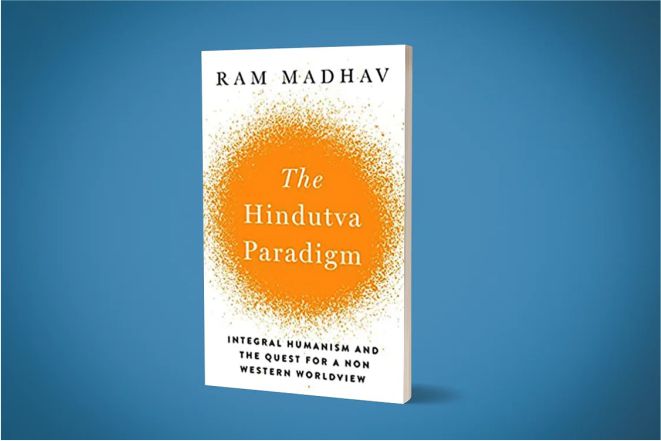
The Hindutva Paradigm by Ram Madhav is not a mathematical book, but it reminded me of classmates who used the above-mentioned creative intelligence in math classes, leaving the entire class in splits and the teacher stunned, stumped, and furious.
Ram Madhav alleges that Nehru “would relentlessly talk about socialism in different ways and in different phrases” but would hardly explain “as to what he really meant by all those words and phrases”. (p. 37) After reading this complaint against Nehru, I asked myself: Have we been told anything concrete in terms of policies and worldview by proponents of Hindutva? The answer is no. My mind retorted without much “crawling” and “indexing” over this query. However, it honestly added a “not yet” to the “no”, implying that the answer may change with the book in my hand and thereby cajoled me into reading the book painstakingly with insight and meticulousness.
The premise of the book and the so-called paradigm suggested therein is as obvious as the color of its spine – i.e., saffron. But the rollercoaster ride on which Ram Madhav takes its readers is nevertheless amusing. Hindutva, over the years, has remained a slogan. Ever since Savarkar popularised the notion, its apparent contradictions have not been resolved. For obvious reasons, no one has dared to define it too concretely or in terms of actual policy recommendations. When Ram Madhav tries to offer a Hindutva paradigm and an alternative worldview, he deserves to be commended for the mere thought of it – regardless of the quality of the output.
The disappointment
An honest exercise in offering a paradigm and worldview demands candor and forthrightness, but, sadly, Ram Madhav has opted for a convoluted way of doing so. In order to ride the bumpy road, he uses the cushion of Deen Dayal Upadhyay and his integral humanism—a philosophy that the author concedes, “very few can really comprehend.” The task that the author has undertaken is to give “a twenty-first-century interpretation of Integral Humanism”. The fact that the whole thesis of Deen Dayal Upadhyay’s Integral Humanism was based upon four lectures that “needed further reflection and deliberation to be developed into a comprehensive philosophy” (see viii-xi) renders us wondering whether the vagueness of Upadhyay was a boon or a curse for the (mis)adventure that Ram Madhav took upon himself.
Ram Madhav further disappoints us – the hopeful readers – by magnanimously quoting western thinkers to legitimize his ideas, but does not forget to stress, at regular intervals throughout the book, that Deen Dayal Upadhyay was not inspired by the West. Instead, Upadhyay is said to have heavily drawn upon ancient Indian wisdom to develop Integral Humanism. But Integral Humanism was already developed by Jacques Maritain. Yes! Ram Madhav accedes that Maritain’s philosophy was theorized three decades earlier than Upadhyay’s but somehow believes and propounds that it was Upadhyay’s original contribution. Some of the sentences that he penned give the impression that it was Maritain, and not Upadhyay, who followed the trail of the other. For instance, “Like Deen Dayal, Maritain too had developed his integral humanism theory in the historical context of the rise of totalitarian ideologies like fascism, Nazism, and communism.” (p. 52)
The declared and undeclared objectives
Ram Madhav believes that ideologies are idiotic. They curb thinking and ‘possess’ human beings. Liberalism, communism, etc. are ideologies promulgated by the west, and these very ideologies are the cause of schisms and confusion in the world. He argues that Europe is the “mother of ideologies” while India has been “the land of ideas”. Madhav implies that an ideology is closed and restrictive while an idea is open and inclusive. (See p. vii) This formulation is not necessarily true. But it is so obvious a thing to refute.
Proceeding in the same vein, Ram Madhav argues that like Mahavira, Buddha, Shankara, Aurobindo, Vivekananda, and Gandhi, Deen Dayal Upadhyay too was a philosopher (not an ideologue). And his thoughts too are philosophical ideas and not an ‘ism’, i.e., ideology. (p. vii) A perplexed reader closes the book, rubs his eyes, and stares at the subtitle of the book, which reads, Integral Humanism and the Quest for a Non-Western Worldview. “ism” is obviously there for all to see!
The central objective of the book was to elaborate upon the Hindutva view and way of life. But the author has failed miserably at this and fallen short of offering anything concrete in terms of an alternative worldview. This failure is so manifest that a reader wonders whether any serious attempt was made at all to justify the title and subtitle of the 436-page-long book. It seems that offering a Hindutva worldview was the proverbial tusk of the elephant, with the actual aim being to glorify Deen Dayal Upadhyay and present him as a philosopher and true successor to Gandhi.
Thus, we see a subheading titled “Deen Dayal: The Champion of Gandhian Ideas” (p. 198) and statements such as the following abound in the book:”… leaders like Deen Dayal Upadhyay were much in tandem with Gandhi’s thinking than perhaps Nehru himself.” (p. 11) The glorification of Upadhyay and the discrediting of Nehru go on in tandem. Differences in ideas between Gandhi and Nehru, for example on village development, are emphasized and prioritized over the idea of India that they collectively stood for (see p. 196–197). Ram Madhav asserts that Nehru wanted independent India to emulate Europe, but “his fellow travelers in the freedom movement” like Dr. B. R. Ambedkar, Dr. Ram Manohar Lohia, and Dr. Syama Prasad Mukherjee had different ideas. (p. 8) This subtle objective of glorifying Upadhyay as a philosopher and successor of Gandhi has also been achieved by consistently mentioning him with Gandhi and other stalwarts.
On a serious subject such as caste, Ram Madhav writes, “Gandhi, Golwalkar, and Deen Dayal were broadly sympathetic to, if not outright supportive of, the Varna system… On the other side of the spectrum were leaders like Savarkar, Ambedkar, and Balasaheb Deoras, the third chief of the RSS, who had more or less endorsed the view that the system has no contemporary relevance.” (p. 174) These sentences are particularly interesting where Deen Dayal and Golwalkar are in the company of Gandhi, on one hand, and on the other hand, Savarkar and Deoras are in the company of Ambedkar. Gandhi and Ambedkar have been employed here to do what Tide and Surf Excel do to the stained clothes in TV commercials.
This is not the only instance. The mentioning-together strategy is brought into play on every possible occasion. For example, see the following sentences scattered throughout the book:
- “On the question of technology, Deen Dayal was closer to Gandhi…” (p. 201)
- “Like Gandhi, he [i.e., Deen Dayal Upadhyay] also argued that true democracy was one in which every voice was heard without outright rejection.” (p. 216)
- “Anyone, who has a different opinion from the majority… his viewpoint must be respected and incorporated into the governance, Deen Dayal said… Gandhi too expressed similar sentiments in his writings.” (p. 218)
- “Both Gandhi and Deen Dayal opined that the success of democracy lay in educating the masses and believed that failure to do so would lead to democracy degenerating into a mobocracy.” (p. 225–226)
- “Deen Dayal, like Gandhi, saw in partition a defeat to the lifetime belief in one national society in India.” (p. 283)
- “From Gandhi to Deen Dayal, many eminent leaders had seen cow protection as having the potential to awaken and unite the people of the country.” (p. 304)
- “Philosophers like Mahatma Gandhi, Sri Aurobindo, and Deen Dayal Upadhyay had not only interpreted India but had also laid out a roadmap for its future.” (p. 361)
Interesting observations
The first three chapters of the book deal with Deen Dayal Upadhyay’s life, times, and thoughts. The rest of the 12 chapters are based upon the explanation and reinterpretation of integral humanist philosophy. While a reader would almost certainly fail to notice any coherent paradigm offered in the book, many of Ram Madhav’s observations are interesting. For example, regarding various Hindutva outfits, he writes:
- “Ram Rajya Parishad was a party founded by a Hindu religious leader, Swami Karpatri. It toed an orthodox Hindu line in politics and was unabashedly anti-Dalit and did not open its doors to those sections. ” (p. 13)
- “The Hindu Mahasabha… was a pan-Hindu party but was expressly anti-minority” (p. 13).
- “Although a large number of cadres and leaders, including Syama Prasad, were inspired by the core RSS vision of ‘Hindu Rashtra’ and partly Savarkar’s Hindutva, the Jana Sangh, from its very inception, presented and articulated a pan-India vision using contemporary vocabulary. Its leaders took care to use words like Indian and Bhartiya in place of Hindu in their public parlance.” (p. 41) In other words, as Narendra Modi has said, “Hypocrisy ki bhi seema hoti hai,” but there was none whatsoever.
For Ram Madhav, even RSS is “difficult to understand, but easy to misunderstand” as it had no constitution and no system of objective in the beginning except Hindu Rashtra. (p. 1) Does RSS have a constitution that is available in the public domain or a system of objectives even today? At least I couldn’t access it on their official site. It was neither in their “Know Us” section nor did anything materialize after I used the “search” option.
I would like to mention a few more interesting observations.
For example, regarding democratic reforms, he states, “The reform that democracies need today is two-fold. First, elected institutions need to become less majoritarian and more consensual. Second, non-elected institutions should not become the voices of the elected majority alone; there is a need to build a stronger non-elected institutional framework for greater balancing. ” (p. 225) I would appreciate this concern, and if the author is sincere, he must ensure that the ruling party takes substantial steps in this direction.
Ram Madhav has discussed that Deen Dayal had toyed with the idea of an “India-Pakistan Federation” and “The idea could not be taken forward due to the 1965 Indo-Pak war and the demise of Deen Dayal in 1968.” (p. 288) I wonder if anyone among the devotees of Upadhyay still adheres to this objective. Is Modi willing to head in this direction or all the talks of Akhand Bharat are actually jumlas to deceive the common folks?
Yet another interesting observation of Ram Madhav is that “The RSS does not view Hinduism as any religion or sect or denomination.” (p. 251) If there is any semblance of truth in this claim then RSS should wage a relentless campaign that Hindus must cease to be a religious category in the census.
Critical Analysis of the book ‘Hindutva Paradighm’ is to be continued.