

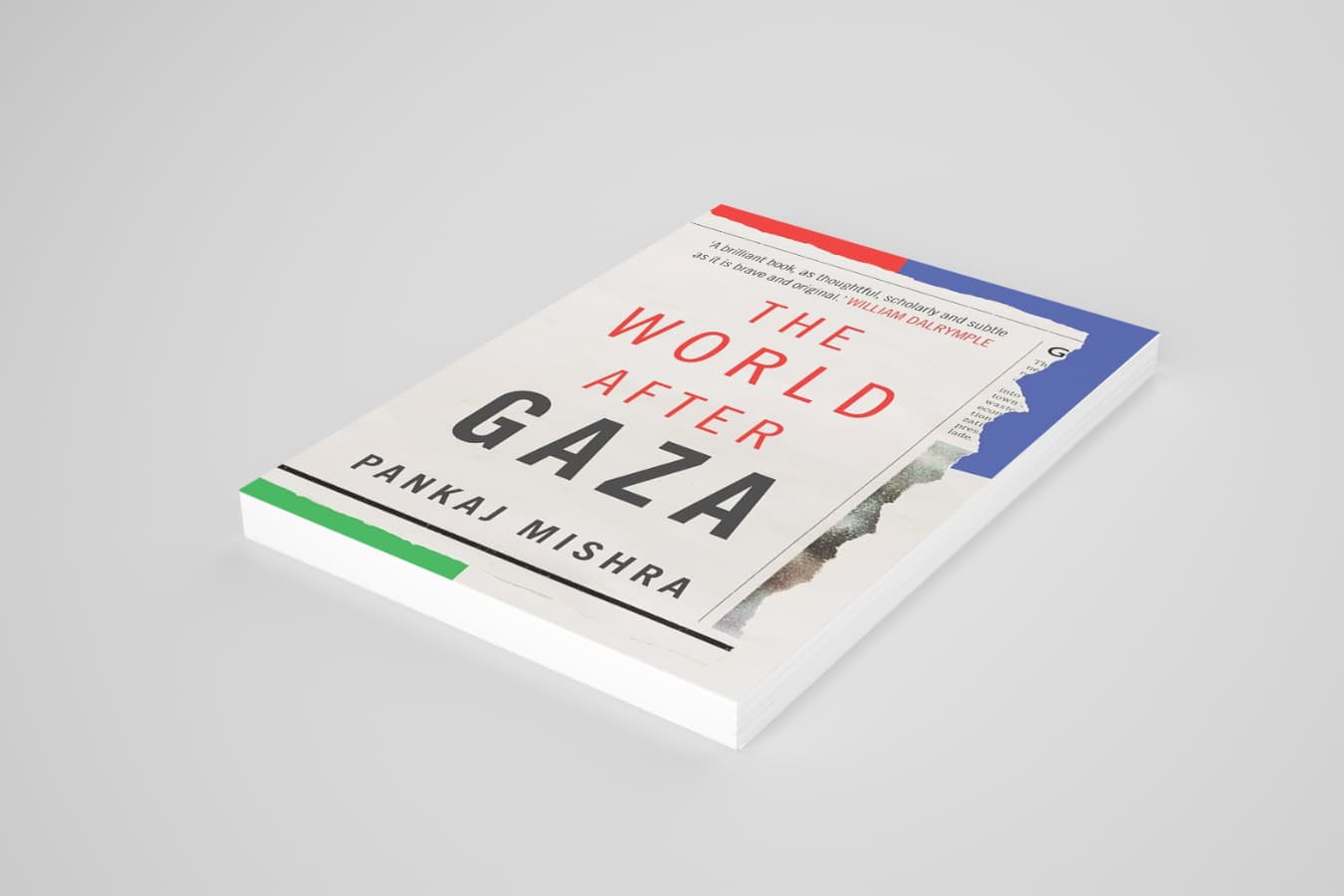
Title: The World After Gaza: A History
Author: Pankaj Mishra
Publisher: Juggernaut
Pages: 292
Year of Publication: 2025
ISBN: 9798217058891
Pankaj Mishra is a critically acclaimed columnist and author of books like Age of Anger: A History Of The Present, From The Ruins Of Empires, and many other works of fiction and non-fiction. He primarily comments on the ideological foundations of modern geopolitical narratives and intellectual edifices of contemporary power structures. In his latest title The World After Gaza, Mishra has responded to the “vast panorama of violence, disorder and suffering that we’re seeing today,” by critiquing the striking division of the world into worthy and unworthy victims. He argues that the narrative around the Holocaust should be reframed as a “distinctive” event in world history rather than being called “unique” in and of itself. While examining how Israel and its supporters instrumentalized the memory of the Holocaust to justify its actions and silence criticism, Mishra critically analyzes Holocaust narratives and draws parallels between the atrocities of Israel in Gaza and past instances of colonial brutality and genocide. He interrogates the violence in Palestine and the polarized response of the world, with the Western powers generally backing Israel, and large sections of the Global South condemning its actions.
The carnage in Gaza, witnessed by much of the world through relentless television coverage, serves as a harrowing testament to the capacity of humans to cause immense devastation and suffering to one another and unveils the grim realities of a global order that permits such violence with near-total impunity. Disclosing the fault lines of politics, power, and morality, this catastrophic event has exposed the fundamental divides in how the world reacts to such unfortunate events. The Holocaust also known as Shoah in Hebrew is inevitably brought up in every discussion of Gaza, whether as a parallel, contrast, or justification, as though the events between Auschwitz and October 7, 2023, are part of a suspended timeline. The Israeli state, supported by the very institutions that construct our collective social narratives, seeks the exclusive right to victimhood, labeling those who speak for Palestine as antisemitic. This intersection of memory, history, and power highlights the complexity of a world where historical narratives are used as weapons and complicity or silence carries more weight than condemnation.
The book is divided into three parts. In the first part of the book, Mishra examines how Israel and its supporters proclaim that the Holocaust is the defining measure of human evil, instrumentalizing the memory of the Holocaust to justify their actions and silence criticism. But undeniably, the remembrance of the Holocaust is often selective and politically motivated. He has critically observed how historical memory can be distorted to support contemporary power structures by extensively referring to Holocaust survivors and scholars like Hannah Arendt, Primo Levi, and Jean Améry. He states that “The Shoah has set the standard of human evil, yet today, its memory is used to enable further suffering rather than prevent it.” As the author notes, the Holocaust “has set the standard of human evil” in Western discourse.
However, intellectuals from the former colonies, disagree with this, citing the brutality of colonial powers towards “black and brown bodies which could be seized, broken, and destroyed outside all norms and laws of war” as their defining experience. Therefore, they consider decolonization to be “the central event of the twentieth century,” rather than the collapse of Nazi Germany. Mishra additionally analyzes how Zionist ideology changed after the Holocaust, especially under Menachem Begin, a Zionist leader and the sixth prime minister of Israel, who used the slogan “Never Again“, initially popularized by Jewish Defence League founder Meir Kahane, to defend harsh military tactics and turned the Holocaust into a justification tool for every repressive action of Israel.
The author excellently traces the processes that led to Western nations becoming fierce allies of Israel and accepting the Holocaust as the absolute manifestation of evil. Further, the author assesses the association of Germany with the United States, its entry into the European Union, and its post-war economic prosperity and how they all were dependent on its enthusiastic appeasement of Israel and its admission of guilt for the massacres in its concentration camps. He argues that “Germany’s moral commitment to the Palestinians is completely erased by its post-Holocaust guilt, which has turned into an uncritical allegiance to Israel, no matter the human cost.”
The state of Israel, as the author argues, was initially contemptuous of the survivors of the Holocaust, and the construction of the Holocaust narrative was very deliberate and methodical and did not spring organically out of the experience of the Holocaust. It was constructed much later, in the 1960s by what he calls the “Americanization of the Holocaust”, which truly gained appeal only from the 1960s when American Jews, frantic that a second Holocaust was imminent, believed their salvation in close links to Israel and thus influenced conservatives to talk about a “Judeo-Christian civilization.” Christian evangelists played a crucial part in winning the full support of the US for Israel because they believed that biblical prophecy includes the need for a Jewish presence in Palestinian territories to enable the Second Coming of Jesus Christ. This is ironic because the Second Coming means that only Christians will be spared and that the Jews will be annihilated. Cynically, Jews see it as assurance that Israel will continue to receive military and political backing from US governments in the future.
The author does not extensively discuss the Oct. 7 attack and how it heightened Israel’s sense of vulnerability. He focuses on the effects on a generation of young people who witnessed “acts of savagery aided by the world’s richest and most powerful democracies.” Critiquing the Western media, he calls out several media outlets, specifically The Atlantic, for publishing an article that cast doubt on the number of people killed in Gaza and included the claim that “it is possible to kill children legally. He has also criticized The New Republic and The New York Times for their implicit complicity in shaping public opinion towards Gaza. The author highlights how selective reporting by global media outlets has whitewashed Israeli conduct. He writes that “Western leaders declined to admit large numbers of Jewish refugees for years after the revelation of Nazi crimes—history repeats itself today, in reverse.”
In the third and concluding part of the book, Mishra examines the extensive global implications of Israel’s war on Gaza. He argues that as Gaza has shown, despite their supposed universality, international law and human rights are frequently disregarded when inconvenient for powerful nations, stating that “Nothing has yielded so much shameful evidence of our lack of passion and indignation, narrowness of outlook, and feebleness of thought.”
He draws attention to how reactions to Gaza have become generational, with younger activists, especially those in the Global South, seeing the action of Israel as a component of a broader colonial fight. In contrast, older Western elites remain steadfast in their support of Israel, revealing a deepening crisis in liberal democracy. Gaza, Mishra says, has pushed many people in different parts of the world “to a genuine reckoning with the deep malaise of their societies,” and to feel the need for fresh struggles for freedom and dignity. Sadly, India is not likely to be among them. The same can be said for other nations under the grip of strongman politics, where nationalistic zeal is used to silence critics and justify violence against marginalized groups. Mishra writes deftly about how nationalism, historical revisionism, and religious identity are being used to consolidate power and the way Israel has framed and justified its action in Gaza.
In The World After Gaza, Pankaj Mishra delivers a discerning critique of how historical memory has been weaponized to justify power and silence dissent. With implacable clarity, he exposes the moral hypocrisy of liberal democracies, dismantling sanctified narratives, and drawing striking parallels between colonial brutality and the atrocity which we are seeing today. Mishra wonderfully highlights the generational and geopolitical divides in responses to such violence, critiquing the flawed linear presumptions that direct our interpretation of history, especially the narratives created of the Holocaust. I think the most significant part of the book is the author’s attempt to dismantle the Israeli narrative, which remains powerful because it is backed by institutional networks worldwide. As he said in an interview and has beautifully examined the phenomenon in the book also that the history we learn, the history we are exposed to, is nothing but a product of various institutions, both national and international, interacting with each other to create a dominant narrative.
The author could have discussed in more detail how the solidarity of the Global South, once founded on the shared anti-colonial movements is now fracturing. While he strongly critiques Western hypocrisy he does not sufficiently explore how right-wing populism within developing nations has contributed to new geopolitical alignments. For instance India, an erstwhile lead-role player of the anti-colonial movement has affiliated with Israel, ironically joining Western nations in restricting free discussion of the Gaza conflict. He does talk about the right-wing populism within the former anti-colonial states; he does not deeply analyze what has reshaped their geopolitical alignments, nor does he fully explore the role of domestic polarization in reinforcing global inequalities.
Given his compelling argument that decolonization has fundamentally reshaped global consciousness, one might expect a new and effective resistance to mass displacement or at the very least, hope that his appeal to a more complicated view of the past could inspire change. However, his pessimism seems to outweigh his optimism. He speaks with admiration about campus protesters supporting Palestine, suggesting their activism might ease the isolation of Gaza. But, is this his vision of solidarity? If so, it offers little solace to those still carrying the weight of their shared histories.
Nevertheless, this strongly argued and well-researched book of Pankaj Mishra, who indeed is one of the most intellectually astute and courageous writers of our time, is not only a must-read for those who continue to show courage in the face of a crushing mainstream or for those like him who while reckoning with the present also reflects upon his early sympathies for Israel due to the supposedly universal consensus that emerged from Holocaust, but for every person who seeks to understand meaning in modern history’s most depraved episodes and ultimately what suffering can make us do.
The in-depth historical analysis of these narratives by the author may deepen the public scepticism towards Western foreign policy and journalism. Its impact could extend beyond academia, influencing the intellectual debate on imperialism, historical memory, and the meaning of justice, as this book compels us to interrogate the mainstream narratives, to question what has gone wrong and the silent complicity that arises from this convenient rhetoric, as evident in case of Gaza.