

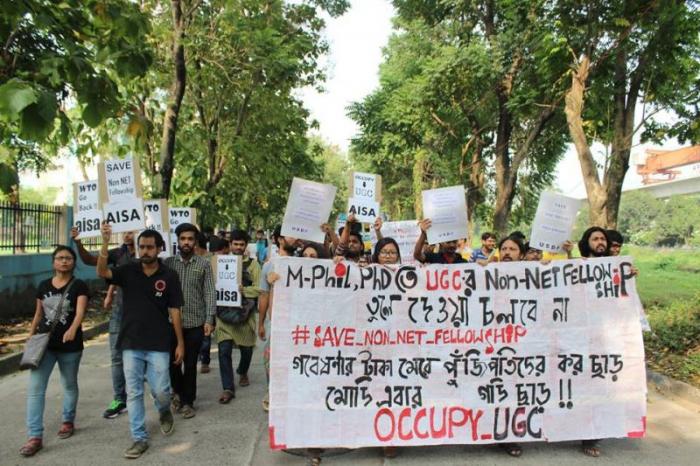
The Budget allocation for the University Grants Commission (UGC), which provides funds and maintains standards in institutions of higher education, has been cut by almost 55 per cent, from Rs.9315.45 cr in 2015-16 to Rs.4286.94 cr in 2016-17. With the setting up of a Higher Education Financing Agency(HEFA), funding for the UGC has been declined.
Presenting the annual budget for 2016-2017, Finance Minister Mr. Arun Jaitley had announced the government’s plans to set up a Higher Education Financing Agency (HEFA). HEFA is to be set up with an initial capital base of Rs 1000 crore. An additional 1000 crore will be received as part of donations and the agency will leverage funds from the market and supplement them with donations.
The major responsibility of the UGC has been to disburse and allocate funds to the universities and keep tab on them to punish those violating the UGC Act. The ministry has, however, proposed constitution of HEFA that will eventually take over the UGC’s financial powers of funding the higher educational institutions.
Under section 20 (1) of the UGC Act, the Commission is bound to follow the diktat of the government, mainly in the matter of providing policy guidance. However, under this provision, functional autonomy of the UGC is totally compromised due to its misuse by the Central bureaucracy. This section has been used undemocratically and illegally to bypass the Commission. As a result, it has failed to ensure transparency and objectivity in its decision-making processes as well as implementation of its regulatory guidelines. The UGC will eventually function only as a certification body. Modeled after the UGC United Kingdom, its Indian counterpart is a statutory body set up by the Parliament Act under the purview of the HRD. Currently, it is charged with coordination, determination and maintenance of standards of higher education.
Since HEFA is going to be a non-banking financial company (NBFC), it is being alleged that it would have a larger representation of the bureaucracy and nominees from the MHRD, instead of empowering academicians who have dominated the UGC so far.
It is believed that the Centre’s move has come up in the wake of the UGC’s mishandling of issues related to Deemed Universities and its failure to revamp the higher education curriculum for years. And also, a special committee set up by the Centre to examine various issues between the UGC and the HRD Ministry have recommended the “wresting of financial powers”.
Once operational, HEFA would provide interest-free loans to higher educational institutions including IITs, IIMs etc for constructing new campuses, expanding or renovating existing infrastructure and creating state-of-the- art laboratories. It is proposed that all central and state higher educational institutions would be eligible for joining HEFA as members, subject to certain conditions.
.
Can HEFA be financially viable? It is clear that HEFA is a non-profit organization; it will leverage funds from the market and supplement them with donations and corporate social responsibility (CSR) funds. Thus, its operative and regulatory mechanisms would be crucial to ensure its stability. As far as financial viability are concerned, to become self-sustaining, HEFA needs to manage investment of Rs. 25,000 crore over next five years and manage an inflow of Rs. 2000 crore from the fee escrow accounts, assuming that the institutions will fully pay loan amount. Since institutions would get funds without any interest liability and market borrowings would come at around 12%, there might be a need of robust donations as well as viability gap funding from the government.
“Consequent upon completion of the process of inviting, examining and selection based on the notice of expression of interest for identifying a joint venture partner for establishment of HEFA, the Ministry of Human Resources Development has appointed Canara Bank for establishment of Higher Education Financing Agency (HEFA)”, the bank said in a stock exchange notice.
Eminent economist Deepak Nayyar said Rs 1,000 crore allocation made in the Union Budget for the proposed Higher Education Financing Agency is “peanuts” PTI reports. Strongly disagreeing with the government’s decision to create such an agency in the education sector, Nayyar, also a noted academician favoured recreating the University Grants Commission (UGC) into a higher education financing authority, something which the United Kingdom has done, which France has done”.
With mixed reactions from various intellectuals, it is hard to conclude, if HEFA will strengthen the standards of education system in India.