

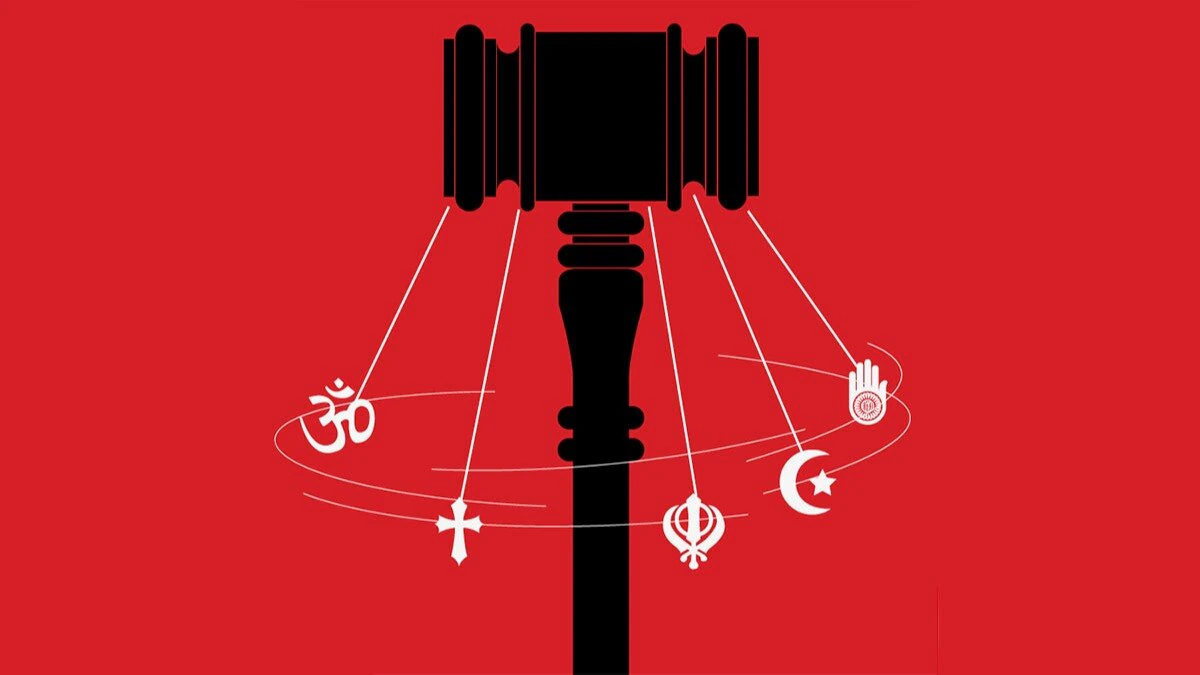
India is a multicultural melting pot, filled to the brim, and often spilling with a gargantuan population which comprises of distinct identities; religious, cultural, linguistic, ethnic, and regional. It is in the backdrop of this diverse set of demographics, that the Indian constitution and the legal system operates.
When the Constitution came into force on January 26, 1950, after much deliberation and protracted debate that extended a period of two years, and eleven months, it was designed, undoubtedly with significant authority, balance in the institution, and exemplary degree of public reason. It was remarkably accommodative of each of the various sections of the Indian population.
However, a provision which was a borrowing from the Irish Constitution at the time, the Directive Principles of State Policy, proposed a set of ‘ideals’ that the Nation should strive to achieve. At an informal level, students of constitutional law understand these provisions to exist in three distinct groups: the social and economic charter, the social security charter, and the community welfare charter. The last of these includes a provision for the controversial Uniform Civil Code, a matter which has been of much contention and debate in recent times. Minorities in India view it as an encroachment to the fundamental right to freedom of religion. Proponents of the code cite a variety of reasons for the implementation of the same, including propagation of a collective national identity, dissuading ill-practices of a particular religious group, and upholding gender justice.
In this article, we attempt at viewing three distinct models of countries that have grappled with the same issue, that of navigating the rift between having a unique set of personal laws, or assimilating into a common civil code.
Nepal – a Secular Republic of the 21st Century
As a young democratic republic, Nepal had the choice to impose on its citizens a common civil code derived from the teachings of the overwhelming majority of its people, over 80% of whom are Hindu. This would’ve been met with meek opposition, as the minorities that hold a propensity to oppose it comprise only a fraction of the Nepalese population. The most significant minority is Buddhist, and, as is done in India, they would’ve accepted the law without much tussle.
However, seeing as to the diversity of caste and ethnicity within the Hindu scaffolding, the nation of Nepal, in 2008, adopted a secular model of personal and criminal law, borrowing largely in part of the western world. Part IV of the Nepalese constitution is also, much like the Indian Constitution, dedicated to the Directive Principles of State Policy. Clause (2) of Article 50 of the Nepalese Constitution skids past a directive that is spiritually somewhat similar to the Article 44 of the Indian Constitution. It directs the following:
“…to consolidate the national unity by maintaining social cohesion, solidarity, and harmony, while recognizing cultural diversity.“
– Article 50 (2) of the Constitution of Nepal
Nowhere else is there an explicit mention of a uniform civil code in the Nepalese Constitution. Perhaps there is not even a need to mention it, as, at least in a legal sphere, the Nepalese tend to follow the personal and criminal law within the quasi-Western judicial framework without protest.
Ever since the establishment of the new Nepalese Constitution, the country has strived towards legally identifying with the western principles of egalitarianism, liberty, and fraternity. These ideas, though not without their analogues, are not directly sanctioned by Hinduism, the dominant faith of Nepal. In fact, despite its history of Hindu kingship, the new Nepal doesn’t officially have a national religion.
It was critical to remove official Hinduism from Nepal, for as a Hindu state it was not inclusive of all of its rich ethnicities and castes, due to the instatement by Nepalese leaders of a Hindu caste system and hierarchical religious supremacy.
– Prakash Bom,
(Declaration of Nepal a Secular Democratic State)
Let us look at another model, one of aggressive secularism, this time, from farther West; that of aggressive secularism in Turkiye.
Turkiye and Kemalism – Discarding Religious Law
After the fall of the Ottoman Sultanate, and the 1923 proclamation of the Republic of Turkey, a gradual cultural revolution took place alongside the political changes in Turkiye. A new philosophy led in its wake sweeping changes; Kemalism, named after the founder of modern Turkiye, Mustafa Kemal Ataturk, whose six ideological principles were secularism, republicanism, nationalism, populism, reformism, and statism.
In 1926, a new civil code was adopted in the country. This stood in stark contrast to the old Ottoman legal system, which operated somewhat under the Shari’a law, derived from Qur’an and Hadith. Since the First (1876-1878) and Second Constitutional Era (1908-1922), this system saw contention against itself at the hands of more secular rulers and ideologues. It could be argued that these changes before the coming of Ataturk acted as a step towards the full-fledged introduction of Kemalism.
The new civil code took inspiration from the European secular states, particularly Switzerland. It granted men and women identical rights and status with regard to inheritance and testimony. However, women were granted the right to vote and be elected to the parliament not before December 1934.
Over the next half of the century, the role of religion, particularly the majority religion of Islam (99.8% of Turkish citizens being Muslim, according to official government reports) was discarded in lawmaking as Turkiye began to see Europe and the West as a yardstick for progress.
A lot of harsh laws against usage of the old Turkish script, wearing of certain kinds of clothing in public spaces, and religious scholarship were imposed on the population. The Turkish took these sweeping changes in a stride of pride, and accepted the erosion of the old cultural identity that had distinguished Turkish civilization for centuries.
While the Turkish population is united in the reverence of the wisdom of their founding fathers, a significant ethnic minority – the Kurdish – remain unsatisfied. 20% of the population is that of Kurds, who throughout the history of modern Turkiye, have been subjected to marginalization, suppression and massacres. As recently as 1991, the secular republic denied the existence of Kurds as a separate ethnic or linguistic group. Their distinct language is illegal in both public and private education to this day.
So we see through this example how an emphasis on common civil laws and a policy of imposition may not be in the best interests of minorities in the state.
However, in West Asia, there is one region where a possible middle ground between national integrity and preservation of religious identity may have been established.
Israel and the System of Qualified Application
In their book, Shari’a in the Modern World, Iyad Zahalka points out:
After the establishment of the State of Israel, the Provisional Government, through Article 11 of the 1948 Government and Law Order, Assumed the British Mandate’s of Palestine legal system. This applied particularly to the prevailing law and jurisdiction of shari’a courts, contingent on later amendments. In this sense, shari’a courts in Israel today are a continuation of the shari’a courts established by the Muslim Ottoman Sultan.
– Iyad Zahalka, Shari’a in the Modern World
Israel, despite the genocidal warfare it has been carrying out in the land of Palestine for the past 70 years, is keen on securing the right to govern their own personal affairs through a legal system for the minority Arab population that inhabits the state. It also allows all the other recognized religions (Christians and Druze people, alongside Muslims) to set up their own courts to govern personal legal matters such as marriage, dower, inheritance and adoption.
This scenario may puzzle those unacquainted with the Zionist brand of Judaism, which was founded upon Biblical History and Secularism rather than any ardent devotion to, or imposition of monotheistic principles. This is the reason why the State of Israel secures for its citizens, Jewish or not, equal rights and freedom to practice their own religion.
“An excellent characteristic of the Israeli system is that it cultivates a cultural mosaic, encouraging cultural and religious freedom. However cultural mosaics can have disintegrating tendencies, especially when the philosophies of the different cultural groups are opposed.“
Shimon Shetreet and Hiram E. Chodosh
(UCC for India: Proposed Blueprint for Scholarly Discourse)
As the judiciary in Israel sees its biggest challenge in its history of more than 70 years as a globally recognized independent state, one can only wait and watch as the ramifications on the Shari’a Courts unfold, as the reins of interpreting the constitution are thrust completely in the hands of the legislature.
Conclusion
Having discussed three models straddling the line between secularism and specific personal law in this article, it is up to us, the citizens to elect representatives that opt for the ideal model suited for our country. India is at once a cultural mosaic, a secular democracy, and a nation of great diversity. It is bearing in mind the fragility of this communal fabric, that the government should take necessary steps to ensure that it encapsulates within its decisions, all the aspirations and goals of every community that inhabits it. India’s population is at variance with that of Israel in being far more indigenous, and unlike Nepal, is much more communally diverse. In such a scenario, it is debatable whether a Uniform Civil Code will be applicable. The nation’s history of including religion in the lawmaking process will also have a bearing in the current scenario, and to do away with religious beliefs in the way of Turkiye might be considered by some to be an injustice to India’s past.