

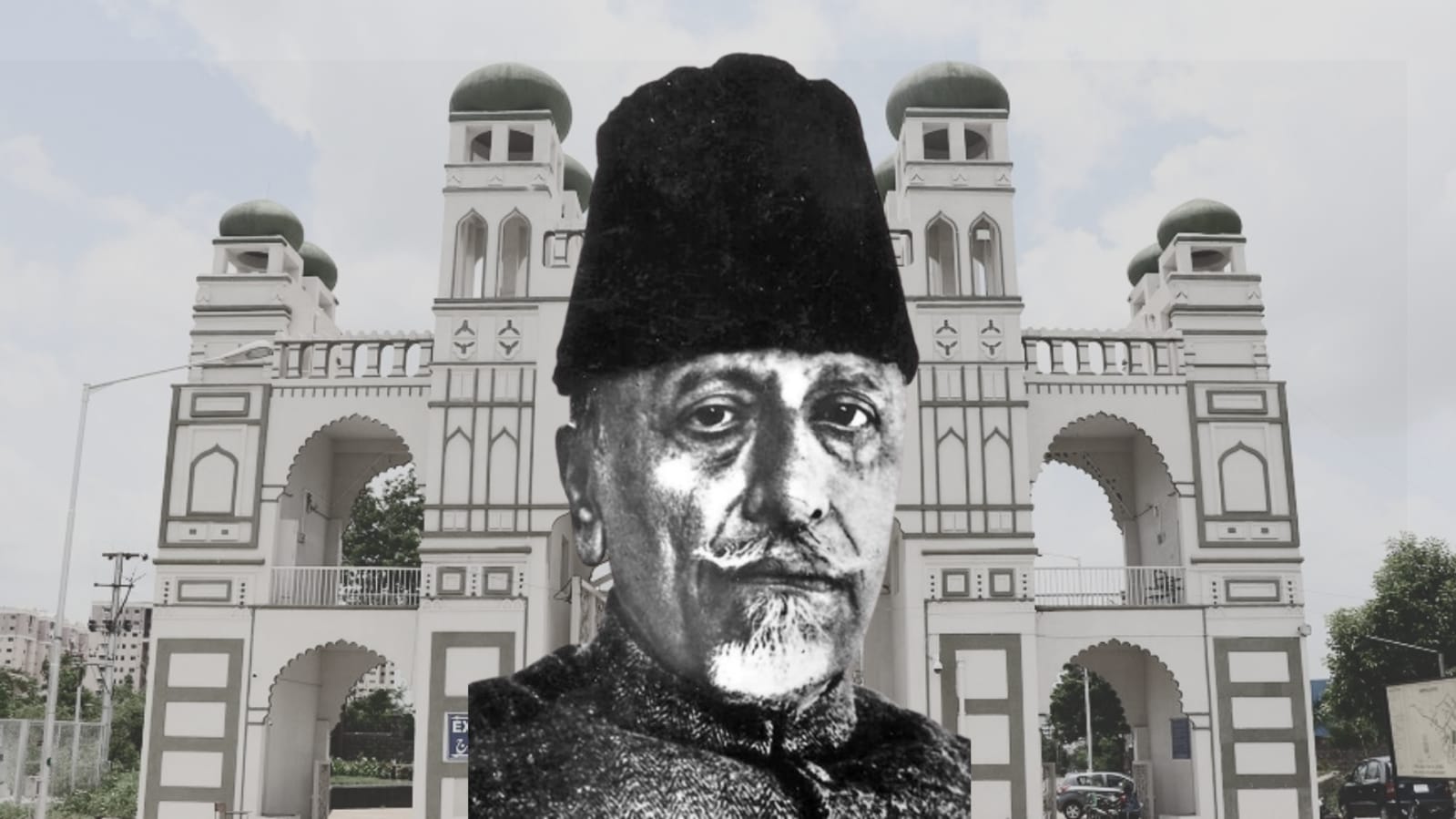
On November 11, which marks the birth anniversary of Maulana Abul Kalam Azad, I visited his grave for the first time today. It is situated peacefully next to the grand staircase of Jama Masjid in Old Delhi, surrounded by one of the busiest and crowded areas of the city. The stillness of the grave stands in stark contrast to the vibrant energy of the market that buzzes around it. As I stood there, I could almost envision the scene from decades ago when Maulana Azad addressed a crowd of thousands of Muslims, urging them to remain in their homeland during the partition. His words carried such conviction that thousands changed their minds about migration and stayed in the land they had always known as home.
In that moment, I felt a profound mix of respect and sadness. The hustle and bustle of Old Delhi surrounded Maulana’s burial site, seemingly unaware of the great man who once guided the nation’s intellectual and ethical compass.
Today, as our institution, the Maulana Azad National Urdu University (MANUU), celebrates Azad Day, I find myself pondering an intriguing question: What if Maulana Azad himself had visited the university that bears his name? What would he feel? How might he react to the academic, social, and political culture of our campus?
I imagine him arriving at the main gate, Bab-e-Ilm, which translates to “Gateway of Knowledge.” The name itself would probably make him smile. As a lifelong believer in the transformative power of education, he would be pleased to see that the university defines its identity in terms of knowledge and learning. However, I fear his first encounter might also surprise him. A security guard might stop him, ask for an identity card, or even require him to sign an entry register. He would wonder when education became a matter of surveillance. And if he questioned the logic of such a bureaucratic nature of administration, perhaps he would be handed a show-cause notice, which is the favorite method of modern educational institutions to silence inquiry.
Entering the main gate, he would probably notice the prominent A+ logo and a big digital display showcasing the university’s standing in international rankings. This would fill him with pride, as he had envisioned Indian public universities achieving global recognition, especially those that cater to linguistic and cultural minorities. But I fear this pride might soon fade. He would quickly notice the absence of Urdu on most signboards, and the only Urdu board that asserts the university’s mission, installed by the Students’ Union, is now hidden behind oversized event banners. He would sense that Urdu, the language closest to his heart, is slowly being erased from the everyday life of the university. It survives on ceremonial occasions, but no longer serves as the vibrant medium of intellectual or cultural expression it once was. This slow erasure of Urdu would pain him deeply, for he saw language not just as a tool of communication, but as the soul of a civilization.
Maulana Azad, who had an eye for beauty and aesthetics, would surely enjoy the greenery of Osmania Central Park, where groups of students convene for discussions and leisure. He would be happy to see young minds engaged in debate and dialogue. Yet, if he listened carefully, he might feel uneasy. The conversations he overhears would not always be about ideas, but often about petty divisions, regional loyalties, campus gossip, and superficial concerns. He would sense a decline in moral seriousness, in haya, and in the intellectual passion that once defined India’s academic spaces. If he observed closely, he would notice how regional consolidations among both students and teachers have replaced the spirit of unity and shared purpose. For a man who believed that education should rise above narrow boundaries, this fragmentation would be deeply disappointing.
As he walks near the School of Arts and Social Sciences, a familiar quote might catch his attention: “Knowledge is a sacred trust (amanah) from God, and it should be sought only for His sake. But the government universities have shown us another path. They ignite in us a desire for knowledge merely because, without it, one cannot secure a government job. Today, in India, knowledge is no longer pursued for the sake of knowledge itself, but for the sake of livelihood! And these grand campus buildings, the new colonies of English education, what kind of beings are they filled with? Seekers of truth and lovers of knowledge? No. They are filled with worshippers of a handful of wheat and a bowl of rice, who have been made to believe that without education, they cannot even earn their daily bread!”
The words are his own, inscribed on a board installed by the Students’ Union. He would smile and be pleased that his message continues to echo through the campus corridors. But as he learns that the Students’ Union elections have not been held for more than a year, his smile would fade. The principles of freedom, democracy, and representation for which he was imprisoned are being undermined in the very space dedicated to his name. Democracy is taught inside classrooms, but the assertion is discouraged outside them.
He would see students coming to MANUU from humble and marginalized backgrounds, many of them the first in their families to receive higher education. He would recognize in them the promise of social transformation that he once envisioned for India. Yet, the comfort would not last long. What would trouble him even more is the atmosphere of fear and conformity that has crept into the campus. Instead of being encouraged to question and engage, students are often discouraged from critical thinking or political participation. The potential of MANUU as a space for nurturing informed, reflective, and politically conscious Muslim youth is being curtailed. The energy that could have been invested in building leadership and vision is being diverted into regional rivalries and personal competitions.
For Maulana Azad, who believed that education must lead to the liberation of thought, spirit, and society, this would be a painful sight. He would see that a university with immense potential to shape a generation of thoughtful Muslim citizens is being pushed into passivity. And perhaps the most disheartening moment for him would come when he realizes how comfortably the institution aligns itself with the very forces that threaten his ideals of democracy, pluralism, and secularism. He would be shocked to find that those who once stood against his vision are now being invited, honoured, and celebrated within the walls of the university that bears his name.
As the sun sets behind the hills of Gachibowli, I imagine Maulana standing quietly near the Arts and Social Science circle, gazing at his own words: “zindagi na bhadak uthne ka naam hai, na bujh jaane ka, zindagi naam hai sulagte rehne ka.” (Life is neither about blazing up nor about fading away. Life is about continuing to smoulder, quietly and steadfastly.)
For me, as a student of MANUU, this imagined encounter is not a flight of imagination but a mirror held up to our times. We celebrate Maulana Azad every year with speeches, garlands, and ceremonies, yet his ideals are increasingly being forgotten in practice. Remembering him requires more than rituals. It demands courage. Courage to speak, to question, and to uphold the truth even when it is inconvenient.