

The nationwide student protests appear to have pushed the BJP government towards one of the most familiar weapons in its political arsenal: delegitimising dissent by questioning the motives, loyalties and even nationality of those who dissent.
Following the students’ Sansad March on 20th July, dissatisfaction with the Modi government has become increasingly visible. What began around grievances concerning competitive examinations, recruitment processes and the future of young people has spilled onto the streets in different parts of the country. Protests in Assam, West Bengal, Maharashtra and Bihar suggest that this is no longer an isolated eruption of anger. It is becoming a broader expression of frustration among young Indians who increasingly feel that the institutions determining their futures are failing them.
Yet an equally important development has taken place alongside the protests. Sections of legacy media and pro-government commentators have begun shifting the discussion away from the students’ demands and towards the alleged character of the movement itself. The questions being amplified are no longer simply: What are the students demanding? Why are they angry? Have examination and recruitment systems failed them? Instead, we are increasingly asked: Who is behind the protests? Are they violent? Are political forces manipulating them? Is there a foreign hand? Are anti-national elements involved? This change in vocabulary really matters.
There is a recognisable political sequence here: ignore dissent when it is small, discredit it when it grows, and when neither works, treat it as a law-and-order or national-security problem.
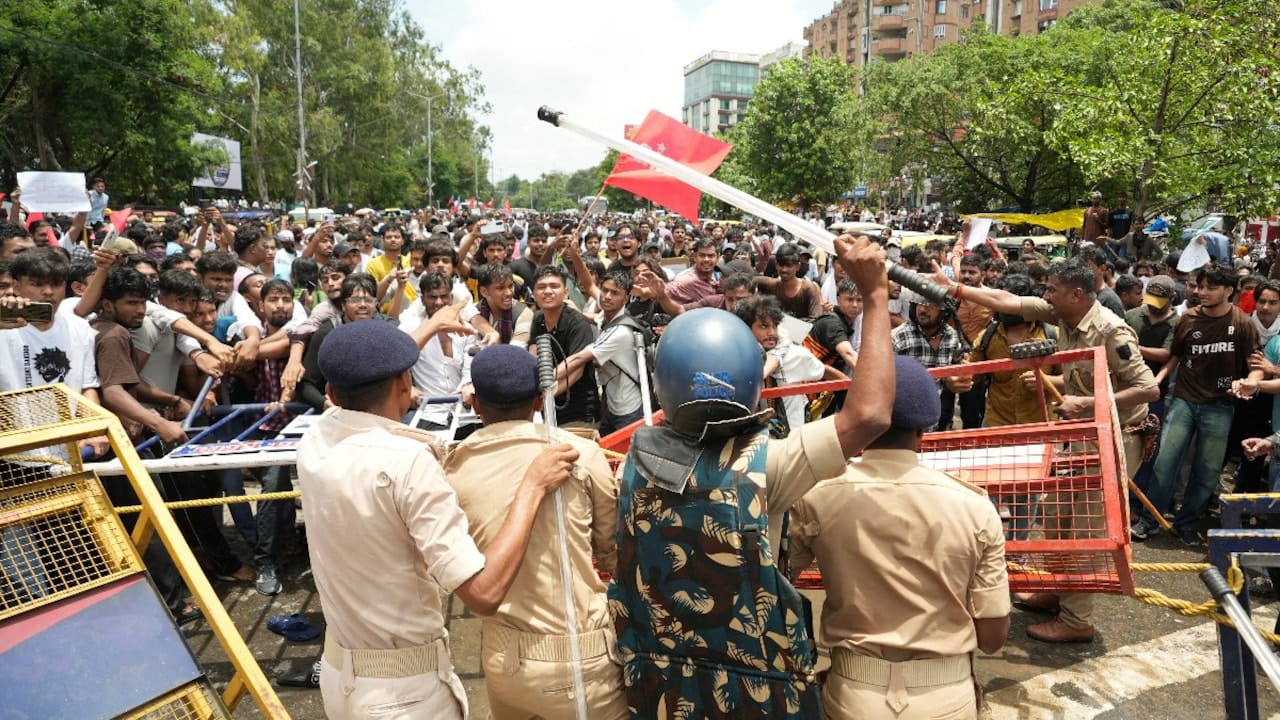
Bihar provides perhaps the clearest illustration of this emerging confrontation. The protests in Patna were met with considerable police force. Images and videos circulating from the demonstrations showed lathi-charges, tear gas and clashes between protesters and security personnel.
There were confrontations from the protesters’ side as well. Videos circulating online appeared to show angry youths chasing BJP workers through the streets of Patna. A BJP MLA subsequently told the Bihar Assembly that he had been trapped during the unrest and feared that he could have been killed.
Violence against political workers or elected representatives cannot be justified merely because those committing it are protesters. But neither can individual confrontations become an excuse to erase the causes of a mass agitation or collectively portray thousands of protesting students as criminals. That distinction is rapidly disappearing.
The state appears increasingly interested in asking who can be prosecuted rather than why so many students are protesting in the first place. Cases reportedly involving hundreds of students, alongside scrutiny of influencers and YouTube channels accused of provoking unrest, deepen the impression that the administrative response is moving from dispute resolution towards deterrence.
The message risks becoming simple: protesting may cost you more than remaining silent. For young people already anxious about examinations, employment and their futures, that is an extraordinarily dangerous message for a democracy to send.
More revealing still is the attempt by sections of the media and political commentariat to locate a hidden conspiracy behind the agitation.
Pakistan, the CIA, George Soros, foreign interests and political conspirators have entered commentary surrounding the protests. These are serious allegations, yet extraordinary allegations require evidence. Merely repeating the names of familiar geopolitical villains does not establish that a student movement is foreign-sponsored. The obsession with finding a mastermind also performs a useful political function: it relocates responsibility.
If students are protesting because they have genuine grievances about examinations, recruitment and governance, then the government must answer uncomfortable questions about its institutions. But if the same students can instead be portrayed as pawns in a foreign conspiracy, the government becomes the victim rather than the object of criticism. Administrative failure is transformed into national security, the dissatisfied student becomes the dangerous conspirator, and accountability disappears somewhere between the two.
The simultaneous reports that the government is willing to communicate with opposition figures and protest representatives make this framing even stranger. Dialogue is welcome. Indeed, dialogue should have preceded confrontation. But negotiations cannot succeed if one side is simultaneously portrayed in the public sphere as manipulated, violent or anti-national.
A government cannot meaningfully extend one hand for dialogue while allowing the other to point accusingly at those sitting across the table.
The protests in Darbhanga further demonstrate why dismissing the movement as the creation of a handful of agitators would be a mistake.
When anger travels beyond Delhi and Patna into towns and districts, it becomes harder to explain everything through the convenient vocabulary of conspiracy. The geographical spread of protests indicates that the underlying grievances have resonance beyond a small political circle. This should concern the government more than any slogan shouted at a demonstration.
Students constitute a constituency whose relationship with the state is unusually intimate. Their examinations are administered by public institutions. Their recruitment often depends upon government agencies. Their universities are regulated or funded by the state. Their employment prospects are deeply affected by public policy.
When these young people lose confidence in the institutions controlling these gateways, their frustration cannot simply be lathi-charged out of existence.
There is another uncomfortable dimension to these protests. For many Indians, aggressive policing is not new. Communities in Kashmir, tribal regions, border areas, remote villages and numerous protest movements have long described experiences of surveillance, criminalisation and disproportionate state force. Muslims protesting controversial policies have repeatedly encountered narratives in which dissent becomes associated with jihadism, extremism or anti-nationalism.
For sections of the political majority, however, such experiences could previously be observed from a comfortable distance. State coercion could be rationalised because it was happening to someone already portrayed as suspicious.
The current student protests complicate that arrangement. Among those experiencing lathi-charges, tear gas ,pellet gun shots and other police action today may also be young people from families that have supported the BJP. The ideological label becomes harder to sustain when the person facing the baton is no longer an imagined “anti-national” but your classmate, neighbour, son or daughter.
Perhaps this moment will produce a broader democratic recognition: excessive state power tastes bitter regardless of who is subjected to it. Civil liberties become meaningful precisely when we defend them for people whose politics, identities and opinions may differ from our own.
After more than a decade in power, the BJP government should have enough political confidence to distinguish dissent from disloyalty. A student demanding accountability over an examination is not an enemy of India. A young person marching against recruitment failures is not automatically part of a foreign conspiracy. A protest does not cease to be legitimate because isolated individuals become violent. And criticism of the government is not synonymous with hostility towards the nation.
The government certainly has a responsibility to prevent violence and protect citizens, police personnel, political workers and public property. Protesters, too, carry a responsibility to keep their movement democratic and non-violent. But the state carries an additional burden precisely because it possesses vastly greater power.
It controls the police. It can file criminal cases. It controls administrative machinery. It possesses investigative institutions and an enormous capacity to shape the conditions under which dissent occurs. Restraint, therefore, is not weakness. It is one of the defining obligations of democratic power.
The government should respond to this movement by addressing the institutional failures that brought students onto the streets, investigating allegations of excessive force, ensuring accountability for violence from every side and opening credible channels of dialogue with student representatives.
Above all, it must resist the temptation to manufacture enemies out of its own young citizens. Governments often discover that delegitimising protesters is easier than answering them. But labels cannot indefinitely substitute for governance. “Anti-national”, “foreign-funded”, “violent”, “Pakistani”, “Soros-backed” or any other politically convenient designation cannot answer a student asking why an examination failed, why recruitment remains uncertain or why demanding accountability brought a police baton down upon them.
India’s students are not asking to be treated as enemies of the state. They are asking the state to work for them. To address this, the government must move beyond the mere resignation of Mr. Dharmendra Pradhan, as that alone is no longer enough.