

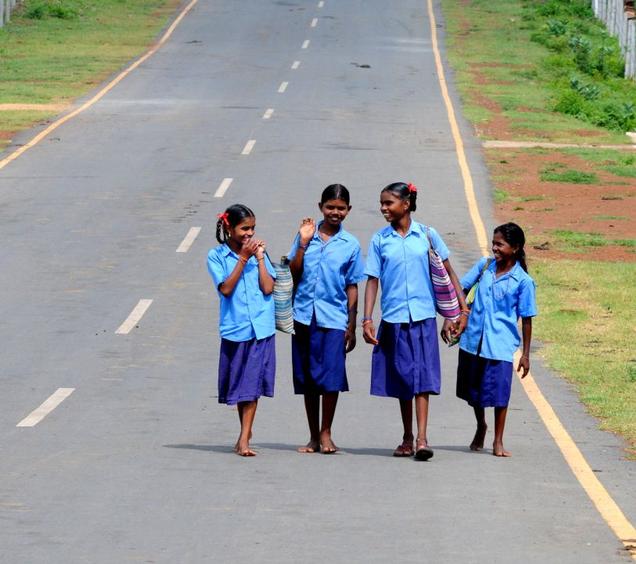
We are now two years beyond the deadline for the implementation of Right to Education Act, 2009. The journey has not been an easy one, mixed with success and failure; it has been demanding radical shifts at various levels of our education system. Reports abound in the media pertaining to the failures in meeting many RTE norms. There are still intense shortages of almost 10 lakh teachers in primary schools, 25% teachers employed are still untrained and the student-teacher ratio falls short of the prescribed norms. News agencies have been frequently reporting about the practical difficulties in its execution especially faced by the poor and the school management.
ASER’s reports in the last few years on the deteriorating learning levels in schools interestingly raise concerns over certain RTE norms. It states that “Learning levels started dropping in many states since RTE came into effect. Coincidence? Correlation? Or, causation?” The report reflects a general feeling that RTE may have led to the relaxation of classroom teaching with the scrapping of all exams and assessments. Without a working alternative mechanism like CCE (Continuous and Comprehensive Evaluation) the problems have increased many folds. It also signals the weakening of public education system in the country and predicts that more than 50% of the children in India will pay for their primary education by 2020.
In addition to the above issues, 25% reservation quota for poor in private schools has created a lot of hue and cry. In its present form it shows many discriminatory practices and cultural gaps. In a society so deeply rooted with discrimination based on caste, creed and socio-economic status, is it possible that our dreams for social justice in education may be realized? Even religion and progressive movements which boast about abolishing discrimination have not been able to resolve this successfully. Rather, they have ultimately adopted these divisive practices themselves.
It should also be kept in mind that the implementation of RTE not only demands financial support and institutional change but needs revisiting the act itself. We should not forget that the ultimate goal of this act is to provide free and compulsory education to all in this country.
Noted critic Mr Anil Sadgopal say that, 25% reservation to poor children in private schools is more like a charity than bringing equality in education. It overlooks the cultural gap and disparity that will strengthen between the lower class non-paying and upper class paying children. It demeans the initial demand for the neighborhood and common schooling system. It is also seen as a violation of Article 21-A of the Indian Constitution which is about free elementary education of equitable quality to the 6-14 year age group.
RTE act was passed six years ago but the government never looked serious about its execution. At such a low percentage of GDP (3.4% in 2014-15) on education, the dream to fulfill even the quantifiable goals looks bleak. It should also be kept in mind that the implementation of RTE not only demands financial support and institutional change but needs revisiting the act itself. We should not forget that the ultimate goal of this act is to provide free and compulsory education to all in this country. One more aspect which is generally overlooked is the corresponding change in the mindset and attitude of the people of this country without which all other attempts look futile.
Many good policies and framework have been formulated to improve the public education system in our country, but when it comes to implementation there are successive failures.
What are the reasons for these continuous failures? Does it mean that the failure reflects the impracticability of these policies? Take National Curriculum framework formulated in 2005 which talks so much about the kind of educational reform needed in our country but 10 years have passed and we don’t see much improvement. Similar fate is likely to be seen in RTE, unless it is marked with judicious action.
One of the most important aspect of policy shifts and reforms in a democratic system is the readiness and acceptance among its stakeholders. Any radical shift without taking the participants into confidence may prove fatal which is seen clearly in the case of RTE. Do we even consider the central role played by teachers in any education system? Were the public school teachers ever ready for the recommendations and norms proposed in NCF or RTE? At the grass root teachers have never been able to even accept the text books prepared under the shade of NCF, 2005. Irony is NCFTE (NCF for Teacher Education) came four years after NCF, 2005. A better way would have been to bring reforms in Teacher Education prior to bringing NCF & NCF oriented text books.
Similarly RTE should have been implemented in a gradual manner with teachers being taken into confidence first. Proposing and implementing all the recommendations at one short and setting a deadline of three years makes RTE look impossible.That is the reason why many critics are skeptical about RTE and look at it being under the guise of profit-oriented privatization and neo-liberal agendas, being pushed like a Trojan horse in the Indian education system. At least the real goal of free and compulsory education for all looks like a distant dream at present.
One of the most important aspect of policy shifts and reforms in a democratic system is the readiness and acceptance among its stakeholders. Any radical shift without taking the participants into confidence may prove fatal which is seen clearly in the case of RTE.
How should we go ahead with RTE now? As said earlier, RTE norms itself needs a relook bringing teachers at the center of this exercise, with only one goal in mind and that is free and compulsory quality education to every child of this country. Teacher’s training program should be taken at an aggressive mass level, strengthening all the institutions like DIETs involved in the teacher education. Similarly, pre-service teachers’ trainings should sensitize teachers on NCF-2005 and RTE, thus ensuring the readiness in implementation in a more appropriate manner at service. Also our society, especially the parents needs to be educated on the need for a common schooling system, equality in quality education and the importance of a strong public education system for the progress of any country. The recent studies done by Azim Premji University in Andhra Pradesh have made it very clear that the prevalent belief about private schools improving learning outcomes is a myth.
All this requires government’s attention especially allocating a higher budget on school and teacher education. Without an honest investment and vigilance from the state, RTE act will fail badly in terms of implementation and that may strengthen the common neo-liberal belief that private and commercialized form of education is the only antidote for a better education system, which may result in more disparities in our country.