

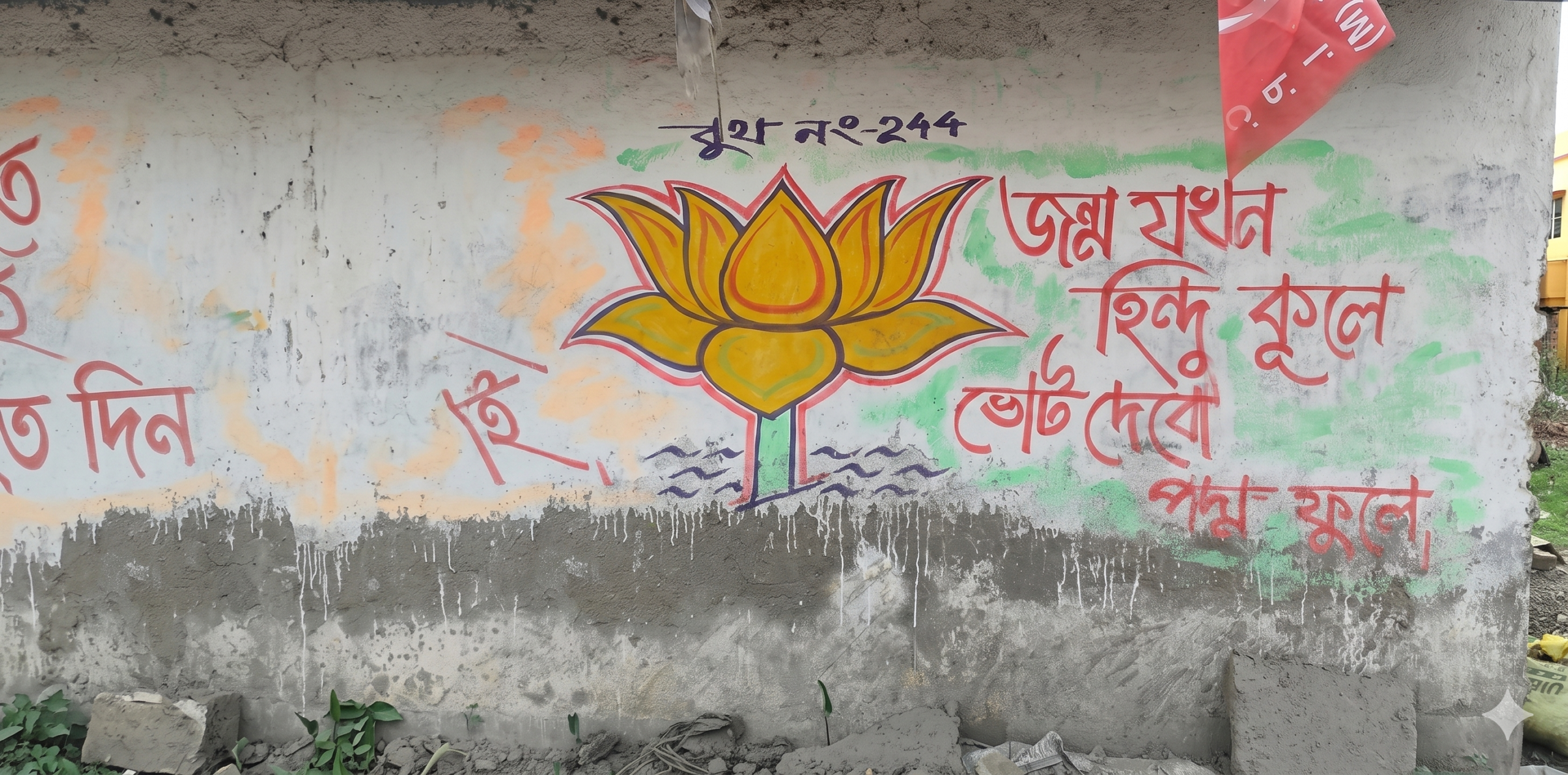
West Bengal is currently experiencing extreme heat. Its political atmosphere is even more intense. The political axis of West Bengal underwent a foundational shift on May 4, 2026. This was not merely a change in the guard; the victory of the Bharatiya Janata Party (BJP) appears to have dismantled decades of conventional secular discourse in a state that once prided itself on being an outlier to the national trend. Many observers suggest this victory is the definitive mandate of the Hindu ‘Bhadralok’ ( According to noted historian Jaya Chatarjee, the Bhadralok class has historically navigated the state’s destiny and played a decisive role in the 1947 Bengal Partition). While this elite once maintained a mask of progressive pluralism, the current atmosphere indicates a pivot toward a more overt communal identity. The sophisticated silence of the previous century has been discarded. It has been replaced by a vocal, ideological upsurge that is already beginning to fray the state’s delicate social fabric.
We are currently witnessing a localized yet systemic rise in violence targeting the Muslim community. It would be a mistake to view these incidents as a mere series of isolated political fights. Rather, the evidence suggests a deeper effort to reorder the social hierarchy of the East. The current trajectory implies that Bengal’s Muslims may face more sustained pressure on their religious identity in the coming months. These manifestations are already visible in both rural hamlets and the dense urban pockets of Kolkata. Institutions that traditionally define the community, mission schools, masjids, and both Khariji and Deobandi madrasas, are finding themselves under an unfamiliar administrative scanner. The physical markers of faith are also being contested. The hijab, the beard, and the skull cap are increasingly framed as symbols of an inherent ‘otherness’ in a state that used to boast of its syncretic culture.
Chief Minister Suvendu Adhikari recently declared himself a leader for all citizens. However, this rhetoric seems to be frequently undermined by ground-level directives that tell a different story. His call for Hindu households to hoist the Bhagwa, or saffron flag, is a potent example of this. Such an act serves to physically and visually bifurcate neighborhoods, effectively marking Muslim households through their absence of color. This practice creates a geography of fear. It makes it significantly easier to identify and isolate specific communities during periods of unrest. In essence, it maps every village and city block into a binary of ‘Us versus Them’. This is not just a symbolic gesture. It is a logistical tool for segregation.
The language used by senior BJP leadership further complicates this transition. Minister Dilip Ghosh has stated quite bluntly that there is no longer a need for minority-specific development. He argues that such policies were part of the previous administration’s ‘appeasement’ strategy. This brand of loose talk is becoming increasingly common in the public sphere. It signals to the local bureaucracy and the police that the constitutional rights of Muslims might be treated as secondary. When ministers openly dismiss the necessity of inclusive growth, it erodes the democratic foundation of the state. It implies that citizenship in the new Bengal is tiered based on religious affiliation. This is a radical departure from the constitutional promise of equal protection under the law.
In response to this mounting pressure, a curious phenomenon is surfacing in Kolkata and the outlying districts. The term ‘Rashtrabadi Muslim’, or Nationalist Muslim, has gained immense popularity, though it is often born of a survival instinct rather than genuine ideological conversion. Many Muslims are joining the BJP not because they have suddenly embraced the party’s core tenets, but to protect their businesses and homes from targeted vandalism. One can now see BJP flags flying over masjids, dargahs, and even kabaristans. This is a form of visual surrender intended to ward off potential attacks. These ‘Rashtrabadi Muslims’ are seeking a little bit of safety from the new government. Naturally, this creates a deep rift within the Muslim community itself. It pits those trying to survive through pragmatic collaboration against those who wish to maintain a stance of political resistance. The administrative machinery is also being utilized to foster a sense of permanent uncertainty. The Special Intensive Revision (SIR) of voter lists has seen the exclusion of a large number of Muslims across the state. Many residents have found their names missing or their citizenship suddenly questioned by local officials. This creates a state of perpetual anxiety where one’s legal existence is under threat. The fate of these individuals remains precarious as the bureaucratic process becomes increasingly opaque. This systematic exclusion functions as a powerful tool for political disempowerment. If you cannot vote, you do not exist in the eyes of the state.
The recent election results show that the Muslim vote bank in Bengal is no longer the monolith it was once assumed to be. The traditional loyalty to the Trinamool Congress (TMC) has fractured significantly. Some voters felt the TMC failed to protect them during the peak of the campaign, while others were lured by alternative local leadership. This division has left the community politically vulnerable. Currently, no single party can claim to be the sole guardian of Muslim interests. In turn, the community is no longer loyal to any single flag. This fragmentation has led to a palpable sense of political powerlessness. The bargaining power that comes with block voting has evaporated. This time, the picture was entirely different. In districts like Murshidabad, Malda, and North Dinajpur, minority votes did not go unilaterally to the TMC. A significant portion shifted toward the Congress and the Left, while regional forces like the ISF dented the TMC’s strongholds.
While the number of Muslim MLAs in the state dropped only slightly from 44 to 40, the TMC’s dominance over them has weakened considerably. Six Muslim MLAs now represent parties that belong to neither the TMC nor the BJP camps. Political analysts point to several reasons for this shift, including deep-seated dissatisfaction with local TMC ‘syndicates’ and the splitting of the anti-BJP vote. SIR also played a role, with nearly 91 lakhs names removed statewide. While official religious data was not released, opposition parties claim a large portion of those removed were minority voters. However, statistics show that name deletions weren’t the only factor. Even in areas with high turnout, the TMC’s vote share dropped as voters sought new alternatives.
For Muslims, several possibilities are unfolding for the future of the state’s democracy. One possibility is that the community remains scattered and marginalized, losing its voice in the state assembly for a generation. Another, more transformative possibility is the emergence of a new, independent political power. This would involve a leadership that rises from within the community, focusing on constitutional rights and legal protections rather than the transactional patronage of mainstream parties. This potential for a new Ambedkarite-style mobilization could fundamentally change the nature of Bengal’s democracy. It would move the conversation away from ‘appeasement’ and toward the language of civil rights.
It is known that the Muslims make up nearly 30 percent of the state’s population. Within this group, the arrival of a BJP government has sparked a complex mix of anxiety and pragmatism. There is a specific concern regarding representation, especially since the BJP did not field a single Muslim candidate in the entire election. Yet, many local leaders believe the democratic mandate must be respected. They argue the new government should be judged by its actions rather than its past rhetoric. The community hopes the government will follow its ‘Rajdharma’ and treat all citizens equally. Political analyst Moidul Islam believes the BJP government’s first priority will likely be administration and infrastructure development. He suggests there may be no immediate cause for panic, as the focus could shift toward a more business-oriented environment. This possibility is being discussed cautiously among the Muslim middle class and youth, who often prioritize jobs and economic stability over identity politics. Still, the void in representation remains a sticking point.
The election results of 2026 suggest that fifteen years of TMC rule have come to a crashing halt. The BJP’s vote share climbed to 46 percent, fueled by a massive polarization of the Hindu vote. In regions like North Bengal and the Matua-dominated belts, the Hindu vote went almost entirely to the saffron camp. Issues like the Sandeshkhali unrest and the implementation of the CAA played a major role in this consolidation. Many former Left supporters also switched to the BJP, viewing it as the only viable vehicle to ensure the TMC’s defeat. On the other hand, the TMC’s grip on minority voters weakened due to legal delays regarding OBC reservations, which led to the cancellation of job certificates for many Muslim youths. However, the transition of power has been marked by reports of brutal violence. Footage of shops being set on fire in East Midnapore suggests that the ground reality remains grim. Small business owners and poor laborers are bearing the brunt of the chaos. The BJP is systematically moving away from trying to include Muslims in its political vision, shifting instead toward a strategy that relies on excluding them to consolidate others. This isn’t just about who is on the ballot; it’s about the entire atmosphere of the state. Between inflammatory campaign speeches and manifestos that focus on policies many Muslims find threatening, the ‘trust deficit’ is widening.
A particularly disturbing trend has emerged with politicians like Ritesh Tiwari, the MLA from Kashipur-Belgachia. He has categorically stated that he would not carry out any public work for Muslim constituents who did not vote for him. ‘No certificates. No projects. Nothing for five years,’ he reportedly told the press. This is a direct violation of a public servant’s constitutional duty to serve all citizens, regardless of their political leanings. Tiwari isn’t alone in this sentiment. New Chief Minister Suvendu Adhikari set a similar tone earlier, declaring he owes his win to Hindu voters and will prioritize their needs. This ‘settling of accounts’ suggests that citizenship is becoming a transactional commodity. Bengal stands at a crossroads where a historic mandate for change is being overshadowed by a politics of exclusion. The Saffron Project is increasingly built on a foundation of polarization, posing a significant challenge to the pluralistic soul of the Land of Reform.