

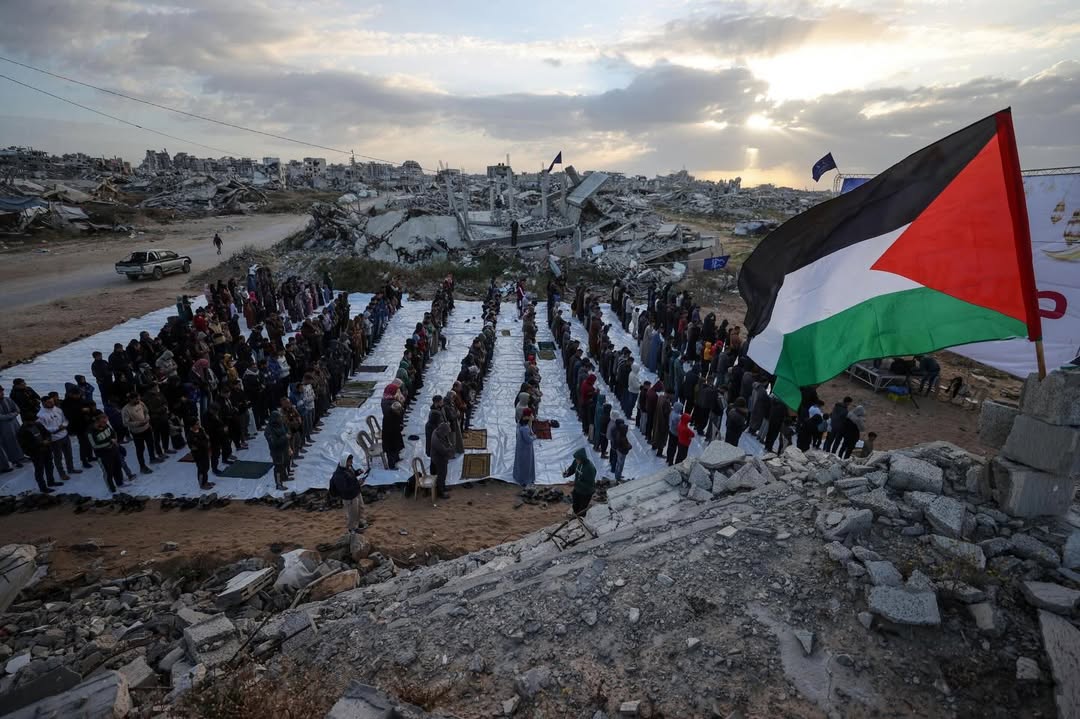
Today is the fifteenth of May. For Palestinians and for those who refuse to look away, it is Nakba Day, the day marked to remember the catastrophe of 1948, when over seven hundred thousand people were expelled from their land, their villages dynamited or renamed, their olive trees uprooted, their keys retained as the only remaining grammar of belonging. But Nakba is not an event that ended. It is, as Edward Said spent a lifetime insisting, a condition, a present tense wearing the clothes of the past. It is the ongoing structure of a world in which one people’s existence is administered as the obstacle to another people’s project.
And in two weeks, the world’s Muslims will observe Eid al-Adha, the day of sacrifice, the commemoration of Ibrahim’s (pbuh) willingness to offer what he loved most at the altar of what he held most clear. This year, more than any other in recent memory, these two occasions arrive in the same breath, not as coincidence but as theological provocation. What does it mean to sacrifice? What does it mean to witness? What does it mean to do either in a world that has made a pathology out of both?
—
On the seventh of October 2023, the military operation named Toofan al-Aqsa broke through the walls of the world’s largest open-air prison. Frantz Fanon, writing from within the Algerian revolution, argued that the colonial world is a Manichaean world — a world cut in two, divided absolutely between the settler’s city of light and the native’s zone of darkness, between those whose lives are protected by law and those whose lives are administered by force. The fence that enclosed Gaza was not merely a security installation; it was the physical inscription of this division, the concrete and wire grammar of who counted as human and who did not. To break through it was not, in the Fanonian sense, simply a military act. It was an ontological one. It was the colonized body refusing, at catastrophic personal cost, to remain on the side of the world where it had been placed.
The world had largely agreed to forget. International attention had drifted. The Abraham Accords were being celebrated as a new regional architecture, one that elegantly bypassed the inconvenient fact of occupation. Palestine was being quietly administered out of relevance. Toofan al-Aqsa refused this administration, tore through it, literally, with its hands. And what followed — the months of bombardment, the leveling of entire neighborhoods, the killing of journalists and aid workers and newborns in incubators, the starvation used as an instrument of war — revealed something the Palestinian people have known since 1948: that the world’s willingness to watch them die has no bottom. But something else also happened, something philosophically significant. In the global response to Gaza, in the millions who took to the streets they had never before walked for Palestine, in the student encampments from New York to Amsterdam to Delhi, in the journalists who kept broadcasting until the airstrikes found them, a new grammar of witness was being assembled. People were learning, sometimes for the first time, what it meant to be a shahid in the sense of the one who sees and cannot unsee.
—
The Cameroonian philosopher Achille Mbembe gives us perhaps one of the most precise conceptual vocabularies for what Gaza represents within the architecture of modern power. In his theory of necropolitics, Mbembe extends Foucault’s analysis of biopower — the management of life as a political technology — into the colonial and postcolonial terrain where sovereignty is exercised not through the optimization of life but through the administration of death. The colony, for Mbembe, is the space where the state of exception becomes permanent, where the distinction between the living and the dead is juridically suspended, where an entire population can be killed without the killing being registered as murder in the legal and moral vocabulary of the governing world.
Gaza is necropolitics in its most undisguised form. It is a territory declared by its occupier to be outside the jurisdiction of the laws its occupier claims to uphold. It is a place where the infrastructure of life, water, electricity, hospitals, and flour is weaponized, withdrawn, and calibrated as an instrument of pressure. What is being administered in Gaza is not merely death but the condition of being killable, the political stripping away of the protection that distinguishes a life from a disposable biological fact. Mbembe calls this condition the death-world: a form of social existence in which populations are subjected to conditions that make life feel like a living death.
But here is where necropolitics alone is insufficient to the reality of Palestine. Because alongside the death-world, Gaza has produced something that should be theoretically impossible within Mbembe’s framework: a civilization of the living. Not mere biological persistence, but a dense, creative, spiritually alive culture that keeps insisting on its own interiority even under conditions designed to extinguish it. This is what the imagery of Toofan al-Aqsa communicated to so many who watched, not only rage, but a terrifying aliveness, a people who had decided that the condition of being killable would not be the last word about them.
—
To understand this aliveness, we must turn to shahada and resist the impulse to translate it too quickly. The word carries within its Arabic root a philosophical density that its usual English equivalent cannot hold. Shahada is first witnessing. The shahid is the one who sees — who stands before truth and refuses to look away even when looking away would ensure survival. It is this same word that carries the foundational Islamic testimony: La ilaha illallah, the great act of seeing through the fictions that organize our unfreedom. To bear witness is, in this tradition, already a form of sovereignty, an insistence that reality will not be defined by those with the power to impose their version of it.
This is why the Palestinian journalist who keeps broadcasting after his family has been killed is performing an act that is both political and theological. He is not merely reporting. He is witnessing. He is producing, in real time, a counter-testimony against the machinery of erasure. And when he is killed — as so many journalists in Gaza have been, in numbers unprecedented in any modern conflict — his death becomes continuous with his life, not a rupture of it. The dying does not cancel the witness; it ratifies it. This is the metaphysics of shahada that the secular world finds so difficult to translate: the idea that a death in truth is not a defeat but a completion.
—
Byung-Chul Han’s diagnosis of contemporary life illuminates, from another angle, why this metaphysics has become so alien to the modern mind. Han argues that we inhabit an achievement society, a world that has internalized the imperative to produce, perform, and optimize, replacing external discipline with the more totalizing tyranny of self-exploitation. The subject of this society is not oppressed from without but drives itself toward exhaustion from within, mistaking its burnout for freedom. The achievement society cannot metabolize uselessness. It cannot make sense of suffering that does not eventually convert into a lesson, a narrative of growth, a monetizable story of resilience. It has replaced depth with efficiency, presence with productivity, meaning with metrics.
What Han describes as the pathology of the achievement society is precisely what renders Palestinian death, and Palestinian life, incomprehensible within mainstream global discourse. The Palestinian who names her martyred child before the camera, who kisses his forehead in the rubble, who returns the next morning to mourn the next one — she is not performing grief in any way the therapeutic apparatus of the achievement society can contain. She is not processing trauma toward recovery. She is inhabiting a mode of being that predates the entire optimizing project: a mode in which life is not a resource to be managed but a trust to be returned, and in which death, at the right moment, for the right truth, is not failure but fulfillment.
For Fanon, the colonized person who takes up the struggle against their dehumanization is doing something that cannot be reduced to political calculation. It is an act of ontological recovery, a reclaiming of the category of the human from a system that has structurally denied it. Toofan al-Aqsa belongs to this Fanonian genealogy: it was a people insisting on existing as subjects in a world that had decided to administer them as objects, and the breaking of that fence was the breaking of the Manichaean order that had kept that fiction intact.
—
Ibrahim, peace be upon him, was commanded to sacrifice what he loved most. The Qur’an does not present this as a moment of crisis. There is no extended wrestling, no dark night of the soul in the Greek tragic sense. What the Qur’an gives us instead is something quieter and grand: a man who has received, through dream, a clarity so complete that the only remaining question is how to move toward it. He does not deliberate. He contemplates, and in contemplating, he is already there. When he tells his son Ismail (pbuh) what has been revealed, the son’s response is the theological hinge of the entire occasion: “Do as you are commanded. You will find me, if God wills, among the patient.” The son, too, does not struggle. He receives. Both of them have already arrived at the place the act will take them; the physical motion of sacrifice only confirms what the interior has long settled.
This is a different order of being from witness in the testimonial sense. The journalist who broadcasts from the rubble is a shahid against pressure; he sees in defiance, in the teeth of a world that wants him not to. Ibrahim’s (pbuh) state moves beyond it to yaqeen, a certitude so total that it has dissolved the distance between the command and the compliance. There is no gap in which anguish could live. The knife is raised not with drama but with the stillness of a man who has already given everything before he gives anything.
Eid al-Adha is not about blood, though blood appears. It is about the refusal to convert love into possession, the willingness to hold what you love most with open hands: your child, your belongings, your life. The animal offered is the ego’s ritual acknowledgment that it cannot be the ultimate guardian of what it loves. And this willingness, this readiness to lose without being annihilated by losing, is precisely what Han’s exhausted, self-exploiting subject cannot access. The achievement society has no practice for this. It has risk management instead.
The diplomatic accords that bear his name were built on precisely the opposite logic: the belief that what you love can be negotiated away for the right price!
—
Palestine, in this light, is not only a political emergency, though urgent, but a civilizational testimony. Seventy-eight years of Nakba have produced a people for whom sabr, the Qur’anic patience that is not passive resignation but a form of cosmically active engaging, has become the very texture of existence. This is not a romanticization of suffering. Suffering is not romantic; it is real, and its reality must be named and opposed with every instrument available. But there is a difference between suffering that destroys and suffering that witnesses, and Gaza, again and again, has chosen the latter even when the former would be more understandable.
The student in Delhi or London who joins a vigil for Gaza, the academic who refuses a grant from a complicit institution, the Muslim who gives on Eid al-Adha to a fund for Palestinian children — these too are acts of shahada. Small ones, partial ones, ones that require no dying and claim no glory. But they belong to the same structure: the refusal to let the world’s convenient fiction be the last word. The refusal to look away. The insistence on bearing witness.
Today is Nakba Day. In two weeks, prayers will be offered, an animal will be sacrificed, and meat will be shared with neighbors and the poor — a grand act that will unfold again in a world that has largely forgotten what it means to push forward what you love. Between these two dates runs a question that has no comfortable answer: what are we willing to witness, and what are we willing to offer?
The oldest answer, and perhaps the only one that does not lie, is the one that has been coming from the rubble of Gaza for over five hundred days: We are here. We witness. And we will not pretend otherwise.