

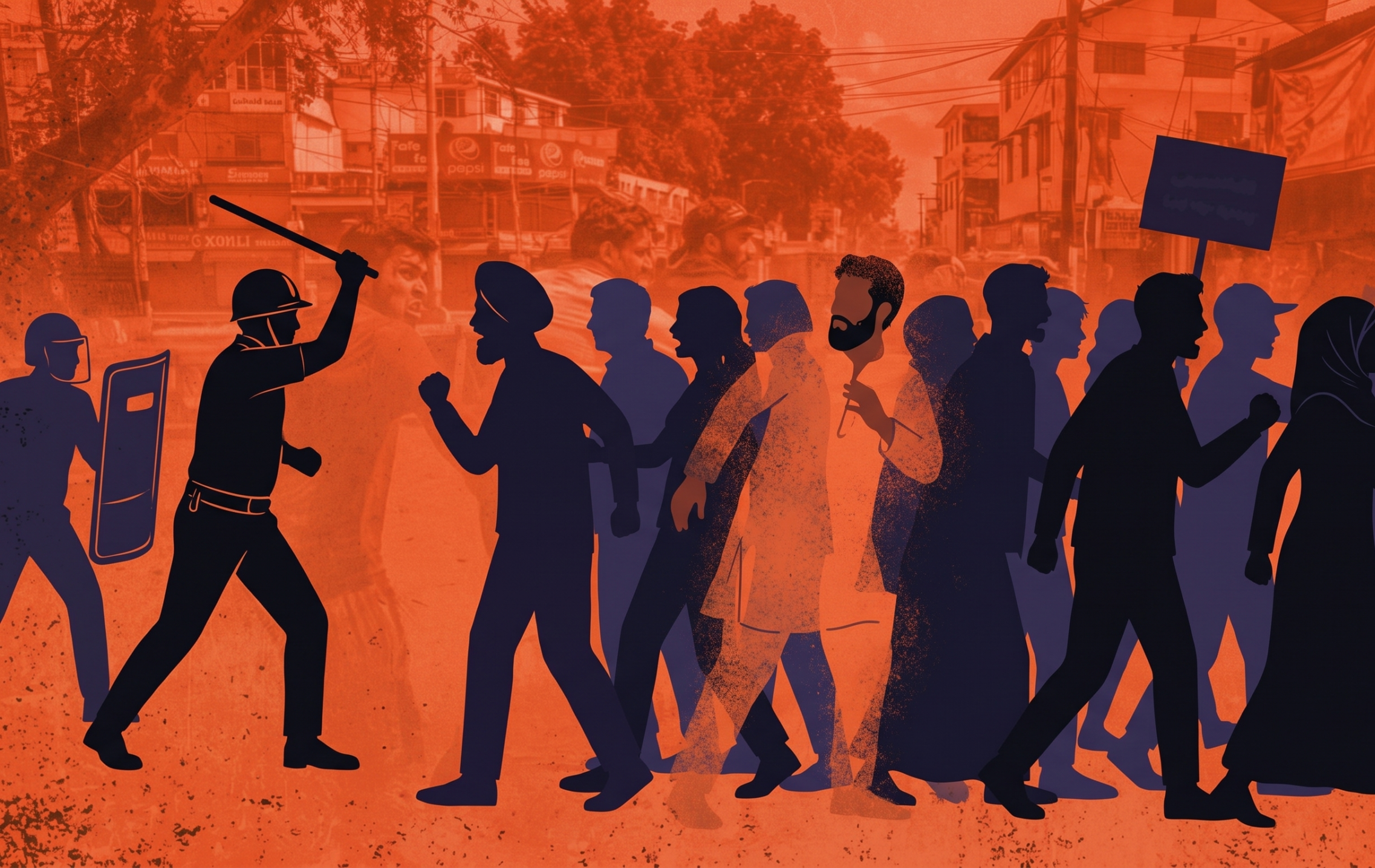
Over the past few months, a great deal of commentary in India has celebrated the Cockroach Janta Party (CJP) mobilization as proof that something has finally cracked in the BJP’s machinery of rule. The argument goes like this: for the first time in years, we have a genuinely cross-caste, cross-religious, cross-regional youth movement, students are angry about paper leaks and unemployment. Crucially, the BJP’s usual weapon, communalizing the protest, assigning it a stigmatized religious identity, doesn’t seem to be working this time.
That is treated as good news. And in one sense, it is. But I want to pose a harder question: at what cost is this “non-communal” unity being purchased? Who has to disappear for this movement to look pluralist? And what does it tell us, not about this one protest but about the deeper structure of what we call secular democratic politics in India, that the price of inclusion, again and again, turns out to be the erasure of Muslim identity?
This is what I am calling, following a long tradition of scholarship, the Muslim Question, not an add-on topic, but a standing structural question that democratic movements in India keep answering the same way, whether they intend to or not.
Two Empirical Cases
First, on 6 August, The Print carried a piece under a pen name Ibn Khaldun Bharati praising Muslim thought leaders, podcasters and opinion-makers for keeping their distance from the protest. Not joining as Muslims. Some joined as individuals, the piece notes, but carefully avoided displaying any identity markers and this is framed as “evolving strategic prudence,” even maturity. The author’s actual words are that depoliticization of the Muslim mind is the prerequisite for de-communalization. Sit with that: political self-assertion diagnosed as the disease, self-erasure prescribed as the cure.
Second, when the BJP’s social media machinery tried to give the protest a communal colour by selectively highlighting Muslim faces in the crowd, CJP and left leaders pushed back, rightly. But notice how. Not by saying, “Yes, Muslims are here and their presence is legitimate on its own terms.” Instead, the defence was that the movement is non-communal, that it united everyone, that religious identity is beside the point. Here, the rebuttal to weaponized visibility was more invisibility.
Inclusion by Erasure
I want to name this pattern, because once you see it, you start seeing it everywhere in Indian secular-liberal politics, not just in CJP. It is not exclusion by expulsion, nobody tells Muslims to leave the protest. It is “inclusion by erasure”. You are welcome, on condition that the part of you that is Muslim recedes from view. This is fundamentally, what Irfan Ahmad calls Hindu Orientalist structure: it recasts Muslims as objects to be represented, corrected, spoken for, or absorbed into a singular civilizational subject called Hindu India.
Here is the pivot of this piece: that Orientalizing structure is not confined to Hindutva’s own discourse. It travels. It shows up inside the movements that oppose Hindutva. When CJP’s leadership decides, on Muslim participants’ behalf, what counts as a legitimate political demand and what counts as “diluting the issue”, when they can mobilize around paper leaks but not around Sharjeel Imam and Umar Khalid’s continued incarceration, they are performing the same gesture as Hindutva itself: deciding, from a position of ‘majoritarian common sense’, what the minority is and is not allowed to say about its own situation.
What the Body Remembers
I do not offer what follows as anecdote appended to argument. I offer it as the argument, felt on the skin. On 20th July, I joined the parliament march and was detained near Akashvani Bhawan, metres from Parliament. Pushed into a police bus, I watched officers outside shout, “is daadi wale ko bhi bahar kheecho” (pull this bearded one out too) after I had just seen them beat another protestor, using the bus as a shield against cameras. Unable to drag me out, they locked the bus from inside and attacked me with nailed boots, slaps, kicks accompanied by anti-Muslim slurs like “Mulla,” “Katua,” “Deshdrohi”, then snatched away my phone.
At Chhatrasal Stadium, I asked a senior officer about my phone and narrated the slurs. His reply: “What can we do? You belong to such a community. Everyone gets driven with the same stick if they belong to that community.” Later, en route to a medical test after twelve hours in detention, an officer asked where I lived. “Jamia Nagar,” I said. “Arre tu to aata he samvedansheel ilaake se hai” (you are already from a sensitive locality) he replied. This is ‘prior theory’ in its purest form: guilt assigned by presumed nature, the very grammar on which communalism runs. Forced to sign the arrest memo without counsel, I spent the night in lockup. The next morning, an officer learned a fellow detainee studied at IIT Madras and praised him, urging him not to waste time on “such activities.” Learning I was from Jamia Millia Islamia, he smiled: “chal tera to samajh aa rha hai” (well, your presence here makes complete sense).
So when CJP’s own defenders insist that emphasizing Muslim identity in resisting fascism “communalizes” resistance, that stance is indistinguishable from the RSS’s own charge of “minority communalism” against any Muslim who names situation as Muslim. Even on welfarist grounds, the silence holds: CJP has said nothing on the scrapping of the Maulana Azad National Fellowship.
The Pattern Continues
As I write this, news arrives from Cachar College in Assam’s Silchar, where a uniform dress code is being pushed through after a hate campaign and an alleged ABVP attack on hijab-wearing Muslim students. And when CJP’s mobilization was at its peak in the capital, during NEET re-examinations a candidate, Kulsum Bano, was stopped at a centre in Ajmer and told to remove her burqa before she could sit the exam. CJP intervened in neither case.
These are not digressions from the Muslim Question. They are its evidence. A movement that cannot name Sharjeel Imam and other Muslim political prisoners, cannot defend a scholarship, cannot speak for a girl told to strip her burqa at an exam hall, has not transcended communalism, it has simply relocated its terms of ‘majoritarian common sense’ from Hindutva’s mouth to its own. Inclusion by erasure is still erasure.
The Muslim Question is secular India’s own test of whether its democracy can hold difference without demanding disappearance. CJP’s evasions do not resolve that test, they only confirm that it keeps being failed.
Author is a Doctoral Fellow at Jamia Millia Islamia and National General Secretary of Fraternity Movement. Can be contacted at [email protected]