

In April 2022, Sahib Hussain, a twenty-six-year-old from Sheikhpur in Haryana’s Nuh district, was seized by armed men in plain clothes, beaten, and driven away. He and two other Muslim men were handed to the police on cow-smuggling charges their families disputed. What makes the episode more than one more entry in the long record of cow-vigilante violence is what happened next: footage of the abduction appeared on Instagram, captioned “Taking away the cow smuggler,” set to a catchy soundtrack, and offered to viewers as something to enjoy. A man’s terror had become a clip with a punchline.
Pause on the person first. Sahib Hussain’s fear was real. The charge against him was an allegation, not a verdict. Yet the edit did not treat him as a person at all. It treated him as content. And that small, ordinary act of conversion, turning a human being into a shareable clip, is where I want to begin, because it points to something larger than any single assault. Call it the aesthetics of violence: the music, images, captions, slogans and rituals through which cruelty is made not just visible but enjoyable, and through which a person is quietly turned into an enemy-symbol whose suffering no longer counts.
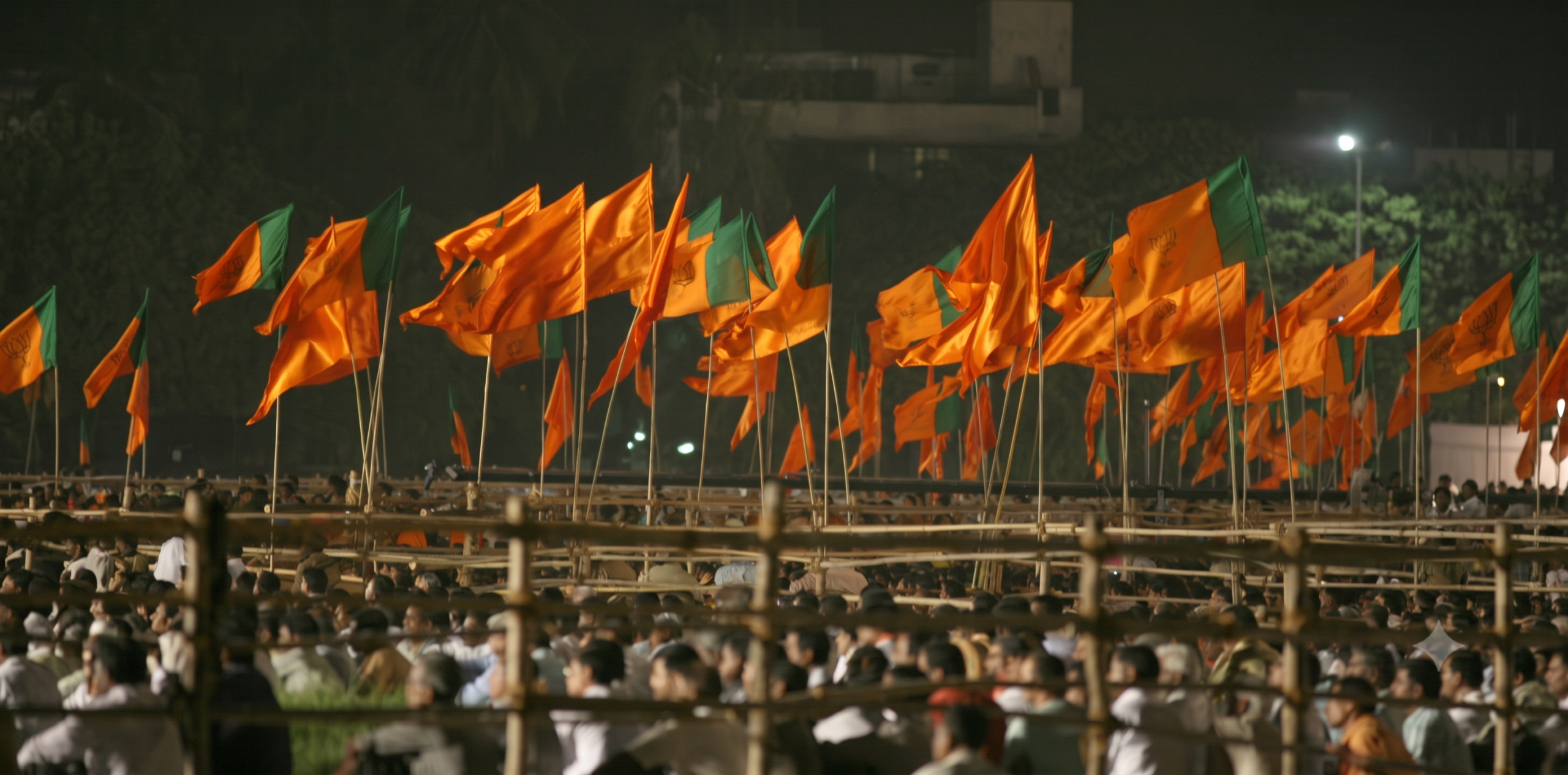
To say violence has an aesthetic is not to say it is beautiful. It is to notice that violence increasingly arrives packaged for feeling. Nearly a century ago, watching fascism rise, Walter Benjamin warned that the real danger was a politics that had learned to make itself beautiful, to give people the thrill of spectacle in place of their rights, until a society could “experience its own destruction as an aesthetic pleasure.” He was describing rallies and newsreels. The insight now fits the vertical video and the trending audio with uncomfortable precision. The Reel of Sahib Hussain’s abduction does not argue that he deserved it. It simply scores the scene, and lets the beat do the persuading.
This is why the packaging matters as much as the blow. Communal violence is rarely the sudden eruption it is made to look like. As the political scientist Paul Brass has argued, riots are produced, organised, rehearsed, and then explained away by people practised at converting everyday tension into mobilisable hatred. Long before anyone is touched, language and image have already done their work, narrowing the space in which a person can be recognised as fully human. The philosopher Judith Butler calls this the question of “grievability”: whether a life is framed as a life whose injury we are meant to feel, or as a mere threat, whose harm passes as relief. The caption “cow smuggler” is not a description. It is a frame that withdraws grievability in advance, so that what follows can be watched without discomfort.
The soundtrack finishes the job. In H-Pop, the journalist Kunal Purohit documents an entire ecosystem of Hindutva pop, songs, verses, and short videos engineered to travel, in which hostility toward Muslims is delivered as entertainment. A vicious line over an infectious tune does not feel vicious; it feels like belonging, even fun. You may forget the target and remember the hook. That is precisely the point. The aim is not to convince anyone of an argument but to tune a whole audience to a feeling, so that cruelty and pleasure begin to arrive together.
Once you start looking, the same logic appears at every stage, not only in the act, but in its celebration. When the eleven men convicted of gang-raping Bilkis Bano during the 2002 Gujarat violence were released on remission in August 2022, some were welcomed home with garlands and sweets. In January 2024, the Supreme Court set that remission aside as unlawful and sent them back to prison. But the garlands had already done their work as public imagery. A crime established not by rumour but by conviction was wrapped in the signs of honour, and in that wrapping the survivor’s suffering simply disappeared from view. The scholar Veena Das has written about how violence “descends into the ordinary,” how it folds itself into the everyday life of a community until it no longer looks like violence at all. A welcome ceremony for convicted rapists is exactly that descent: not a denial of the crime, but its absorption into a scene of pride.
The spectacle even runs forward, into boasting. Recently, the Hindutva activist Swatantra Bhardwaj became the subject of a case over an alleged assault during protests at Delhi’s Jantar Mantar on the father of an activist, an act he himself recounted in detail on podcasts and social media before claiming the accounts were exaggerated. A Delhi court granted him interim bail on condition that he stop posting and speaking to the press. Bail is not guilt, and the case is still being heard. But the pattern is unmistakable: the violence is not hidden; it is performed, narrated to an audience as a badge of identity. This year in Jaipur, men accused of assaulting Abhijeet Dipke, founder of the satirical Cockroach Janta Party, were reportedly garlanded after their release. The Reel, the podcast confession and the garland are variations on one theme. Each turns harm into something to circulate, and belonging into something you earn by celebrating it.
And here the responsibility comes home to the rest of us, because a spectacle needs an audience. Rhythm, humour and a triumphant pose make a clip easy to watch and easier to share; a like turns a viewer into a small co-author of the event’s meaning. Susan Sontag, writing about our endless exposure to images of suffering, warned that repetition not only awakens us, but it can also anaesthetise, dulling the very response the image seems to demand. That is the quiet catastrophe. Not that we see cruelty, but that we get used to it, until what once appalled becomes background noise and we scroll on unmoved.
The logic is not confined to violence against bodies. The bulldozer, sent to demolish the homes and shops of Muslims and the poor, has become less a machine than an emblem, stamped on posters, set to music, sold as merchandise, while the families it ruins vanish behind the image of a strongman’s resolve. Flowers, chants and applause are never neutral decoration. They tell an audience what to be proud of, and whom to forget.
Violence, in other words, does not always arrive looking like violence. Sometimes it comes wrapped in music, slogans, flowers and a camera. An assault becomes a story of pride; a conviction becomes a homecoming; a demolition becomes a meme. But behind every clip is a person whose pain cannot be edited away. Sahib Hussain was a human being before he was a caption, and he remained one after the account that posted him was quietly deleted.
To resist all this is partly a discipline of the mind: to keep allegation separate from proof, to refuse the frame that decides in advance whose suffering counts. But it is also a discipline of feeling—to notice what our attention rewards, and to stay disturbed. The real question the spectacle poses is not only why some people commit violence. It is what happens to the rest of us when we learn to look at it without flinching. When cruelty becomes familiar, the victim disappears from the image. He does not disappear from the world. Our responsibility begins by looking again.
REFERENCES
Incidents
Nuh abductions (April 2022): “Cow Vigilantes ‘Abduct’ Three Muslim Men in Haryana’s Nuh, Police Arrest Victims,” The Quint, 2022, https://www.thequint.com/news/india/vigilantes-abduct-three-muslim-men-in-haryana-nuh-police-arrest-the-victims
Bilkis Bano (convicts released 15 August 2022; remission set aside 8 January 2024): “Supreme Court Quashes the Remission of 11 Convicts in Bilkis Bano Case,” Supreme Court Observer, 2024, https://www.scobserver.in/journal/supreme-court-quashes-the-remission-of-11-convicts-in-bilkis-bano-case/.
Swatantra Bhardwaj (interim bail, September 2026; case ongoing): “Delhi Court Grants Three-Week Interim Bail to Swatantra Bhardwaj to Observe His Conduct,” Newsgram, 16 September 2026, https://www.newsgram.com/india/2026/09/16/swatantra-bhardwaj-case-update.
Abhijeet Dipke / Cockroach Janta Party (Jaipur, 2026): “Cockroach Janta Party: Abhijeet Dipke’s Attackers Receive Grand Welcome After Release,” DNA India, 2026, https://www.dnaindia.com/india/report-cockroach-janta-party-abhijeet-dipke-s-attackers-receive-grand-welcome-after-release-following-jaipur-protest-incident-watch-3213523
Books
Walter Benjamin, The Work of Art in the Age of Its Technological Reproducibility (1936; Harvard University Press, 2008).
Paul R. Brass, The Production of Hindu-Muslim Violence in Contemporary India (University of Washington Press, 2003).
Judith Butler, Frames of War: When Is Life Grievable? (Verso, 2009).
Veena Das, Life and Words: Violence and the Descent into the Ordinary (University of California Press, 2007).
Brahma Prakash, Spectacle State: How Hindutva Shapes Feeling and Culture (HarperCollins India, 2026).
Kunal Purohit, H-Pop: The Secretive World of Hindutva Pop Stars (HarperCollins India, 2023).
Susan Sontag, Regarding the Pain of Others (Farrar, Straus and Giroux, 2003).