

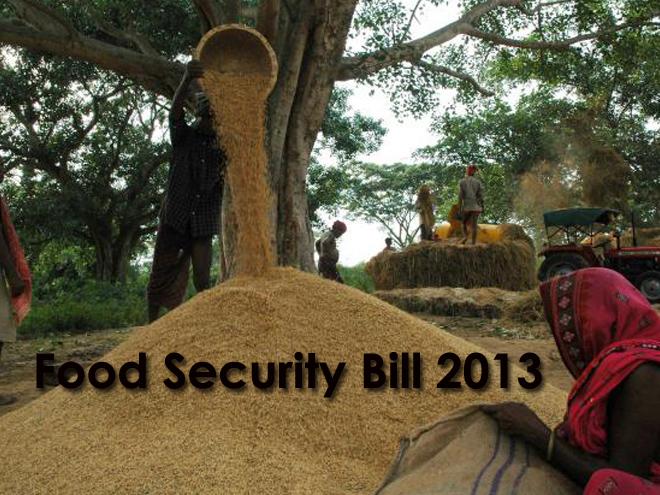
Public distribution system evolved as a system for distribution of food at affordable prices. Unlike as we know it today, it started in India in the 1960s to counter food scarcity in urban areas with an intention to stop grain hoarding and check prices. Now comes its next evolution, as a right for food for all, that emanates from right to life.
National Food Security Bill (NFSB) passed by both houses of Parliament introduces itself as “to provide food and nutritional security in human life cycle approach by ensuring access to adequate quantity of quality food at affordable prices to people to live a life with dignity”.
Bird’s eye view:
1. The bill guarantees “Right to receive food grains at subsidized prices by people belonging to priority households covering 75% of rural population and 50% of urban population.
2. It entitles every pregnant woman a meal free of charge during pregnancy until six months after the child birth through local anganwadi and a maternity benefit which is not less than Rs.6000.
3. It ensures nutritional needs of children by providing free meal for children of age group – 6 months to 6 years through anganwadi and one free midday meal for children up to Class VII in all Government run/aided schools.
4. In case of non-supply of above entitlements the government is required to pay allowance to such people.
5. Empowerment of women by making elderly woman as head of the household and giving preference to women and their collective in licensing of fair price shops.
6. Envisions reforms in present PDS such as end-to-end computerization to ensure transparency of transactions at all levels, leveraging “aadhar” for proper targeting of benefits, cash transfers and other measures .
Economists take
There are two contrasting opinions, one where Prof. Bhagati and Arvind Panagariya of Columbia University, feel that, the bill will make an already stressed fiscal situation worse and fuel inflation hurting the poor more. On the other hand Prof. Amartya Sen’s contention is that if the goodies doled out to the middle and richer classes – subsidized power, fertilizer, LPG connections – are reined in, there will be more than enough money for food entitlements [1]. Jean Drèze, a well-known activist and economist, also a member of NAC that pioneered the bill, in his opinion piece in The Hindu [2] pitches for the bill where he says “wide coverage and clear entitlements are two pillars of the fairly effective PDS reforms” while admitting to its shortcomings and dangers ahead.
Politicians contention
Congress calls it a game changer in terms of hunger eradication, a pledge of its 2009 election. Principal opposition calls it “lollipop” to garner votes in coming election. It flayed the present government for the hurry, but eventually voted for it. Samajwadi party called it “anti-farmer” and stressed for inclusion of provisions for farmer’s interests. AIDMK raised objections that it didn’t ensure continued adequate level of allocation of food grains to States.
Activists’ opinion
Activists’ groups such as Right to Food Campaign have welcomed the bill as first step, though being critical of its provisions falling short. PUCL secretary Kavita says “Without adequate nutritional support, the bill is inadequate in terms of food security. Even the amount of food grain allotted of 5kg is not sufficient for an adult person”[3]. Tribal activists called for full coverage as part of the bill, questioning the rationale in excluding 33% [4]. Farmers’ group opposes the bill saying it nationalizes the agriculture by making government largest buyer and procurer denying farmers their bargaining powers.
“Without adequate nutritional support, the bill is inadequate in terms of food security. Even the amount of food grain allotted of 5kg is not sufficient for an adult person”
Sreelatha Menon sees a hope for migrant poor laborer who can press for their right for ration card in place of their stay [5] as mostly urban migrants have ration cards in their home districts and so face hardships in getting their due. Harsh Mander, an activist, cautioned against privatization of Integrated Child Development Scheme with government encouraging manufactured “ready-to-eat meals” not hot cooked meals. For further reading [6].
The evolution is not going to stop here as the bill implementation begins it is bound to raise many challenges. Like government’s ability to procure enough grains, state government’s commitment to transparency by end-to-end computerizing. It has many unanswered questions like, how would it be managed in a dry year? Will it accommodate all the deserving ones without exclusion in the 67%? Ensuring fair functioning of fair price shops is another challenge. All these need to be discussed, debated and apprised to government by all concerned citizens.
References:
1. http://www.tehelka.com/critics-cry-unaffordable-only-when-the-beneficiaries-are-the-poor/
2. http://www.thehindu.com/opinion/lead/from-the-granary-to-the-plate/article4974764.ece
5. http://www.business-standard.com/article/opinion/the-right-to-ration-cards-113071300663_1.html
6. http://righttofoodcampaign.blogspot.in/p/right-to-food-act.html