

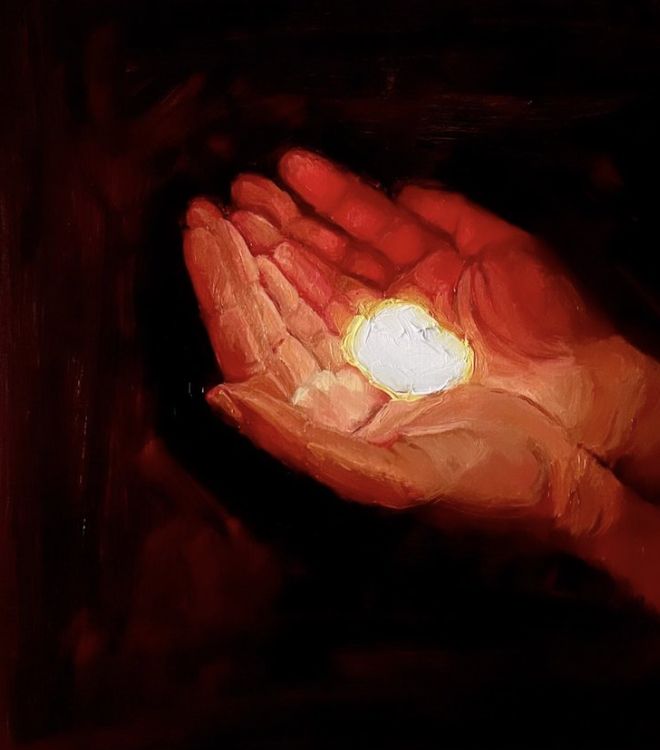
The word hope appears, at first glance, to be very small, written with only a few letters, but its power is immense. In the society in which we live today, understanding this word and feeling its necessity in our lives has become extremely important. We live in an age of comparison: some want to surpass others in education, some in wealth, and others in fame. To fulfil these desires, a person makes every possible effort and struggle. If success comes, waves of happiness follow; if defeat occurs, despair surrounds the person.
Especially in our times, it is vital for every student to understand the importance of hope. When a student sits for competitive examinations, such as the UPSC, NEET, UGC-NET, or any other government service exam, he or she works hard throughout the year with the hope of success. But when success does not come, many begin to think that everything has ended. As a result, we hear and witness thousands of tragic incidents of suicide. If, after a temporary failure, a student holds firmly to the cloak of hope with patience, that despair can transform into optimism, helping them continue living and persevering in sustained struggle. Therefore, it would not be inappropriate to call hope one of the greatest assets of a human being.
Thus, if a person places trust and reliance in their Lord and keeps in mind that even if the entire universe were to unite to give something, it could not give it unless Allah wills, and if it were to take something away, it could not do so unless Allah wills, then hope should be placed only in Allah. Reliance upon Him neither weakens a person’s resolve nor allows it to break. With this hope, a person remains hopeful and thinks that surely one day all their affairs will be set right, and the journey of their efforts will reach the beautiful destination of results. In reality, this is the very force that strengthens our resolve and reinforces our certainty, comforting us in every sorrow with the assurance that one day everything will be fine.
In his powerful essay, Umeed ki Khushi, Sir Syed Ahmad Khan (1817-1898) sketches hope with a very beautiful example. When a child sleeps in a cradle, and the helpless mother, who must earn a livelihood for the child’s upbringing, goes out carrying the child with her, her hands remain busy with work while her heart stays with the child. As she sings a lullaby, she says:
“O my child, sleep peacefully. May no trouble ever come upon you, may no hardship befall you. May you never have to endure the difficulties and trials that your parents have endured. May your fame exceed that of your father. May your love bring peace to our hearts. May your laughter and chatter illuminate our dark home. O lamp of our hopes, may your sweet words soothe our hearts.”1
Through these words, a mother expresses her hope that when her child grows up, he will be adorned with the qualities she desires and will traverse the paths of success and prosperity that she sincerely wishes for him. In this hope, she forgets the hardships and troubles of today. Thus, that weak yet hopeful mother spends a long stretch of her life in anticipation that one day the dark clouds of grief and hardship will disappear, and she will surely receive the reward of her efforts in the form of her son becoming a successful human being. That very thing is hope.
It was hope that sustained Prophet Ya‘qub (alyhis-salam), after the separation from his beloved son, Yusuf (alyhis-salam) when he was thrown into a well and subsequently sold by his brothers. With this hope, Prophet Ya‘qub (alyhis-salam) spent a long portion of his life. Although his eyesight faded as tears flowed from grief and separation, the cloak of patience and hope never slipped from his heart and hands. Ultimately, his patience and hope bore fruit, and God restored the light of his eyes in the form of his dear son.
Hope and trust in Allah were also the companions of the innocent Yusuf (alyhis-salam) in that dark well into which he was cast after brotherhood and fraternity were torn apart. With hope, despite his innocence, he endured the hardships of imprisonment. In the end, Allah the Almighty not only delivered him (alyhis-salam) from the darkness of the well and the trials of prison, but also granted him knowledge and wisdom and honored him with the seat of authority as the ruler of Egypt.
This is one such manifestation of hope from the Qur’an and there are many such shining models of hope are found in the Qur’an. The lives of the Prophets (alyhimus-salam), the Companions, and every successful person, we learn the same lesson: no matter how difficult the circumstances seems to appear, and even if the storm of temporary failure attempts to shake the structure of our resolve, we must not allow our determination and courage to break. Rather, while continuing our struggle, we must move forward through the perilous valleys of life with hope and expectation for success and salvation.
Regarding the temporary nature of grief and hardship, their eventual end, and the need to keep the flame of hope alive, the poet Faiz Ahmed Faiz (1911-1984) wonderfully said:
ye fasl umīdoñ kī hamdam
is baar bhī ġhārat jā.egī
sab mehnat sub.hoñ shāmoñ kī
ab ke bhī akārat jā.egī
khetī ke konoñ-khudroñ meñ
phir apne lahū kī khaad bharo
phir miTTī sīñcho ashkoñ se
phir aglī rut kī fikr karo
phir aglī rut kī fikr karo
jab phir ik baar ujaḌnā hai
ik fasl pakī to bharpāyā
jab tak to yahī kuchh karnā hai
This season of hopes, my friend,
Will be ravaged again this time.
All the toil of mornings and evenings,
Will once more go in vain.
In the corners and furrows of the field,
Mix again the fertilizer of your blood.
Water the soil again with tears,
And think of the coming season,
Think of the coming season.
When destruction must come again,
Even if one harvest ripened, what then?
So long as this is what must be done.
As Md Mursalim eloquently observes in his article published in The Companion, hope and power are deeply intertwined: “Holding onto hope is what gives us the power to move toward the goal we wish to achieve. Losing hope equates killing oneself in one’s own hands. A person who has iman in Allah, the Everlasting, cannot entertain losing it.”
Indeed, despair has no place in a faith-rooted worldview. This truth is profoundly articulated by Allama Iqbal, who presents hope as an essential link between the believer and God:
Na ho nā-umīd, nā-umīdī zawāl-e-ʿilm-o-ʿirfān hai,
Umīd-e-mard-e-muʾmin hai Khudā ke rāzdānon mein.
(Despair not, for despair marks the decline of knowledge and gnosis;
The hope of a true believer resides among the confidants of God.)
(Bāl-e-Jibrīl, p. 139)
References:
1. Maqalat-e-Sir Syed (Urdu), Vol 15, p.
2. Nuskha Hai Wafa (Kulliyat-e-Faiz) (Pg. 282) Publication: Educational Publishing House (2009) Edition: 2009