

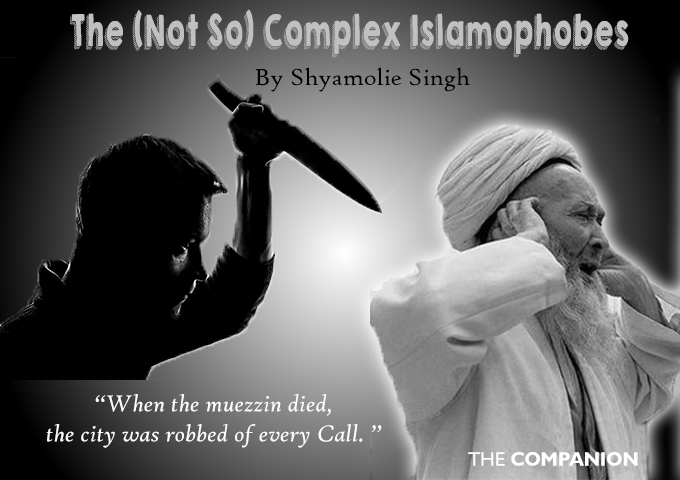
When the muezzin
died, the city was robbed of every call.
The houses were swept about like leaves
for burning. Now every night we bury
our houses—theirs, the ones left empty.
We are faithful.
–“The Country Without a Post Office”, Agha Shahid Ali
Over the past few months, many of us have come across many attempts by activists across the spectrum of the left and even those identifying themselves as liberal who talk about many issues affecting Muslims. For the purpose of this work, I draw the time frame of this from the events of #Notinmyname to the latest, deeply upsetting killing of the muazzin (the one who offers azaan) of the Noorani Masjid in Rajahmundry, Andhra Pradesh by the unknown assailants, who also desecrated the sacred space of the Masjid and defiled copies of the Qu’ran. For many of us with a deep skepticism that we have towards most sections of the left and liberal political activism, it has been a complicated interaction. Many groups have spoken, repeatedly, of Muslim issues, but what vocabulary do these groups and individuals use? These questions are not new – in any sense of the word – and they have been raised time and again by Muslim activists and organisations. Whether it is in the movement for Najeeb, for Hadiya, against the discourse of love jihad, for self-respect, for Muslim presence and politics in these-so called universities of excellence – these questions have been raised time and again. Many times, these questions have been dismissed as products of “identity politics”, as the products of those of us unwilling to understand solidarity, and even as a sign of ingratitude towards those who are speaking out about Muslims. This can be remembered from the statement Aditya Nigam, professor at Centre for the Study of Developing Societies (CSDS), New Delhi, and a self-professed activist (for 20 years) had made in the light of some of the critiques aimed at left liberals for their shallow politics – “If there hadn’t been these cussed left liberals, Muslims would have had none but themselves to defend themselves.”[i] Or even, in a different context, of a professor in Jawaharlal Nehru University, who opposed criticisms aimed at many savarna professors and the entire structure of the exclusionary administration by claiming that he had been marching for Mandal before any of these students had been born. Clearly, there is a demand for gratitude (and servitude). As Simple Rajrah put it so sharply in her piece, thanks, but no thanks[ii].
And that demand will continue to be rejected. Clearly, the Muslim as discursive object of study is a very popular subject right now. And it always has been. Whether on the subject of sexuality, or through the lens of security, through the lens of terror, or through the lens of the state, there has always been an attempt to categorise, discipline, and produce many forms of “the” Muslim for the purpose of power. Violence then, has existed at all levels, epistemic, physical, social, mental, emotional and political. Sometimes, this is hard to define, and it is hard to point out what is discomforting about a certain depiction, or about the vocabulary used.
Take the case of a recent QueerFest that was organised. While the Fest itself contained an interesting variety of conversions around caste, sexuality, occupation, and had a few Muslim voices, including from Palestine and Kashmir, who called occupation, violence and pinkwashing, there had been an interesting debate that had preceded the actual Fest, when the posters were released. There were a set of posters that had been made of many of the landmarks of Delhi, with the rainbow splashed them. One of them was the Jama Masjid. While some defended it as an “iconic” representation of Delhi, as any other landmark that was being represented, the Jama Masjid is not any other landmark in Delhi. As Huma Dar, and Gee Semmalar asked, how committed were most of the sections of the queer movement to actually taking themselves and others to task for their anti-Muslimness, and the erasure of Muslim voices, and the refusal to engage with Muslim movements (which are automatically deemed homophobic and transphobic, no matter what they do)? Was this event going to talk about, as Dar put it, deconstructing the “Muslim-as-fetish”, the appropriation of “Islamicate tropes”, with little or no conversation or concerted attempts to talk about the saffron washing and homo-nationalism involved in much of the queer movement’s association with Hindu imagery and upper caste politics. As Ghazala Jamil has also pointed out in her book, Accumulation by Segregration, while there has been an increasing consumption and museumization of some parts of Delhi, like Old Delhi, there is no substantive, or genuine conception of citizenship available to Muslims in this country. While the “culture” is often consumed as heritage by the upper-caste, upper class elite of this city, they continue to deny housing, rights, space, equality and freedom to actual living, breathing Muslims who wish to inhabit it.
So – we are not merely talking about Islamophobia as erasure, Islamophobia as silence, Islamophobia as absence. We are also talking, particularly in this context, of production. In the months after the lynching of Junaid in a train near Ballabhgarh, there have been quite a few voices, including those who identify themselves broadly on the left and some others who identify as liberal, who have spoken about this apparent pandemic of anti-Muslim violence. Not in My Name is only one such example. Many student organisations, even those with a history of concerted violence against Dalit and Muslim students, like the Students Federation of India, have come out and spoken up against anti-Muslim violence. And this is what interests me. In the light of Afrazul’s publicly viewed killing, many groups, ranging from the liberal to the far-left spoke about Afrazul. And this is what interests me, and makes me curious. How was Not in My Name, or these condemnations and presence at protests in the city even possible, considering many of these very people have held and continue to hold distinctly anti-Muslim views, predominantly Hindu views, and a distinct fetish for secularism primary in their lives. How were these two things being reconciled?
I argue that this was done precisely by producing the “lynching” as something outside of structure – as something that could either by opposed by a useless law like the MASUKA, or as something that one could be rid of, like a speck of dust off our clothes – and something that was not a direct production of Hinduism itself. One can “condemn” Afrazul’s murder, one can condemn lynching and one can claim that it is still not in your name, only if you do not see yourself in a hierarchical relationship to the entire structure behind this event. The lynching becomes something that has nothing to do with the fact that you follow Hinduism – a religion based purely on caste and exclusion; it becomes nothing to with the relationship Hinduism has with Islam (and not just with Muslims, and I will come back to this point shortly); it becomes something you can disconnect with because you are secular.
You produce the lynching – and share the images endlessly to add to it – and you are only comfortable with engaging with the dead Muslim, the lynched Muslim, the Muslim you can theorise, not ones who will define their own lives and politics. This is why this contradiction can continue: why people who demonise Islam in their everyday politics, who oppose Muslim politics, who speak the language of “competing communalisms”, who say “no to Islamic fundamentalism, no to terror”, who will attempt to criminalise even phrases like Insha’Allah, these very people can comfortably extend their solidarities to Afrazul, to Junaid, to Pehlu Khan. This politics of solidarity is complex to tackle, but also exceedingly hollow. Fascinatingly, in the true tradition of appropriation and erasure, Islamophobia itself has been turned into an industry for the majority of the left and the liberals in India who can use it to wipe themselves clean of any complicity. The moment that is over, normal life resumes. There is a need to remind them that, as Waseem RS wrote, “As Muslims, we refuse to live in the cocoon assigned to us by the left.”[iii] Nobody wants the definitions, the contours assigned to our politics by the left.
The contours ask for a politics devoid of sentiment, of any sort of connection. You may call it identity politics – or narrow, or all of the above. But for many of us, the sharing and re-cycling of the videos of Afrazul were a deeply personal, and traumatic thing. The language of rationality, of impartiality, of going beyond and transcending one’s identity – perhaps many of us are too sentimental for this kind of transcendence. For many of us, politics is a fuller thing – where the neat divisions of public and private, the imposition of the secular over the religious, identity and ideology do not hold easily. The industry of clinical solidarity has no space for all this.
Also read Tracking left unity in JNU on how not to fight fascism
And returning to the point I raised above – this distinction is made by many of these performances of solidarity politics where they are willing to extend solidarity with (some) Muslims, they continue to villify and attack Islam. And they continue to speak the language of a secular politics that has no space for many of us who have no interest in speaking that register. For those of us who have no interest in the division of the public sphere as devoid of religion and the private where religion may be allowed; for those of who see the violent, exclusionary history of secular politics in India, this kind of selective solidarity and appropriation is unwanted. What kind of artful performance is it, to extend solidarity and support to certain victims you deem appropriate, while continuing to secretly hope for the ban on what you call fundamentalist, extremist organisations? What kind of twisted politics is to defend the right of Hadiya as an “adult woman”, while also misrecognising her right to follow Islam and throwing doubt on the motives of Shafin Jahan? Yes, we do identity politics, because the case of Hadiya affected some of us deeper than we would ever admit. Perhaps, our politics is full of haphazard connections and reactions; perhaps, for us, Hadiya was not just a “symbol of women’s autonomy” as she was to you[iv], but someone whose faith affected our own, someone whose determination to hold onto her belief has given so many of us hope.
Two days ago, the muazzin of Noorani Masjid in Rajahmundry, Mohammad Farooq was killed by unknown assailants. In the never-ending database of violence, this is all his death would be reduced to: his name, the city, the time, the date. A serial number, to round off 2017. But it was a deeply violent, symbolic act as well. The literal silencing of the call, the desecration of the space, the burning of the Qu’ran: how would you speak of this in the dead, secular register of your solidarity? Where would you even begin to speak of it? How?
References
[i]https://www.facebook.com/aditya.nigam.52/posts/1397324583680206
[ii]http://thecompanion.in/dear-left-comrades-thank-allies-now-leave-us-alone/
[iii]http://thecompanion.in/islamophobia-left-muslim-solidarity-politics-matters/
[iv]https://www.facebook.com/scroll.in/videos/1635501496532724/