

One of the biggest challenges of post-colonial India was to annihilate the caste frameworks and its subsequent societal orders, which were well established within its population. Of multiple initiatives taken, the Mandal Commission recommendations and their implementation were one of the critical junctures in India’s social justice revolutions. The academic ‘agraharas’ in the country witnessed the influx of students from the lower sects of the population and challenged the Brahmanical status quo in state-owned academic institutions. Well, The English & Foreign Languages University, Hyderabad, or in short, EFLU also has a similar story to share. “The ick was very evident in the faces of the upper castes, who used to ‘guard’ the institution as an abode free of outcastes when our people started to get admission.”, says one of the initially admitted SC students of EFLU. From electing a Muslim candidate as their first Union President back then and now, a candidate from a Telugu tribal community, EFLU Hyderabad has a legacy of a Dalit-Muslim fraternity that’s worth documenting.
In 1966, the Indian constitution was revised to extend the reservation policy for 20 years. Protests against reservations began in India that same year. When the V.P. Singh administration accepted the Mandal Commission report in 1989, these anti-reservation movements acquired significant traction. The Mandal Commission debate has ushered in a new political era for Dalits and other marginalized groups, including Muslims. The socio-political empowerment of Dalits, Muslims, and OBCs in this nation, made possible by the post-mandal politics was always unthinkable for the RSS and its other factions. Like any other campus in the country, the EFLU also witnessed the oppressed joining hands against the dominant Brahmanical temper. Initially, a deemed university, CIEFL (Central Institute of English and Foreign Languages) got central university accreditation in 2007 and became EFLU, the campus was chosen by students from all backgrounds including OBCs, SCs, and STs. This influx transformed the university spaces into a politically aware and charged arena. While student politics flourished with students from lower castes taking the lead, the administration that used to be an elite-Savarna, hassle-free atmosphere started to curb it colluding with right-wing student groups within the campus.
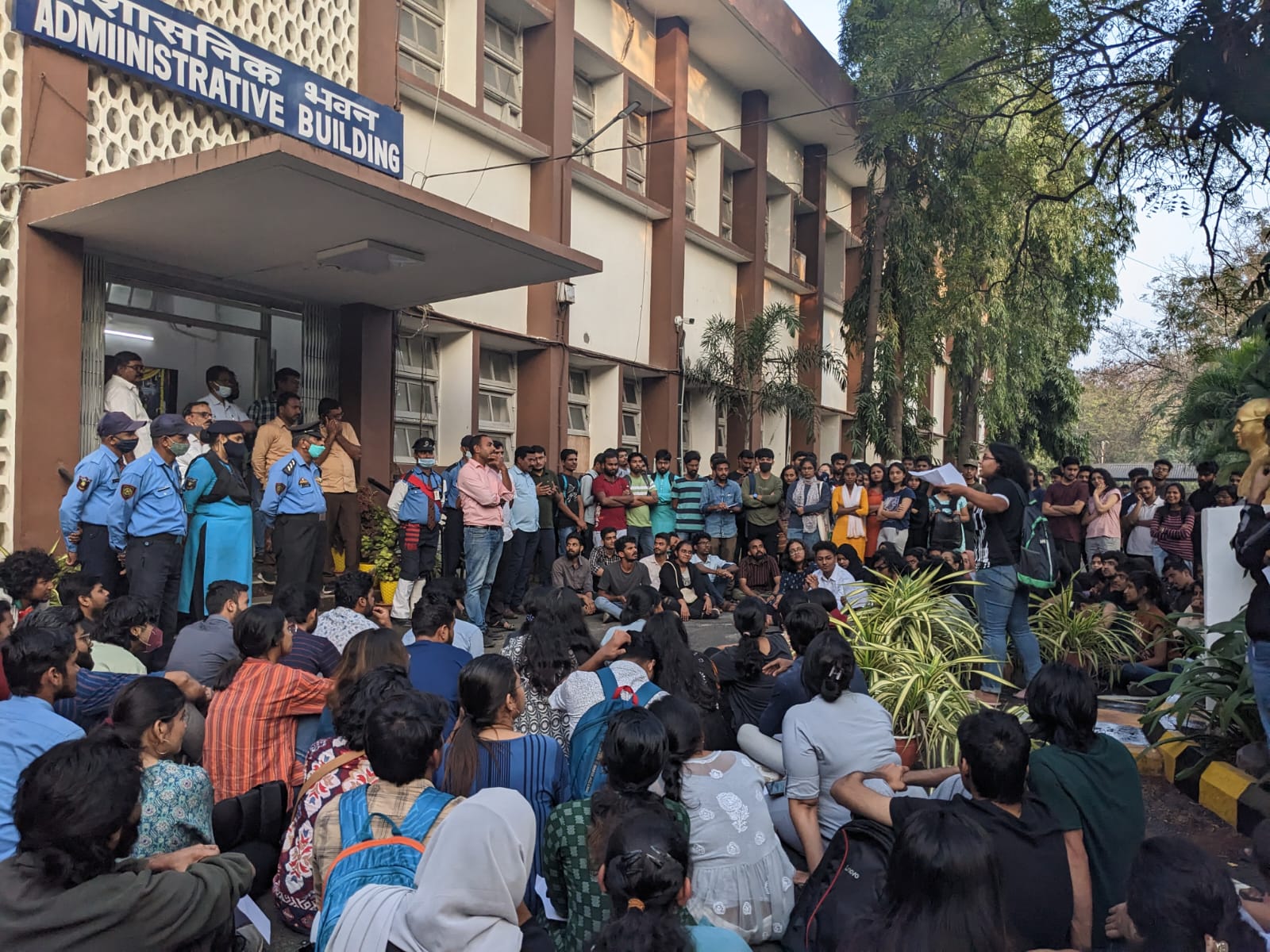
EFLU’s political legacy is very close-knit with that of Osmania University. Former EFLU students recollect giving asylum to their OU compatriots during the rampant police raids while the Telangana Movement was at its peak. Both campuses were at the forefront of representing the marginalized voices of the country and raising relevant political questions. The 2012 OU-EFLU beef fest is just one such event among the long list of political dissent. The “Chalo EFLU” was another movement initiated by the EFLU students, a consortium for SC/ST/OBC/Minority students against academic discrimination. The students orchestrated a movement wide enough that students from other universities in the state marched to the campus in solidarity with the unfairly rusticated students of EFLU. Mudassir Kamran, a Kashmiri PhD scholar was institutionally murdered by the administration in 2013, and the campus was in turmoil with sit-in protests and outrages that lasted for weeks. The students brought in different social activists and speakers to address the issue.
Recently EFLU hit the headlines again with a raging student uprising seeking justice for a fellow student, who was sexually assaulted within the campus premises. The protest even led to an indefinite hunger strike which forced the VC and proctor to resign and announce the student union election that was not conducted since 2019.
As said earlier, the dissents were welcomed by the administration with hefty repressions and ‘disciplinary’ actions. A research paper titled “Dalit Counter Public and Social Spaces on Indian Campuses,” studies how political activism on three significant Indian colleges waned after 2013 and EFLU is one of the universities that the paper’s author, Kristina Garalytė, a professor at Vilnius University in Lithuania, discusses. Several EFLU students add to Kristina’s points in the publication by pointing out that the university’s leadership has historically suppressed criticism and does so through a variety of devious tactics.
The EFLU administration was known for its ‘show-cause’ intimidation tactics where students got show-cause notices for sticking posters around the campus. The administration even went on to send a copy of the notice to the students’ house from fake addresses as well. Another feat of the administration was to involve state apparatus like the police in simple cases that the administration could resolve with ease. Mudassir was one of the victims of this act by the administration. The EFLU administration took this attitude to the next level when they complained with serious allegations of communal incitement resulting in OU police charging nonbailable sections on the students. The students are still fighting in court against the administration.
This repressive attitude never succeeded in dampening the morale of the students in any way. The recent student union elections did assert the same. The 2024 student union election, one after 5 years of no elections witnessed an inspiring political movement where political parties of Dalit-Muslim communities come together under one banner (INSAF-Inclusive Students Allied Front). While it was TSA, SIO, DABMSA, and SFI against the saffron heads back then, this time with SFI exited the alliance, spurring their typical Islamophobic and fundamentalist labels, the alliance was led by TSF, Fraternity Movement, MSF, and NSUI. The alliance clean-swept the union with a Dalit President and Joint secretary. The union also had 2 Muslim women as the General Secretary and Vice President. The mandate clearly sent out the message of how Dalit-Muslim solidarity is the answer to the fascist Hindutva forces of the country. The result also pointed to the fact that the ‘red left’ parties are not only an unnecessary burden but also a menace to the Bahujan politics of social justice. The 2025 student union election also showcased the same politics where TSF’s Dalit President candidate and Fraternity Movement’s Muslim Joint secretary were elected. NSUI maintained their sports secretary seat with a Muslim candidate this time.
The increasing stakes of Dalits and Muslims in central universities were always a concern for the Savarna state. These mandates did indeed stand tall, disturbing the Savarna mindsets of the academia. Not for so long, as the central government brought in its machination to curb these rightful assertions of academic spaces by the Bahujans of the country.
The first stroke was the CUET imposition over all the institutions in the country. The CUET exam patterns induced the saffronisation of campus spaces rapidly, complimented by the NEP reforms. Hindutva agendas were officially carried out without any hindrance through government-sponsored programs. The violence perpetrated by the Sangh Parivar against Dalits and minorities on the streets of the country was increasingly reflected in university spaces. The ABVP violently gained strength. However, Muslim, Dalit, and Left organizations continued to resist these dominant discourses with rebellious voices. Scrapping DACE and MANF, both introduced for the upliftment of Dalit-Muslim students also fastened the process of eradicating the Bahujan populace.
All these attempts are resisted through the cultural assertions challenging the dominant Brahmanical festivities and poojas. The Muslim community of the campus conducts Grand Iftar and Eid Prayers within the campus spaces, spreading the message of fraternal politics. Malayalis conduct Onam by doing away with its casteist shades and conducting discussions around its political motivations. Regional cultures and festivals are conducted challenging the homogenizing caste-based rituals and commemorations. But the administration’s bias can be clearly understood while they allow casteist festivals in office and ‘restricted’ spaces on the campus, allowing speakers which blares “mandir wahin banega” but unnecessarily indulge and stop academic discussions, study circles, and other Dalit-Muslim rejoices.
EFLU Hyderabad stands as a microcosm of India’s ongoing battle for social justice and equality. From its inception, the campus has been a battleground where marginalized communities, especially Dalits and Muslims, have asserted their presence and resisted the Brahmanical dominance entrenched in academia. The university’s political landscape has been shaped by its students’ unyielding spirit, challenging systemic oppression through collective solidarity and cultural assertions. In these turbulent times of hate, the political movements and projects at EFLU show how campuses can remain bastions of democracy and dissent against oppressive forces.

What an ARTICLE!!! I really appreciate Mr. Harshad and Mr. Rishal, on even having the guts to speak without any filters. I myself am a dalit-muslim student from Solapur, Maharashtra, currently studying in 12th(Science). I recently discovered about EFLU and it’s ample resources. Facing backlash only because of my ethnicity and the reason that I belong to 2 communities, both of them being in sociopolitical rivalry with the saffron flag, I started researching about EFLU to pursue my dream of studying literature from a prestigious university. But after some excavation, I think my dream might never be fulfilled. I thank both of you to bring this up to me and the world. It takes courage and truthfulness to stand against a whole current of people… But now I do need a suggestion, should I consider EFLU for my UG-PG???