
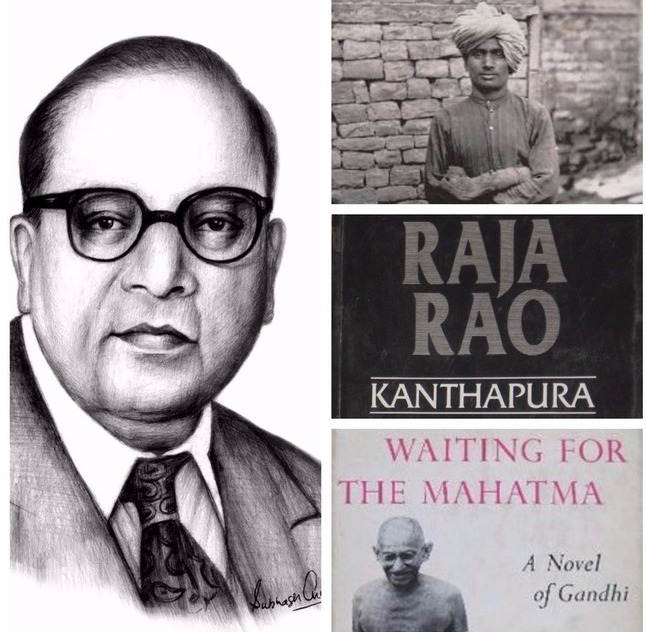
The prominent early twentieth century English novels from India are historical fictions which have the nationalist struggles in their background. The novels considered to be more significant ones are obviously Kanthapura (1938) by Raja Rao, Untouchable (1935) by Mulk Raj Anand, and Waiting for Mahatma (1955) by R.K. Narayan, otherwise called ‘Mahatma Novels’. These three novelists Raja Rao, Mulk Raj Anand and R.K. Narayan are called the trinity of the first flowering generation of Indian English fiction. Here I am trying to analyze how their novels nullify the possibilities of a non-nationalist narrative of the Independence struggle.
Nationalism and its metanarrative subsume the divergent voices into its fold on the imagined basis of ‘shared history’ and ‘national unity’ and relegates the minoritarian differences as agents of colonialism. As Benedict Anderson puts it, “Newspapers and Novels are the major propagators of nationalism”.[1]
The so-called Gandhi/Mahatma novels Untouchable, Waiting for Mahatma and Kanthapura are aware of the limitations of Gandhism and thus envision a nationalism by resolving the disillusions with Gandhian nationalism by bringing in Nehruvian socialist ideologies and accepting technology without compromising the ‘Indian traditional values’. But again they are very much situated within the Gandhian aspirations of nationalism. Dr. B.R Ambedkar who had an alternative political perspective for empowering the Dalits with separate political representation is nowhere in these novels, which are on the other hand not much contented with Gandhi. Snehal Shingavi tells how the Gandhian and left socialist politics worked in vain for the goals of erasing casteism, “Gandhi’s paternalist solution offered the untouchables temporary moral relief but left varnashrama and caste prerogatives relatively intact, while the left-wing’s economic determinism, which argued that nationalism would lift all economic boats, had no specific plan for the untouchable future. And even though the moderates and the left were convinced that caste-based discrimination had to be ended and had themselves engaged in social activism to that end, neither had a coherent plan that it could implement and neither was willing to open a rift with the orthodox right wing to defend the principle of equality. And more to the point, none were able to convince substantial numbers of untouchable political activists that their plan could produce the desired end[2].”
David Arnold[3] in his book titled “Gandhi” analyses the power profile of Gandhi and how Gandhi had used his immense popularity among Indians in making Ambedkar sign the Poona Pact in 1932 and thus remove the chances of political empowerment of Dalits in India through separate political representation. The question is about the violence of non-violence. Gandhi aware of his popularity was going on a strike until death and Ambedkar was very much aware of the consequences of probable death of Gandhi and how India would react to Dalits and attacks against Dalits on the issue had already begun. Wasn’t Gandhi coercively convincing Ambedkar by threatening with his own life, thus not only narrowing the destiny of Dalits, but also violating the ideals of Gandhi’s own Satyagraha and ahimsa – peacefully persuasively convincing the enemy/oppositioner of the truth? To be read together with this is the tale of Palwankar Baloo[4] who was a Dalit, highly talented and enthused in cricket, but was denied batting and even team captainship due to his caste status. Baloo, always socioculturally destined to bowl for the upper caste and foreign batsmen, was a major figure in convincing Ambedkar to sign Poona pact along with MC. Rajah. In October 1933, Baloo contested to Bombay Muncipality but lost election as his opponent was a high caste Hindu, highly favourable.
Let’s come to Mulk Raj Anand’s Untouchable. It’s the tale of Bhaka an untouchable who does scavenging in the colonial India and lives through everyday’s casteism. Bhaka, who is respectably different from ‘his own lot’, after the epiphanic moment of realizing his ‘self’, the omniscient narrator tells us, listens to Mahatma’s speech and gets enthralled by being addressed as ‘Harijan’ and knowing that a Brahmin scavenges in Sabarmati Ashram. Yet he is confused of Gandhi’s remarks like ‘all jobs are equal’, ‘scavenging is service, cleansing Hindu society’, ‘Harijans should give up alcohol, meat and adapt to Hindu cleanliness’. At the end from the talk of Iqbal Nath Shershar, Bhaka is hopeful about the apolitical solution of technology, “the Flush system” which can liberate the scavengers. It is obvious, that the absence of Ambedkar in the novel is not incidental, rather deliberate as the Dalit movements under Ambedkar were already active by then. Especially in a book titled and themed untouchable, the Dalit leader Ambedkar who was very much critical of the Gandhian rhetoric of anti-untouchability, envisioned annihilating caste through a political, social, cultural, social, spiritual project, is not merely absent rather made invisible. Anand’s letters on India give a glimpse of his politics and how he viewed that Indian National Congress has the exclusive authority to speak on the behalf of the whole India including the minorities and how he thought that separate electorates will damage the unity of India[5].
Why did Raja Rao choose a Muslim character for a policeman who constantly surveils on the nationalist struggle in Kanthapura and who unlike the other Hindu villains is portrayed using bestial images like He ‘growl[s],’ ‘prowl[s],’ is a ‘bearded monkey,’ a ‘bearded goat,’ a ‘dog,’ and so on. All the political activities are taking place inside the temple and the pariahs, hindu and Muslim characters are outside this parliament. Considering that Kanthapura has always been metaphorically analyzed as the microcosm of India, isn’t Raja Rao constructing an image of India which is Savarna? Is a multi-religious, de-casted India/Kanthapura possible?
The acceptance of difference, and the inherent social heterogeneity are always feared to fragment the nation. This fear of minority comes out in the form of the embodied villains of Badekhan in Kanthapura and solely Hindu Indias – Hindu nations or rather savarna Kanthapuras and savarna Malgudies. Murthi the protagonist, who is in the forefront of building the temple and nationalism in Kanthapura is the ‘Guru’ of the Pariahs as well. Delighted of the ‘touchable’ treatment Pariahs joins the national struggle. Likewise, Anand’s untouchable characters lack the political consciousness, as historically seen in the forms of Sweeper’s Union 1928, Depressed Classes Movement of Ambedkar, the Gandhi novels though aware of the limits of Gandhism, turns a blind eye towards Ambedkar, indicative of not only the sociological subjective caste positions of these authors, but also how historical fictions create a literary memory of national struggle which only reflects one-side of the nationalist struggle. Rumina Sethi[6] in Myths of the Nation remarks on the same as how historical fictions use the loophole of being fiction, yet create historical narratives thus memories, of a struggle which was highly heterogenous as the nation is, into a homogenous narrative which is nationalist and making the marginal voices and leaders like Ambedkar invisible.
[1] Anderson, Benedict. Imagined Communities : Reflections on the Origin and Spread of Nationalism. Verso Books, 1991.
[2] Shingavi, Snehal. The Mahatma Misunderstood: The politics and forms of South Asian literary nationalism. Anthem Press, 2013.
[3] Arnold, David. ” Gandhi” Routledge, 17 June 2014.
[4] Guha, Ramachandra. A corner of a foreign field: the Indian history of a British sport. Picador, 2002.
[5] Anand, Mulk Raj. Letters on India. Routledge, 1942.
[6] Sethi, Rumina. Myths of the Nation, National Identity and Literary Representation. Oxford University Press, 1999.