
The Holy Qur’an serves as a crucial book of guidance from Allah Almighty for all of humanity. According to the Holy Qur’an, previous nations were also provided with various divine books from Allah. However, a consistent reality emerges – no prophet in the language of the Holy Qur’an escaped opposition from their people. They were often branded as magicians or liars, leading to the rejection of their words and the neglect of their teachings by their entire nation.
Muhammad ﷺ was sent as the final messenger by Allah, upon whom the last book was revealed, the Holy Qur’an. He was acknowledged as a benefactor for all worlds, and this sacred text serves as a tangible expression of divine mercy. Following Muhammad ﷺ, the responsibility of upholding and understanding this divine guidance fell upon those who believed in Allah and His Last Messenger ﷺ.
As time progressed, however, the Muslim Ummah distanced itself from the Holy Qur’an. While the need for translations or commentaries lessened for Arabic speakers, conveying the essence of the Qur’an to those unfamiliar with its language and historical context became essential. Remarkably, this task materialized after a significant passage of time.
In the Indian subcontinent, where various translations of the Holy Quran can be found, the credit for the first complete translation goes to Shah Waliullah Dehlavi RA*. He undertook this task in the Persian language, while his son, Shah Rafiuddin RA, provided a literal translation. Additionally, Shah Abdul Qadir RA translated it into the Urdu idiom.
There was a time when the Quran alone sufficed for understanding its contents, and people diligently read and comprehended it. However, with changing times and the encounter with other nations and their sciences, the focus of Muslims shifted. This marked the period when the Islamic world began work on the principles of the Quran and Hadith. Jurisprudence and Shariah were in the early stages of development, but little did anyone foresee that these new sciences would divert attention from the Quran’s original central position. Consequently, various Islamic governments engaged in work on jurisprudence and other sciences, yet they failed to maintain the Holy Quran as the primary axis.
As the Holy Quran disappeared from its original central position, a natural consequence was the weakening of our connection with our Lord. A phase ensued where people prioritized rulers over the Lord, attaching undue significance to rules and laws crafted by them. Thus, there came a time when we veered away from the path of the Lord, losing our direction in the process.
It was during this period that irrational practices gained momentum—the door of contemplation and ijtihad was shut, leading us further astray. Simultaneously, a disconnect from God emerged, and certain individuals were perceived as close to Him, marking the onset of a new era of Sufism.
It is not surprising that those distant from God, who can afford to cease critical thinking and opt for imitation, also find themselves distanced from Deen. Examining the history of the 14th and 15th centuries clarifies the extent to which we drifted from these fundamental aspects. Religion, in the current era, has been reduced to mere customary expressions, severed from its connection to the individual, society, and the broader systems of politics and economics. Thus, a new world has unfolded.
This transformation spans not a mere one or two days but a journey of a thousand years. It didn’t occur due to any singular individual or specific government but resulted from prolonged periods of detachment from the Qur’an. When Muslims realized that proximity to the Qur’an holds the key to eternal salvation, it sparked a resurgence of attachment to the Holy Qur’an everywhere, initiating a movement of revival.
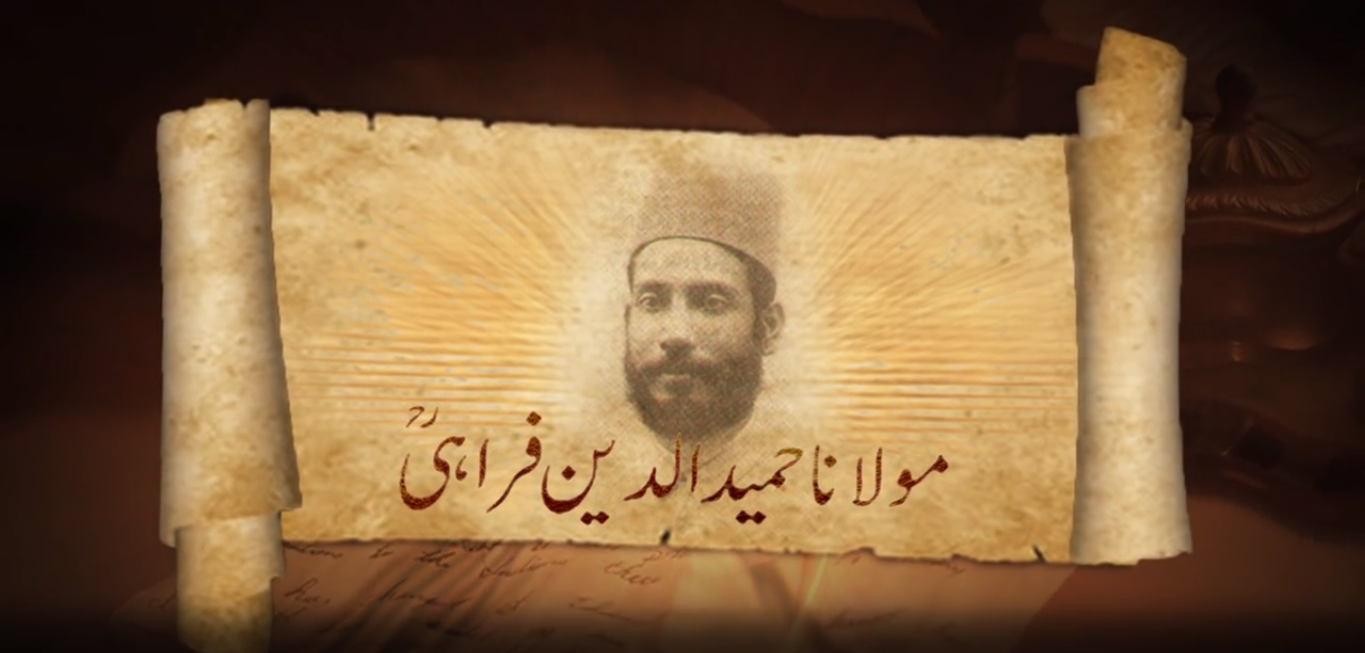
Imam Farahi RA and His Contributions
Imam Hamiduddin Farahi RA (1863-1930) was born in Phariya, a village in the Azamgarh district of Uttar Pradesh, India. He passed away on November 11 in Mathura, where he was laid to rest. His maternal uncle and teacher were the esteemed Allama Shibli.
Imam Farahi RA dedicated his life to the study of the Holy Quran. His every aspiration revolved around this sacred book, and a substantial portion of his life was devoted to its comprehension. Although he did not produce an extensive body of written work, what he did write was remarkably comprehensive. Dr. Enayatullah Asad Subhani describes him as a philosopher, orator, excellent writer, and poet proficient in Arabic and Persian. Yet, all these facets, according to Dr. Subhani, were secondary to Imam Farahi RA. The true essence that dominated his heart, mind, and actions was the Quran itself (1).
Imam Farahi’s RA accomplishments are numerous, though a comprehensive discussion of all of them is beyond the scope of this brief overview. To gain insight into his work, we will categorize it into four main parts.
- Connecting Man to the Book of his Lord:
During the era of Imam Farahi RA, several scholars were not only comprehending the Holy Quran but actively promoting its understanding. Figures such as Shah Waliullah Dehlavi (1703-1762) in India, Muhammad ibn Abd al-Wahhab (1703-1792) in Arabia, Bediüzzaman Said Nursi (1877-1960) in Turkey, and Muhammad Abduh (1849-1905) in Egypt emphasized the significance of the Holy Quran. They presented its teachings to the people, highlighting the importance of Sunnah alongside the Quran.
Imam Farahi RA similarly called upon people to engage with the Holy Quran and encouraged them to reflect deeply. Unlike being content with superficial understanding, Imam Farahi RA advocated for profound contemplation of the sacred text.
What sets Imam Farahi RA apart is his unique approach to the Holy Quran. He emphasized understanding all other aspects of life through the lens of this book, giving it a central and unparalleled position. This distinctive stance on the Holy Quran distinguishes him from others. During an era marked by religious oblivion and a superficial sense of it, Imam Farahi’s RA remarkable achievement lies in his call to the Holy Quran. He positioned it as the central axis, declaring it the pivot—a crucial accomplishment given the prevailing state of religious practice and understanding.
In his commentary on Surah Kausar, Imam Farahi RA articulates, “Religion rests on the foundation of sound knowledge and action. Knowledge entails recognizing our Lord, understanding our relationship with Him, and steadfastly maintaining this awareness. Such knowledge naturally instills a sense of love and gratitude in the heart, leading to corresponding actions. This interplay between knowledge and action mirrors the relationship between cause and effect, outward and inward, where knowledge corresponds to faith, and action aligns with Islam” (2).
“Our primary guide should be intellect, leading us to knowledge, truth, and subsequently righteous deeds… In essence, a person’s first source of salvation is his intellect, his most reliable companion. The second is knowledge, firm support for him, and the third is righteous action, guiding him to profound prosperity”
- Inviting towards Contemplation and Ijtihad:
Considerable time has elapsed since we sought the key to unlock the door of Ijtihad. Perhaps, we failed to locate it because we did not recognize the urgency for such a quest. We contentedly reaped the fruits of our elders’ labor. However, a time arrived demanding the breaking of this lock. New avenues of thought and contemplation needed unveiling, creating an environment conducive to intellectual exploration.
While the call to understand and act upon the Holy Quran is widespread, scholars typically fall short in urging contemplation, with their focus often leaning towards the pursuit of rewards. In contrast, Imam Farahi RA extended an invitation to every student to contemplate the Holy Quran. He advocated for basing our Ijtihad on the Holy Quran and deriving intellectual sustenance from it. Imam Farahi RA expresses, “Our primary guide should be intellect, leading us to knowledge, truth, and subsequently righteous deeds… In essence, a person’s first source of salvation is his intellect, his most reliable companion. The second is knowledge, firm support for him, and the third is righteous action, guiding him to profound prosperity” (3).
- Making the Qur’an the Center of Knowledge:
Even after Ijtihad, the significance of the Holy Qur’an remained confined to recitation and translation. While efforts were made to interpret it, the central position that this sacred book deserves was still elusive. Imam Farahi RA passionately emphasized this matter, both intellectually and practically. He recommended that Osmania University in Hyderabad be founded on these principles, and the foundation of Madrasat-ul-Islah mirrored the same ethos. Unfortunately, Imam Farahi’s RA ambitious project remains unfinished to this day. In the late 20th century, discussions on the Islamization of knowledge commenced, yielding some progress but falling short of completion. Yet, the centrality of the Qur’an sets it apart from all other endeavors. Further exploration is needed to determine how knowledge can be acquired with the Holy Qur’an at its core and who will play a pivotal role.
Does the Qur’an offer principled guidance, or does a comprehensive overhaul of the entire academic structure become necessary? Dr. Muhammad Enayatullah Asad Subhani notes, “Imam Farahi’s (RA) second distinctive characteristic is his assertion that the Holy Qur’an is the origin and axis of all Shariah sciences. His vision was for the Holy Qur’an to serve as the sun, with all religious sciences and Shariah forming its solar system. This solar system should continually revolve around the same sun, perpetually connected to it and deriving light from it” (4). For further details, refer to Imam Farahi’s Kitab al-Takamil fi Usul al-Taweel.
- Invitation to the concept of Nazm-e-Quran (Coherence):
The notable achievements mentioned above of Imam Farahi RA are interconnected and form an integral part of a broader vision. His aim was to draw people closer to the Lord through engagement with the Book of the Lord. He not only called for contemplation on this sacred text but advocated for a form of ijtihad grounded in the Quran. His desire was to advance the journey of knowledge in the light of the Holy Quran. The underlying foundation for all of this was his understanding of the concept of Nazm-e-Quran.
While there had been previous work on cohesion in the ayahs of the Qur’an, distinct from Nazm, Imam Farahi’s RA approach to Nazm-e-Quran was unique and groundbreaking. Regarding Nazm-e-Quran, he states, “Our goal in understanding Nazm-e-Qur’an is nothing but contemplation in the Holy Qur’an because this is the key to it, opening the way to guidance and piety, on which the entire religion revolves.” According to Imam Farahi RA, guidance leads to insight, and piety purifies the self. Faith, encompassing all fields of knowledge, is part of guidance, while laws, morals, and matters of the heart are part of piety. This fact has been made clear by Allah in the Holy Qur’an and the Torah and the Bible. The journey towards understanding Nazm in the Holy Qur’an commences with contemplating its very essence, leading the thinker to comprehend this systematic order. Every verse, even the smallest, prompts contemplation, guiding the thinker progressively higher until the complete unveiling of the verse, bringing to light the merits of the Surah, and revealing the wisdom that encompasses all knowledge and piety (Dalail Al-Nizam: 21) (5).
Imam Farahi RA not only discusses the complete order in the Holy Quran but also emphasizes the necessity of a similar system in a Muslim’s practical life. He underscores the intellectual aspect of Nazm, emphasizing its practical dimension. Subsequent scholars have further developed and expanded upon these ideas.
This brief discussion of Imam Farahi’s RA work does not encompass all his contributions. We encourage the readers to delve into his books to grasp the philosophy of Nazm-e-Qur’an and derive benefit from the Book of God.
*RA= Rahmatullah Alaih [May Allah’s mercy/blessing be upon him]
References:
1- Subhani, Muhammad E. A. “Allama Hamiduddin Farahi”. Hidayat Publications, pp. 20.
2- Farahi, Hamiduddin. “Tafseer Surah Kauthar”, Tafseer Nizam al-Qur’an. Daira Hamidyya, pp. 430
3- Qur’anic thoughts. Afadat Hamiduddin Farahi (F. Ubaidullah.Trans.). Daira Hamidiyah, p. 23
4- Ibid, p. 214
5- Allama Hamiduddin Farahi: Life and Thoughts, Farahi Seminar, Daira Hamidiya, p. 97