[On the Passing of Professor Khurshid Ahmad]
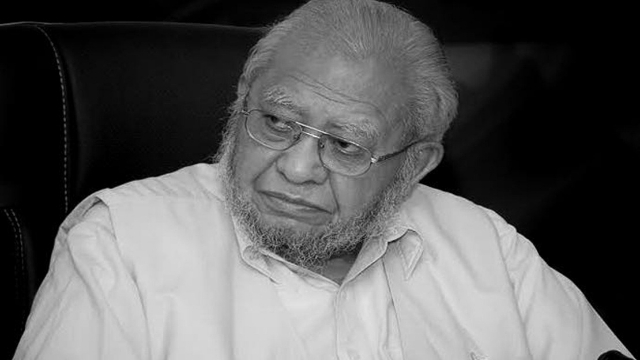
Just a short while ago, a sorrowful news was received from Mr. Saleem Mansoor Khalid, Sub-Editor of Tarjuman-ul-Qur’an, Lahore, that Professor Khurshid Ahmad has passed away. Inna lillahi wa inna ilayhi raji’un (Indeed we belong to Allah, and indeed to Him we will return.) He had been ill for quite some time, yet his insightful writings on contemporary issues continued to emerge consistently. Finally, his appointed time arrived, and he departed this world, presenting himself before his Lord with a legacy of invaluable services. Since yesterday, a meeting of the Majlis-e-Numaindegaan (Council of Representatives) of Jamaat-e-Islami Hind has been underway at its Markaz. After the Maghrib prayer, Ameer-e-Jamaat, Syed Sadatullah Husaini, conveyed this sorrowful news to the participants, and all prayed for him.
Professor Khurshid Ahmad was born in 1932 in Delhi. He earned a bachelor’s degree in law and completed post-graduate degrees in economics and Islamic studies. He became a member of Islami Jamiat-e-Talaba in 1949 and was elected its Nazim-e-Aala (national head) in 1953. In 1956, he formally joined Jamaat-e-Islami Pakistan and held various responsibilities within the party, eventually serving for a long time as its Naib Ameer (Vice President).
Professor Ahmad made significant contributions in the fields of Islam, the Islamic movement, education, politics, and especially economics. He attained international recognition in these domains and authored over 70 books in Urdu and English. In acknowledgment of his services, he was awarded the first Islamic Development Bank Award (1988) and the King Faisal International Award (1990). In 2010, the Government of Pakistan honored him with the Nishan-e-Imtiaz, the highest civilian award. He received several other international accolades as well.
In 1978, he was appointed Federal Minister for Planning and Development of Pakistan and also served as Deputy Chairman of the Planning Commission. He was elected as a member of the Senate of Pakistan in 1985, 1997, and 2002, and served as chairman of the Senate Standing Committee on Economic Affairs and Planning. From 1955 to 1958, he taught at the University of Karachi. He chaired the International Institute of Islamic Economics at the International Islamic University Islamabad (1983–1987) and served as Vice President of King Abdul Aziz University, Jeddah (1979–1983). He held prominent roles in several institutions and was the founding chairman of two key ones: the Institute of Policy Studies, Islamabad, and the Islamic Foundation, Leicester (UK).
Within Islamic movement, he is recognized as a close associate of Maulana Syed Abul A’la Maududi. He made significant contributions to promoting and explaining Maulana Maududi’s thoughts through his writings. His edited book “Tahreek-e-Islami: Ek Tareekh, Ek Dastaan” is well-known, in which he organized Maulana Maududi’s writings from Tarjuman-ul-Qur’an in chronological order to show that Jamaat-e-Islami’s formation in 1941 was not sudden but the result of a decade of groundwork. He also recompiled several of Maulana Maududi’s works, notably “Islami Riyasat” (Islamic State).
He served as editor of various journals. One of his edited magazines, Chiragh-e-Rah, gained much acclaim for its special issue on Islamic law. In 1997, he was appointed editor of Tarjuman-ul-Qur’an, Lahore. His editorials published there covered diverse religious, intellectual, social, political, and economic topics with depth and rigor. Whatever topic he wrote on, he first thoroughly researched it, then boldly analyzed it and clarified a path forward.
Professor Khurshid maintained close ties with Islamic movements worldwide. This was evident in the heartfelt obituaries he wrote for the leaders of various movements. He also had a warm relationship with the leaders of Jamaat-e-Islami Hind, particularly with Maulana Syed Jalaluddin Umri. Their correspondence dates back to when Maulana Umri was Secretary of Aligarh’s Idara Tahqeeq-o-Tasneef-e-Islami. Even after Maulana Umri became Ameer, their exchange of letters continued, including feedback on writings and Jamaat’s activities. Some of these letters were published in Tahqeeqat-e-Islami. When Maulana Umri’s book “Relations with Non-Muslims and Their Rights” was published, Professor Ahmad appreciated it immensely and expressed a desire to translate it into English. He had the first half of the book — which dealt with the rights of non-Muslims — translated, but for some reason, its publication in the UK could not materialize, so he sent over the translated material. Later, the complete English translation of the book was published by Markazi Maktaba Islami Publishers, New Delhi.
When Tahqeeqat-e-Islami completed 25 years of publication, a special issue was planned, and prominent personalities were invited to share their thoughts. Professor Ahmad responded with a letter full of praise and appreciation, excerpts from which are as follows:
“I was overjoyed to learn that you are publishing a special issue on the completion of 25 years of Tahqeeqat-e-Islami. I have been reading it since its inception and have probably missed very few issues. I have been reading Tahqiqat-e-Islami since its inception, and there are probably very few issues that I have not gone through. This journal has rendered valuable services by intellectually enriching the discourse on the message of Islam and various religious themes.
My respected brother, Maulana Syed Jalaluddin Umri, is a model of the piety and scholarship of our predecessors — may Allah prolong his life. Allah has blessed him with exceptional intellectual and spiritual abilities, and through them, he has continued the mission that was initiated in the twentieth century by Maulana Syed Abul A‘la Maududi and his early associates. Under Maulana Umri’s leadership, Tahqeeqat-e-Islami has had the honor not only of keeping the old lamps burning but also of lighting new ones and conducting research on topics that the early pioneers of the movement either did not work on explicitly or only touched upon briefly.
Through Tahqeeqat-e-Islami, some rare and significant topics have come to light, such as ‘Islam and Social Service,’ and ‘Islam and Relations with Non-Muslims.’ These are unique accomplishments of this journal and its editor. I extend my heartfelt congratulations to all of you for these scholarly efforts, which are not merely academic in nature, but also serve as a means of presenting Islam’s revolutionary message in the light of contemporary challenges and needs.
I sincerely pray to Allah that this work not only continues but progresses by leaps and bounds. I am confident that just as the contributors to Tahqeeqat-e-Islami have rendered commendable services, Insha’Allah, in the next phase, a new generation of writers will also emerge through this journal and enrich our intellectual and scholarly landscape, ensuring that this legacy continues.
I pray to Allah that He accepts such efforts from all of you and from us — efforts that bring betterment to humanity in this world and lead to our salvation and success in the Hereafter.”
(Tahqeeqat-e-Islami, Aligarh, October–December 2006, pp. 62–64)
It was my honor to meet Professor Ahmad once. Likely in 2013, the Department of Tafsir and Quranic Studies at International Islamic University Islamabad organized a seminar on “Challenges in Quran Translation.” Brother Professor Obaidullah Fahad Falahi and I had the chance to attend. We learned that Professor Ahmad was at the Institute of Policy Studies, so we expressed our wish to meet him. He kindly agreed. He received us warmly, treated us with great hospitality, and spoke for a long time — as if he had known us for years. He inquired about the Jamaat and its institutions. When Brother Fahad brought up some economic topics, it was like a flood of knowledge was unleashed. Brother Fahad was so delighted he said, “I will turn this conversation into a written article.”
I mentioned to him, “Your book Islam ka Nazriya-e-Hayat is very well known in Islamic circles. We would like to publish it in India through Markazi Maktaba Islami, New Delhi.” He replied, “Many editions of this book have been printed here in Pakistan. It is even taught in government institutions. I have now revised it and prepared it in the form of three books: (1) Mazhab aur daur-e-jadeed, (2) Islami Falsafa-e-hayaat, (3) Islami Nizam-e-hayaat. These will soon be published by the Institute of Policy Studies, and I will send you copies.” Alhamdulillah, those books were later published by MMI.
I have been fortunate that Professor Ahmad regularly read my writings and books, and I often received his kind words of appreciation. Our link of communication was the respected Saleem Mansoor Khalid, who would convey the Professor’s greetings and requests, and I would send the desired material. Just a few months ago, I compiled a collection of writings by senior Islamic movement figures on the topic of Iqamat-e-Deen, which included a valuable article by Professor Ahmad. I sent it to him as a humble gift.
The passing of Professor Khurshid Ahmad marks the end of an era in the Islamic movement in India and Pakistan. The vow for the establishment and revival of deen taken by Maulana Maududi and his companions and students has been fulfilled. Most of them have completed their mission and departed, while some await their appointed time. They remained steadfast in their path. May Allah forgive Professor Ahmad, grant him a place in Jannat al-Firdaus, and bless his family and fellow workers in the Islamic movement with patience and strength. Ameen, Ya Rabb al-‘Alameen!