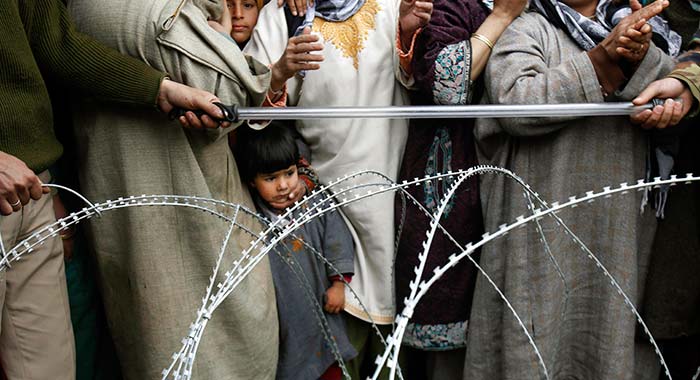
More than the results of recently held state assembly elections in the state of Jammu and Kashmir, it is largely the overwhelming participation of people that has become the great cause of astonishment for people of different shades and opinions. The unexpected large scale participation of people has taken aback both camps of separatists as well as mainstream politicians. And as a matter of great curiosity the whole issue is being viewed differently. Interpretations and explanations put forward by people in this regard are apparently acrimonious, inadequate, and unsound, all robed off in respect and rationality. The apologists of Indian Democracy view it as a triumph of democracy. Intelligence agencies of India had interpreted it as a failure of militancy and separatist politics. And Separatists on their part views it as a suffice measure to counter the saffron wave. Whatever grains of truth are in these postulations, the educated sections of society, particularly students, speculates it in their own way. They, particularly on social media, perceive it a participation of short memory and selfish people who forget the sacrifices of youth. Whatever may be the nature of politics of future government and form of coalition, the set of serious questions surfaced cannot be ignored easily. To speculate about and to reach to a convinced conclusion would consume much time of people living across different demarcated lines.
Normally, like past, participation of people in great number from Jammu and Ladakh was an expected equation. For, People from these two regions had a history of greater participation even in the heydays of Kashmir conflict. However, their resolve to seek solution of their problems through democratic means, in recent election, is not overtly democratic. The polarised politics explicitly shows the problem of participation along religious lines. The people from Jammu vote not by taking into consideration the representative ability of the people in politics, but largely being overwhelmed by Hindutva politics. Jammu being largely a population of followers of Hinduism, have voted for being Hindu in identity and interest. And in Ladakh people voted for their long ties to selected few. While there is something in Ladakh to celebrate as the triumph of democracy, in Jammu there is nothing as such. The problem of Jammu against Kashmir goes back to the early days of Indian independence in 1947. Back then interests of Jammu and Kashmir would contrast and clash gigantically. Kashmir valley would aspire for sort of autonomous status and Jammu would stand for complete formal integration of the state with India. Same things can be seen in the recent elections as well and which compels one to contemplate that nothing has changed. And apologists of democracy therefore needs to pay a serious thought to the deepening differences of these two regions before presuming such polarised participation as an obvious triumph of democracy.
The large scale participation of Muslim inhabitants of Kashmir valley however is purely related with the process of democratisation taking place in Kashmir. In recent elections people realized that their worth of vote is going to form the government.
The speculation of separatist leaders that people voted in order to defeat the excessively increasing Hindutva politics is again not far from being a faulty assumption. Undoubtedly the way earlier BJP tried to concentrate on Pandith votes, living in exile in different parts of India, came as wave of threat to the inhabitants of valley, but that should not be considered the pivotal cause of excessive participation. Local mainstream political parties utilized such apprehensions to grab a lion’s share by mobilising people against such apprehensions. But what actually led the people to thrash away the boycott politics and vote unprecedentedly was neither a measure to counter the Modi wave in Kashmir, nor bored of the cause being championed by separatist politicians.
The large scale participation of Muslim inhabitants of Kashmir valley however is purely related with the process of democratisation taking place in Kashmir. In recent elections people realized that their worth of vote is going to form the government. Unlike the past, and probably owing to the change of central government, people realized there is now no scope for “made in Delhi” governments. They realized in a fair polling it is overtly people who are going to usher in a change or play crucially in the formation of government.
The confidence of people about conduct of fair elections and realization that they have power to decide the destiny of future is decidedly a departure from the past scepticism. Earlier people largely share a belief that it is centre government that is installing governments over state and people whether vote or not, hardly matters. But recent election revealed the hope of people in not being entirely powerless. This was perhaps the reason that people voted profusely. The return of faith in fair elections and realization that people matters in democratic set up is the distinguished feature of recent election. If it is taken as the fact and yardstick to measure the difference, without ignoring how people were mobilised through money, or false promises, then there is certainly something that India needs to be happy about. Large scale participation of people of main Kashmir valley reveals their earnest effort to resolve their issues by embarking on the path of democratisation. And it is here the staunch followers of Indian democracy have got a chance to celebrate as triumph of real democracy in reaching the dry areas of dissent
However, amid the wide variety of things offered by recent elections to speculate or celebrate about, there is no need to turn a blind eye to the basic problems or ignore the core issues oozing out of Kashmir problem. The large scale participation of people in election was largely to undo the national conference’s corrupted and despotic rule. Their participation was to seek solution of their immediate problems if not the ultimate problem. The dirty politics of Umar Abdullah regime stained not only the Indian democracy but reduced people’s faith in India’s secularist credentials. There is general consensus that Umar Abdullah, the protagonist of “PEPPER GUN REGIME”, ruled for five years without any popular support. Towards this the recently flood hit valley exemplified the best proof, when administration was nowhere, just because of lack of legitimate support at ground level. It was largely military and media might that enabled pepper gun regime to prevail. Otherwise people had no confidence in Abdullah family’s third generation running a powerless and corrupted regime. People were fed up of promotion of nepotism and backdoor entries. More so the unrepresented nature of the regime was troubling people tremendously. Application of extensive force and fortune making acts of police worked as ghee in the political fire of Kashmir elections.
The verdict of people of state is the blatant realty of realism. It was their frustration and unrepresentative nature of Umar regime that actually increased the total portion of vote share.
The status quo politics of Abdullah dynasty and their trade in dreams, rhetorical demands of autonomy and rubric of revocation of draconian laws like AFSPA and Public Safety act was no more going to befool the people. The verdict of people of state is the blatant realty of realism. It was their frustration and unrepresentative nature of Umar regime that actually increased the total portion of vote share. The way anti-congress sentiments and corruption facilitated the victory of BJP at centre, similarly the state of Jammu and Kashmir turned out to be a replica of it. The anti National Conference and multiple levels of corruption caused the actual thrill in the recently held elections in the state. And the biggest benefit of the situation was taken by People’s Democratic Party. Otherwise, even the political manifesto of the PDP is not that much impressive.
Anyway, the recent elections have many things to speculate about seriously. People have once again realized the worth of voting. Probably it is due to this that even the separatist camp is feeling the heat and it is under such circumstances that days to come will witness shift in strategies followed by both mainstream as well separate groups.
Featured Image Source: http://www.niticentral.com/2014/11/12/jammu-kashmir-elections-stake-244568.html