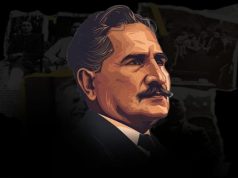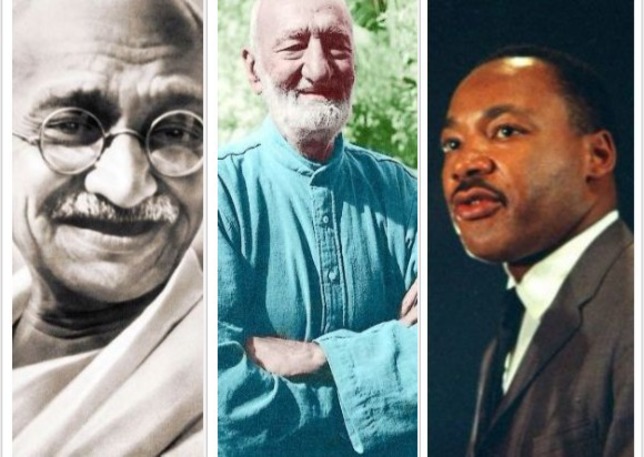
This year, 2018, is a unique coincidence of recent events and several tragic decadal anniversaries. It marks 70 years of assassination of Mahatma Gandhi as well as 60th death anniversary of Maulana Abul Kalam Azad and 30th of the ‘Frontier Gandhi’, Khan Abdul Ghaffar Khan. Martin Luther King Jr. was assassinated 50 years ago on 4 April 1968.
One of the most important events also occurred in the Middle East 70 years ago – the Nakba in Palestine, when close to 600 villages were destroyed by Zionist militia that later formed the Israeli Defence Forces. The worst massacre of Deir Yassin was conducted on 9 April 1948, killing hundreds of Palestinians. The Nakba, meaning ‘catastrophe’, occurred as the Zionist militia initiated Plan D to conquer the British Mandatory Palestine. It resulted in about 12,000 casualties and 800,000 Palestinian refugees who fled to neighbouring Arab countries. The primary purpose laid down by David Ben-Gurion, Israel’s first prime minster, was to transfer as many Arabs as possible out of Jewish territory.
Another interesting coincidence is that two top British imperialists were involved with freedom movements in India and Palestine. Edwin Montagu was the Secretary of State of British India who introduced the 1918 Montagu-Chelmsford reforms in India, though Indian nationalists were not satisfied with it. Montagu was also a practising Jew and a staunch opponent of Zionism; he called it a “mischievous political creed”. Another imperialist was Lord George Curzon – British War Cabinet member and a Viceroy of British India, who brought the 1905 partition of Bengal, thus creating the Hindu-Muslim dichotomy. In Palestine however, he too, like Montagu, was opposed to a Zionist state.
As we look back at the lives of these men – their ideas and legacies, the events in history and recent developments – it is interesting to note the people who work for social reform, education and more importantly non-violence, stand united across time and space while the same is true for those who stand for hatred, racism and militancy.
Back in 1918, Mohandas Gandhi was conferred the title of Mahatma, while Abdul Ghaffar Khan had earned the title of Badshah Khan for opening schools and fomenting social reform near Peshawar. Gandhi was transforming the Indian National Congress from a debating group of lawyers to a mass movement in India. He had already opened the Sabarmati Ashram in 1915 at Ahmedabad and led the peasant Satyagraha movements in Champaran and Kheda districts. In the North-western Frontier, Abdul Ghaffar Khan was involved in two interrelated struggles of reforming violent tribalism among his Pathan brethren and overthrowing the harsh British rule under Viceroy Curzon. He opened the first school at his village of Utmanzai in 1910, at the age of 20 years; much to the resentment of British commissioners and the local mullahs. His inspiration was the missionary headmaster at Peshawar, Rev. E F F Wigram. Khan also founded a social reform movement around 1919 called Anjuman-e Islah ul-Afaghena, since his Pakhtun tribal lands were divided among Afghanistan and British India.
Following Curzon’s partition of Bengal, the Muslim League and the Hindu Mahasabha had emerged by 1909, to “safeguard the interests” of their respective communities. Muhammad Ali Jinnah was an active member of the Indian National Congress and would lead the Muslim League in 1916, while he gave legal defence to Bal Gangadhar Tilak in 1909 and married a Parsi woman in 1918. Pandit Madan Mohan Malaviya presided the first Hindu Mahasabha session in 1909 and was simultaneously President of the Congress. He was rewarded Bharat Ratna posthumously in March 2015, along with A B Vajpayee. Jinnah and Malaviya had supported the Swaraj Party as late as 1924, which was a joint front of the Congress, Khilafat and Swaraj movements.
During the First World War, the Arabs had revolted against the already sickening Ottoman empire to support the British, as they believed it would bring them freedom and self-determination. The Sharif of Mecca, Hussein bin Ali, was however shocked to learn about the Balfour Declaration, which instead induced a dreadful colonisation of Palestine. Indians were also promised freedom if they assisted the British in the Great War, but were betrayed by the repressive Rowlatt Act(s) in 1919.
The end of the First World War in 1918 and the dismemberment of Ottoman Empire initiated two long, complex and extremely brutal conflicts – one in Palestine and the other in India. Indian Muslims started the Khilafat movement in 1919 while the first political party was formed in Palestine – Christian Muslim Association. The objective of this party was to gain complete freedom, to oppose Zionist agenda and further Jewish immigration. Palestine at this time was home to about 100,000 Jews – natives as well as European immigrants.
The Khilafat movement, led by Ali brothers and Maulana Abul Kalam Azad, was aimed at pressuring the British government to preserve the Ottoman Caliphate – which held the cultural pre-eminence as the unofficial leader of the Muslim world. The Ottoman Empire however had rivalries with Muslim states like the Saudi kingdom of Najd and the Qajar dynasty of Persia.
At the turn of the 20th century, British India was facing successive famines; more than 2 million had died in the 1899 famine. Peasant uprisings had become common. Lord Curzon had declared in his Durbar address in Delhi, that the “principal condition of the strength of the British throne is the possession of the Indian Empire, and the faithful attachment and service of the Indian people.” The Rowlatt Act was a draconian law that allowed indefinite detention of any Indian without availing him a legal counsel or a court trial. About a thousand Sikhs, Hindus and Muslims were massacred at Jallianwala Bagh, Amritsar in April 1919. Mahatma Gandhi therefore began to rally a united resistance against the British rule; thus the first All India non-violent civil disobedience movement was launched formally on 1 August 1920. The Principal of madrasa at Deoband, Maulana Mahmud Hasan, issued a fatwa to join this movement.
A lesser known development occurred in the Pathan homelands of the North West Frontier Province (NWFP). A Third Anglo-Afghan war had started in May 1919 and the Khilafat movement was trying to gather help from the German Empire and Afghanistan to overthrow the British rule in India. The movement found a ready liaison in Abdul Ghaffar Khan, who was making secret visits to Deoband since 1912. His Pakhtun region was placed under the 1901 Frontier Crimes Regulation, much worse than the Rowlatt Act. Maulana Obaidullah Sindhi was preparing for an armed rebellion in collaboration with Khan, but these plans were abruptly aborted as the Maulana had fled to Mecca. He was captured en route by the British, while Mahmud Hasan was captured by the Sharif of Mecca and handed over to British. These secret activities were later called as the Silk Letters Conspiracy by the British.
Of course, all these events were completely unknown to the founding fathers of Hindutva like Vinayak Savarkar, Keshav Hedgewar and Madhav Golwalkar. They thought the involvement of Gandhi and Congress in the Khilafat movement was merely an ‘appeasement’. From Savarkar, Golwalkar and Deendayal Upadhyay to Sangh professors and the latest right-wing magazine; they never understand that the famines, Rowlatt Act, war against Caliphate, Jallianwala Bagh massacre, Frontier Regulation and the Anglo-Afghan war had aroused the anger of all Indians. The British Empire had inflicted several adversities which brought out the best from all Indians; the discontentment was successfully channelized towards the freedom struggle. As for the Indian National Congress, they had already elected 4 Muslim presidents by 1918, besides many Hindus, Parsis and Christians. All the non-violent activists were going to prison when a ‘Swatantrya Veer’ Savarkar repeatedly sought mercy with the British and promised sinister collusions.
The Hindutva groups disbelieved the Khilafat-nationalist collaboration right from the beginning since it was completely contradictory to their fascist agenda. They never understood how Indians whether orthodox or liberal, peasant or intellectual, could unite against history’s largest oppressor, even if the initial breeze was brought by Muslims. Bankimchandra Chatterjee’s 1882 novel Anandamath, which projected Muslims as the real enemy, had well polluted their minds. However, fair-minded people who work for public education, welfare and social reform are capable of sacrifice and non-violence, and can always unite for a larger cause, regardless of their religion. Such qualities are completely foreign to Hindutva.
Simultaneously, perhaps due to the monotheistic doctrines and reform movements of Arya and Brahmo Samaj coupled with Islamic revivalism and Christian Missionaries, several low-caste Hindus were rapidly embracing Islam, Christianity and Sikhism. Eventually, between 1881 and 1921, the share of Hindu population in the subcontinent had dropped from around 79% to 75%. All these developments seem to have aroused in the fundamentalists a bitter animosity against Islam and Christianity. Indeed, after the Khilafat movement and the heinous Mopla rebellion in (Kerala) 1921, the Hindu Mahasabha resolved to reunite as a Sangathan to fight against the common enemy – who weren’t the British, but Muslims. The Moplah rebellion was initially targeted against the British but later spilled against Hindu jenmies (landlords) in the region who were supporting the British against Congress and the peasant Moplas. It is in the wake of these events that the Rashtriya Swayamsevak Sangh (RSS) was founded in 1925 and the Hindu Mahasabha took a sharp fascist turn under Vinayak Savarkar.
In his book titled Bunch of Thoughts (1966), RSS ideologue Golwalkar writes, “we find that even though some people may call us communal and all that, still their beliefs and our beliefs are the same. Only, we have the courage to say the truth, whereas they try to appease and propitiate out of fear, of course, under the garb of ‘broad-mindedness’, ‘secularism’ and so on. That is all. No other difference …”. Prime Minister Narendra Modi dedicates the longest chapter to “Param Pujya Guruji” Golwalkar in his 2015 book Jyotipunj, and the same passage is quoted there. Golwalkar discusses Muslims, Christians and Communists under Internal Threats. C P Bhishikar, the biographer of Hedgewar, Golwalkar and Pandit Deendayal Upadhyay, also writes that Muslims and Christians were falsely projected as ‘nationals’ and participation of the Congress in the Khilafat movement was merely an appeasement. He further writes, “On the one hand, opposition to the Hindu Rashtra ideology has assumed the character of unbridled, unprincipled appeasement of the religious minorities and on the other, interested forces are trying to confuse the nationalistic and patriotic minds, thereby making the country a faction-ridden, spiritless weakling. Communists, Christians and Muslims are three virulent, intolerant communal forces eager to devour this great country.” It is interesting to note that Home Minister Rajnath Singh had claimed during the JNU row that the agitation was backed by Pakistan based Lashkar-e-Taiba. The recent Ram Navami processions and ensuing riots in West Bengal have seen a Deputy Commissioner of Police hit by a bomb while a bust of Maulana Abul Kalam Azad was pulled down.
Savarkar especially couldn’t believe in religious harmony, because his militant nationalism was based on race and blood, rather than the civil coexistence of Gandhi and Azad. He considered Gandhian nonviolence a ‘doctrinal plague’, an impractical and immoral outcome of insanity. In his book Hindutva: Who is a Hindu?, Savarkar keeps repeating the supremacy and unity of the Hindu race and blood. He writes, “The Bohras and such other Mohammedan or Christian communities possess all the essential qualifications of Hindutva but one, that they do not look upon India as their Holyland … Ye, who by race, by blood, by culture, by nationality possess almost all the essentials of Hindutva and had been forcibly snatched out of our ancestral home by the hand of violence – ye, have only to render whole-hearted love to our common Mother and recognise her not only as Fatherland (Pitrubhumi) but even as a Holyland (Punyabhumi); and ye would be most welcome to the Hindu fold.”
This passage is undoubtedly the motive behind Ghar Wapsi campaign and the position of Dr. Subramanian Swamy, who wants all Muslims to acknowledge their Hindu ancestry and DNA, failing which they must go to Pakistan. It is also the cause of Sangh’s delusion that Islam was spread in India only by the sword; RSS ideologue Golwalkar calls Islam a long story of “Sword and Koran” while senior journalist Minhaz Merchant mentions “sword wielding Islam” in his DailyO article. Orientalist historian Thomas Arnold had however recorded that Islam had already reached Kashmir, Bengal and Malabar long before Arab or Turkic invaders. This prejudice explains the NIA’s ‘proof’ of Hadiya (Akhila) Ashokan’s brainwash and their claim of her husband’s association with ISIS and Kerala High Court’s annulment of their marriage.
Vinayak Savarkar is indeed the founder of Hindutva and the old saint of BJP. This was the reason his portrait was installed in the Parliament by the late President A P J Abdul Kalam during Vajpayee’s premiership. Prime Minister Modi has paid him tribute in May 2016 and had released a Gujarati movie back in 2013. The perception of purity of blood and race is why Amish Tripathi, author of Shiva Trilogy and Ramachandra Series, cannot accept the Aryan Migration/Invasion Theory and why genetic studies can cause furores.
While Gandhi and Congress were opposed to the Zionist conquest of Palestine through displacement of the Arabs, as much as they sympathised with the victims of the Holocaust, Savarkar had great sympathy for Zionism. He writes, “And speaking relatively alone, no people in the world can more justly claim to get recognised as a racial unit than the Hindus and perhaps the Jews. … If the Zionists’ dreams are ever realised – if Palestine becomes a Jewish State and it will gladden us almost as much as our Jewish friends – they like the Mohammedans would naturally set the interests of their Holyland above those of their Motherland in America and Europe …”. The ethno-religious nationalisms of Hindutva and Zionism are indeed united in spirit, separated only by distance and culture. Both movements had supported the British during the Second World War. As the Zionist militia in Palestine was acquiring a lot of weaponry and training during the Second World War, Savarkar was also running a “join military campaign” and mobilising volunteers. Having mastered the art of deception, both movements later celebrated the independence they had achieved from the British.
While religion is the cause of enmity for ethnic and militant nationalists, social reform and non-violence can unite people across religion, time and space. The Indian nonviolent struggle was highly influential upon Martin Luther King Jr. Adhering to Gandhi’s disobedient methods, King began in 1955 a struggle against racism and demanded the US Government to legislate voting rights for Black Americans, from which they were barred. In one of his sermons as a Christian Minister, King said, “Before I was a civil rights leader, I was a preacher of the Gospel. All that I do in civil rights I do because I consider it a part of my ministry. I have no other ambitions in life but to achieve excellence in the Christian ministry. I don’t plan to run for any political office. I don’t plan to do anything but remain a preacher. And what I’m doing in this struggle, along with many others, grows out of my feeling that the preacher must be concerned about the whole man.” In 1963, 250,000 demonstrators marched to the Lincoln Memorial in Washington, where King gave his famous I Have a Dream speech. Though King was awarded the Nobel Peace Prize in December 1964, Malcolm X was assassinated just three months later. After several nonviolent protesters bore persecutions from the US government, President Lyndon Johnson finally passed the Voting Rights Act in 1965. King advised Johnson to halt the bombing of Vietnam, to negotiate with the National Liberation Front of Vietnam and to admit China to the United Nations.
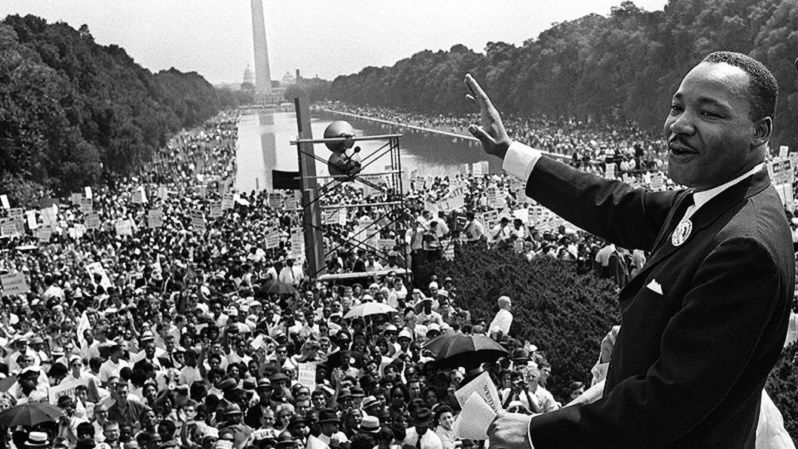
Martin Luther King Jr. is perhaps the only famous Christian in centuries who really implemented the Biblical injunction of turning the other cheek. “Recompense to no man evil for evil … Therefore if thine enemy hunger, feed him; if he thirst, give him drink: for in so doing thou shalt heap coals of fire on his head. Be not overcome of evil, but overcome evil with good.” (Bible, Romans:12; KJV) The American King of reform understood very well, “Darkness cannot drive out darkness; only light can do that. Hate cannot drive out hate; only love can do that.”
King also highlighted the primary purpose of education. He said, “education which stops with efficiency may prove the greatest menace to society. The most dangerous criminal may be the man gifted with reason, but with no morals. We must remember that intelligence is not enough. Intelligence plus character – that is the goal of true education. If we are not careful, our colleges will produce a group of close-minded, unscientific, illogical propagandists, consumed with immoral acts. Be careful, brethren! Be careful, teachers!” King was perhaps warning against our post-truth era, rise of Donald Trump and Climate Change deniers.
Interestingly, this Black Gandhi was assassinated by a White supremacist, just as Mahatma Gandhi was shot by a Hindu supremacist. Also interesting is the fact that the Frontier Gandhi was hated by the Muslim League. In 1929, Abdul Ghaffar Khan had raised a disciplined and non-violent army of one lakh Khudai Khidmatgars (Servants of God), who wore reddish-brown uniform. The British easily crushed the trigger happy rebels but feared the non-violent Pathans. It was however a fellow Pathan from the Muslim League who put the British to shame. Abdul Qayyum Khan, as the Chief Minister of Frontier province, not only poised Jinnah against Abdul Ghaffar but also crushed the Khudai Khidmatgars. He and his brother, besides several leaders of the movement were jailed for seven years without any legal charges or trial. More interesting is the fact that, while a mass Quit India movement had begun in August 1942, the Hindu Mahasabha, Swayamsevak Sangh and the Muslim League fully cooperated to support the British and formed coalitions in Bengal, Sindh and the Frontier.
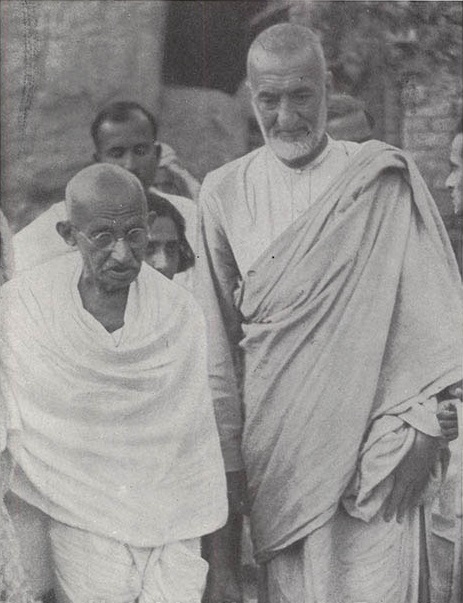
On the contrary, Gandhi and Khan had resigned from the Congress when the latter decided to support the British against a Japanese invasion. Unlike the Congress leadership, non-violence was not a mere strategy for the two Gandhis; it was to them an article of faith. In one of his speeches, Badshah Khan declared, “There is nothing surprising in a Muslim or a Pathan like me subscribing to the creed of non-violence. It is not a new creed. It was followed fourteen hundred years ago by the Prophet all the time he was in Mecca. But we had so far forgotten it that when Gandhiji placed it before us, we thought he was sponsoring a novel creed”.
When communal riots were raging in 1946, Gandhi was urging Bengalis to stop the bloodshed and Khan was pouring his heart in Bihar for peace. His Khudai Khidmatgars protected Hindus and Sikhs in Peshawar. Post independence, Abdul Ghaffar campaigned several times against military rule in Pakistan and was frequently arrested. He had channelized the Pathan passion towards a satyagraha and spent a total of 27 years of his life in prisons. He was in fact detained by Pakistan for longer periods than by the British. Khan was named Prisoner of the Year in 1962 by Amnesty International and nominated for Nobel Peace Prize in 1985. Even at the grand old age of 95, he would speak to a large crowd against military rule. He is the first foreigner of post-partition India to receive Bharat Ratna in 1987.
Badshah Khan died on 20 January 1988, as several insurgencies were rocking the Indian subcontinent. The US President Ronald Reagan was working on the Operation Cyclone that covertly assisted the Mujahedeen of Afghanistan against Soviet invasion. Before the Palestine Intifada (1987) and Kashmir insurgency (1989), another Gandhian gave peace a chance. During Khan’s last days, an American psychologist named Mubarak Awad visited him. Awad was a Palestinian Christian born in Jerusalem and had migrated to USA. He published academic papers and gave several lectures on how Gandhian nonviolence can be used against Israeli oppression in the Occupied Territories. The ‘Palestinian Gandhi’ himself demonstrated disobediently in Israel and founded an organisation named Nonviolence International in Jerusalem in 1983.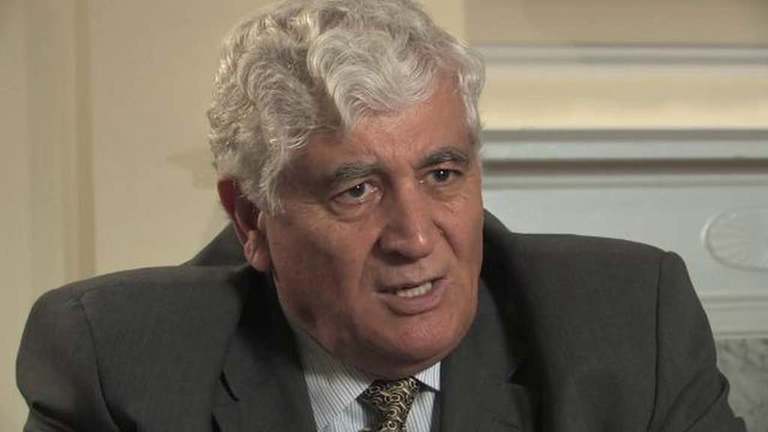
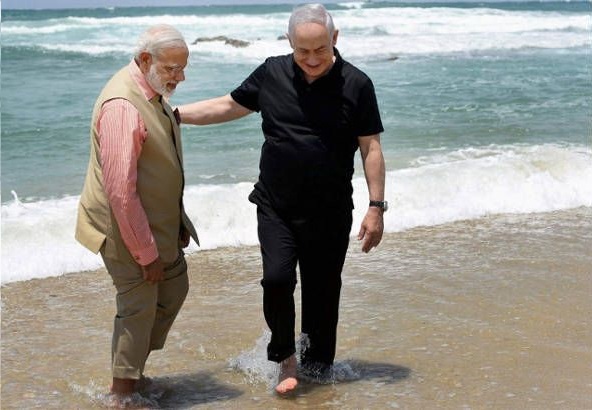
As Gandhians across the world have shared inspiration, the followers of militant-religious nationalism also have a lot to share. At the behest of a BJP leader (claimed police), Sri Ram Sena members had hoisted the flag of Pakistan at a Tahsildar office in Karnataka in January 2012. Dhruv Saxena from BJP’s IT cell was arrested for aiding Pakistan’s intelligence agency ISI in February 2017. Prime Minister Narendra Modi has visited Pakistan to meet Nawaz Sharif, twice – uninvited. Terrorist attacks in Jammu and Kashmir have risen from 322 in 2016 to 342 in 2017, after Surgical Strikes and Demonetisation. The relationship of Hindutva and Pakistan seems like the romance of Ross and Rachel from the famous American serial Friends – they are on a break but can’t live without each other. So strong is the bond of ethno-religious nationalism, that Modi and Netanyahu indulged in some barefooted bromance on an Israeli beach in July 2017. Savarkar and Ben Gurion must have been smiling together.
Despite several uprisings and terrorist activities, the Palestinians, Kashmiris as much as Naxalites in India have so far failed to achieve justice and self-determination against military occupation. While Arundhati Roy had advised the Maoist rebels to use nonviolent struggle for their cause, another American professor again contemplates Gandhian nonviolence and civil disobedience for Palestine. Dr. Norman Finkelstein is an American Jew, whose parents were Holocaust survivors. Author of several avant-garde books on Zionism, Finkelstein proposes that if Palestinians could channelize their strong will and self-sacrifice towards a nonviolent satyagraha, they might achieve what several decades of armed struggle could not. No doubt, as Israel was created and sustained through international lobbying, the freedom of Palestinians has also to be achieved through widespread support. The good news is that a non-violent anti-apartheid style Boycott, Divestment and Sanctions (BDS) movement has already gained momentum around the world, which poses a threat to Israel’s oppression and potentially to Israel’s very essence. The recent 128 vs 9 votes in the UN General Assembly against locating US embassy in Jerusalem shows that the world at large does not support the Zionist-American ambition of a greater Eretz Israel.
Mahatma Gandhi had said that satyagraha is but the nonviolence of the strong. It was but the indomitable will of Yasser, Sumaiyya and Bilal that bore the cruellest persecution of Meccan chieftains and won sympathy of the silent majority for Prophet Muhammad. Today, be it Palestinians or Indian tribals or Kashmiris, if they could use the strategies of nonviolence, they can force the oppressor to the negotiation table and secure self-determination.
As we mourn the assassination of Mahatma Gandhi by a Hindu nationalist, of Black Gandhi by a White supremacist, the persecution of Frontier Gandhi by the Muslim League as well as the catastrophe of Palestinians at the hands of Zionism, we must also remember two important lessons from history.
One is that fascists and supremacists, from all nations and traditions, are extremely hateful and resort to extremely violent means to maintain their supremacy. Three recent events must not be ignored in this context. One, US President Donald Trump was defending White nationalists involved with the Charlottesville violence in August 2017. Second, Savarkar’s Hindu Mahasabha has garlanded Nathuram Godse at a temple in Gwalior while RSS thinker Ratan Nigam believes that Taj Mahal, Red Fort and Jama Masjid were originally all Hindu monuments. Third, an Israeli politician who heads the Third Temple campaign is joining hands with Neo-Nazi affiliates of Austria.
The other lesson is that education and social reform can work absolute wonders if combined with self sacrifice and nonviolence. Hindu, Muslim or Christian, tribal or intellectual, Maulana or Minister, Arab or Jew – noble methods work for everyone. Oppression and fascism are characteristics of the cowardly and must therefore depend upon power, wealth, deception and weaponry. Nonetheless, there are noble, courageous and very inexpensive ways in which the weakest can compel, if not defeat, the most powerful oppressors. That is the power of nonviolence.
“Nor can good and evil be equal. So repel that with something gracious, so that between whom and you was enmity may become your close friend.” – Qur’an, 41:34.
Book References:
- India’s Struggle for Independence by Bipin Chandra et al
- Hindu Nationalism: A Reader by Christophe Jaffrelot
- Silken Letters Movement by Maulana Muhammad Miyan; Muhammadullah Qasmi (tr)
- Ghaffar Khan: Nonviolent Badshah of the Pakhtuns by Rajmohan Gandhi
- One Land, Two Peoples: A History of Modern Palestine by Ilan Pappe
- Pandit Deendayal Upadhyay: Ideology and Perception: Concept of Rashtra by C P Bhishikar
- Savarkar by Sudhakar Deshpande
- Ghost Wars: The Secret History of the CIA, Afghanistan and Bin Laden by Steve Coll
- What Gandhi Says: About Nonviolence, Resistance and Courage by Norman Finkelstein