
The de-colonial discourse emerged, with the contributions of Walter Mignolo, Romen Grosfoguel, Salman Sayyid and the likes, as a strong theoretical retaliation to the colonial oppressive narratives perpetrated by the whites, demonizing the black people. Fanon and Malek Bennabi were two towering intellectuals who altered the course of Algerian history, and approached the problem of oppression from a philosophical perspective and tried to make it a pragmatic concern.
Frantz Fanon was a revolutionary thinker who observed psychology of colonialism, focusing on the specific importance of cultural identity, which determines the human conditions in post-colonial life. Pointing to the cultural effects of western dominance over the black bodies, his works like Black Skin and White Mask (1956) and Wretched of the Earth (1961) extensively talked about the possibilities of transforming one’s language, lifestyle, faith, rituals and even dressing as the weapon of resistance against the violence of colonialism.
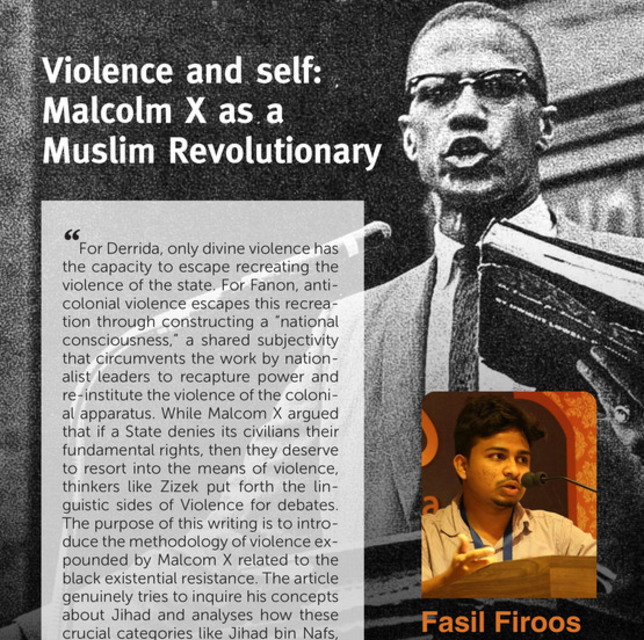
Continuance and perseverance of ‘Decolonial Studies’ put forward things like politics of the black along with bringing the ‘language of violence’, politics, romanticism, spirituality and the art to the terrain of academics. These studies which rekindled various debates formed themselves as a new thinking line or a discipline. ‘Violence’ got more attention and debate value among the intellectuals following the release of Jacques Derrida’s gripping work The Force of Law: Mystical Foundation of Authority. The famous discussions of ‘divine violence’ by Derrida and Fanon are some of the leading examples of this trend. For Derrida, only divine violence has the capacity to escape recreating the violence of the state. For Fanon, anti-colonial violence escapes this recreation through constructing a “national consciousness,” a shared subjectivity that circumvents the work by nationalist leaders to recapture power and re-institute the violence of the colonial apparatus. While Malcom X argued that if a state denies its civilians their fundamental rights, then they deserve to resort into the means of violence, thinkers like Zizek put forth the linguistic sides of violence for debates. The purpose of this writing is to introduce the methodology of violence expounded by Malcom X related to the black existential resistance. The article genuinely tries to inquire his concepts about Jihad and analyses how these crucial categories like Jihad bin Nafs, Jihad bil Lisan, Jihad bil Yad etc. are effectively made useful in constituting his theories regarding Jihad.
What is Jihad?
Jihad is a highly comprehensive word which includes different aspects of life. Its vast meanings include the oral and written efforts towards making the intellectual and thoughtful revolts, the efforts to make the thoughts and emotions of the people conformed to Tawhid (belief in One God and unity of all His creations) and the armed struggles against the enemies of truth. A person who is trying to protect his wealth and prestige is also doing Jihad. Unfortunately, under the Western epistemological dominance, the meaning of Jihad was deformed to imply that Jihad is equivalent to killing, slaughtering, looting and destruction. The majority of the European writers see Jihad as the armed struggle organised for the propagation of Islam. In the books like A hand book of early Muhammedan tradition, authored by MJ Velsinki, and The religion of Islam authored by Klein, researcher and intellectual, the meaning of Jihad was confined as war for the propagation of Islam.
Once, beloved Prophet (PBUH) said; “You have returned from the lesser Jihad unto the greater Jihad”. He only clarified that greater Jihad is the servant’s struggle against his own desires, which was the important aspect of Jihad put forth by Prophet.
“Fight in the way of Allah those who fight you but do not transgress. Indeed, Allah does not like transgressors. And kill them wherever you overtake them and expel them from wherever they have expelled you, and Fitnah is worse than killing. And do not fight them at Masjid al Haram until they fight you there. But if they fight you, then kill them. Such is the recompense of the disbelievers. And if they cease, then indeed, Allah is forgiving and merciful. Fight them until there is no (more) Fitnah and worship is acknowledged to be for Allah. But if they cease, then there is to be no aggression except against the oppressors.” (Quran: chapter 2, verses 190-193).
Moreover, the strict instruction of Prophet’s closest ally Hazrath Abubakr to his soldiers is one of the most important records in the history, which upholds the modern values of human rights in the treaty of war.“You shall not engage in treachery, you shall not act unfaithfully, you shall not engage in deception, shall not indulge in mutilation, you shall kill neither a young child nor an old man or a woman, you shall not fell palm trees or burn them, you shall not cut down any fruit-bearing tree, you shall not slaughter a sheep or a cow or a camel except for food”.
The Jihadist approach of Malcom X
Malcom X was trying to understand Islam as a Human rights movement. He tried to convey the fraternity, humility, piety and concepts of Jihad in Islam to uplift the Afro-American people in a modern way to create a new sociality of justice among them. Malcom sacrificed his life for the establishment of a new social order with freedom and justice as key emancipatory concepts, by revolting continuously against the white supremacy and racial apartheid. In the following section, I am trying to understand the nuances of Malcom X’s approach within the categories of Jihad.
Jihad-bin-nafs
Jihad which Malcolm X stood for Afro-American goodness can be divided into Jihad-bin-nafs, Jihad-bil-Lisan Jihad-bil-Yad. Jihad bin Nafs means to struggle with the self in an effort to seek individual growth to overcome personal weakness for becoming more pleasing to Allah. Jihad bin Nafs is also termed as jihad-ul-Akber by scholars as it is the base of the all Jihad. When prophet Muhammed (SAW) returned from the wells of Badr, he said: “we have returned from the lesser Jihad to the greater jihad (Jihad ul Akbar)”.Prophet was asked, “what is Jihad ul Akbar?” Then he replied “Jihad ul Akbar is the striving of a man against his self and his desires”.
When we place the Jihad-bin-nafs with the life of Malcolm X particularly it has been read by scholars like Kaisha Hick in two modes. The first being Malcolm is performing the shahadah. The shahadah is always performed in Arabic by the person who wishes to convert to Islam. The shahadah is the foundational principle of being a Muslim and no person who wishes to convert to Islam is considered a Muslim unless they perform or take the shahadah. While in prison, according to his autobiography, Malcolm X took the shahadah in the frame of Nation of Islam: “For evil to bend its knees, admitting its guilt, to implore the forgiveness of god, is the hardest thing in the world. Again, again, I would force myself back down into the praying-to-Allah posture”. (Shabazz & Haley, 1965,p.196). In order for Malcolm to take the shahadah and step into his new identity as a Muslim, he had to reject everything he was previously up to that point.
The second phase of Jihad-bin-nafs occurred after his splitting from Elijah Muhammad and Nation of Islam. This dramatic demonstration was cruel and pathetic condition, as he mentioned in his autobiography “the thing to me worse than death was betrayal”.(Shabazz & Haley, 1965,p.352). During this period he traveled to Mecca and performed Hajj that helped him to understand clearly the epistemic and ontological frame work of Islam, and how Islam engaged in the experience of Black people.
While reading Jihad-bin-nafs in the context of black Nationalists we have to analyze how both Islam and Christianity dealt with Black people. Malcolm believed that Islam was the best religion for Blacks and much for the same justification. Racism was inherent in the American brand of Christianity that was introduced to enslaved Africans. According to Richard Brend Turner, in the text ‘Islam in the Afrian-American experience’, Blyden saw the missing physical depictions of Christ as an equalizing characteristic. “Although he [Blyden] was a Presbyterian minister, his experience in West Africa led him to believe that what he perceived as Islam’s lack of racial prejudice and doctrine of brotherhood made it a more appropriate religion for people of African descent than Christianity”.(Turner, 1997,p.52).
Abid Rashad, in his work, Islam, Black Nationalism and Slavery: A detailed History states that Blyden constantly attacked Christianity for having imposed racial inequalities upon Black people, and felt that the absence of pictorial representations in Islamic societies had saved Blacks from always having distinguished and saintly people depicted to them as White”. (Rashad,, 1995, p.150).
According to Sherman Jackson “ As the frustrated ninetieth century Black Edward W. Blyden complained in his classic, Christianity, Islam and the Negro Race, Christianity came to the Negro as a slave, or at least as a subject race in a foreign land. Along with the Christian teaching, he and his children received lessons of their utter permanent inferiority and subordination to their instructor, to whom they stood in the relations of chattels”. Jackson, 2005,p.40).
Jihad bil Lisan
The Meaning of Jihad-bil-Lisan is to make our tongue as sword for spreading the truth, resisting the bad and nurturing Islam. In other words this jihad (jihad by the tongue) is concerned with spreading the word of Islam with one’s tongue or writing and the verbal defence of Islam. Malcolm X’s life fully revolved around as an orator. His great weapon against the oppression of Black people was continuously speaking about the suffering of Blacks and thus invoking resistance.
His oratory skills didn’t end up in mere spoken words, but it urged for collective action. One can understand the elaborated meaning of Jihad bil Lisan than the classical definition, though this creative amalgam of speech and action. “His commitment to the liberation of the blacks from bondage, body and soul, was total and consuming. “My hobby is stirring up Negroes,” he liked to say, and he gave it eighteen or twenty hours a day every day”. (Goldman,1979,p.17). After the Hajj period he used to keep encouraging others to convert to Islam, and to spread ideology of Islam within Afro-American.
Eddie Glaude in his book Is it Nation Time? argues that “More than any other black figure during the first stage, Malcolm X articulated the underlying, almost visceral, feelings and sensibilities of black urban America-North and South, Christian and non-Christian, young and old. His early rhetoric was simply prescient: too honest, too candid, precisely the things blacks folk often felt but never said publicly due to fear of white retaliation, even in the early sixties (Glaude,2002,P-30).
Though Malcom X, as the minister of nation, represented the ideology of both nation of Islam and Elija Muhammed, his speeches delivered till 1959 were not recorded. Keisha Hicks observe that “there are two explanations, the first being when he became the National Minister in 1955 the goal for Elijah Muhammed was to use Malcolm to build the Nation of Islam by establishing temples. In that vein, Malcolm used his oratory skills to attract new members to the Nation of Islam. The second reason was that white America and the mainstream media did not begin to pay much attention to the Nation of Islam until the television exposed The Hate produced aired in New York City”. (Hicks, Keisha,1964.pg-55).
In 1955 when Malcolm X became the spokesperson of Nation of Islam he was used by Elija Muhammed to propagate the ideology and politics of the Blacks. He began his career as an orator and debater while incarcerated at Norfolk Prison Colony. On this point Malcolm asserts: “But I will tell you that, right there, in prison, debating, speaking to a crowd, was as exhilarating to me as the discovery of knowledge through reading had been. Standing up there, the faces looking up me, things in my head coming out of my mouth, while my brain searched for the next best thing to follow what I was saying, and if I could sway them to my side by handling it right, then I had won the debate-once my got wet, I was gone one debating. (Shabazz & Haley, 1965,p.22).
Jihad bil Yad
Within the dominant discourses, Jihad bil Yad hurries to the psyche than Jihad bil Lisan or Jihad bin Nafs. Jihad bil Yad or Jihad by the hand requires a believer to choose what is right and combat injustice by one’s actions. Here I would like to comprehend Jihad bil Yad as a variant of physical actions, which can include actual violence as well. In the case of Malcolm X, the message was simple. During that time Black people were catching hell all over from the white man and non- violent direct action was not working. This social condition forced Malcolm to think that it’s illogical to be non-violent with someone who is violent with you.
For Fanon, violence which is, as this article places, closely related to Jihad bilYad, was all about breathing the air of freedom for blacks. As Ziauddin Sardar observes in preface of Black Skin and White Mask, “for Fanon the struggle is nothing less than an attempt to survive to breathe the air of liberty”. This was the same track upheld by Malcolm through his philosophy of violence. Malcolm’s life enhanced the possibility of resistance against white supremacy. From the shell of helplessness he looked at the height of keeping the toll of resistance. Once, in a protest movement he stated that I cannot compromise with cold politics anyone laughed on my feet, I will certainly do the same thing with him. Such darker incidents sharpened his determination of resistance against apartheid or whatever went wrong on the ground of discrimination within black society.
Such strong will power and commitment kept his ideology different from the ideology of Martin Luther King. It is very obvious from the work of Tiffany Gallati’s Malcolm X and Martin Luther King Jr. Non-Violent v. Violent Resistance in the Civil Rights Movement in the American South. Tiffany states that “although Dr. Martin Luther King Jr. is the man most commonly identified with achieving equal rights for African Americans, his philosophy of non-violent, peaceful resistance would not have had the effect that it did without Malcolm X’s militant rhetoric as a backdrop. Malcolm X advocated fighting the status quo even with the use of violence and preached racial segregation. He believed that white supremacy could not be conquered through love, but only through vigorous self-defense “by any means necessary”. Martin Luther King Jr, on the other hand, preached integration, non-violence and peaceful protest”. In contrast to Malcolm X’s view that violence should be met with violence, Martin Luther King Jr. felt that one should attempt to make his enemy his friend. Violence, King thought, was immoral and impractical as a tactic in the struggle for civil rights. On the other hand, Malcolm X felt that retaliatory violence was an essential reaction when one was violated by a criminal act. He felt that you cannot communicate to someone in a language that they don’t understand and those who commit violence do not understand love.
The methodology of Jihad bilYad was applicable in his life with the power of Iman(faith in God). His political stand was within the religious concept of resistance, especially after the Hajj. To conclude, let me quote Malcolm again: “the history of unpublished violence against our people clearly indicates that we must be prepared to defend ourselves or we will continue to be a defenseless people at the mercy of ruthless and violent racist mob. We assert in those area where the government is either unable or unwilling to protect the lives and property of our people, that our people are within their rights to protect themselves by whatever means necessary. A man with a rifle or a club can only be stopped by a person who defends himself with a rifle or club”.
References:
1.Andreas Krebs. The Transcendent and the Postcolonial violence in Derrida and Fanon.Human Architecture: Journal of the Sociology of Self-Knowledge.
2.Keisha A. Hicks. (2009). The Multifarious Jihad of Malcolm x: From Malcolm Little to El Hajj Al Malik El-Shabazz.
3.Derrida, Jacques.2002. Force of Low: The Mystical Foundation of Authortiy.In Gil Anidjar, ed. Acts of religion .New York: Routledge.
4.Richard Brent Turner. Islam in the African American Experience
5.Malcolm X. 1961. Embassy, Los Angeles Speech. Nation of Islam. April 16, 1961
6.Jackson, Sherman A. 2005. Islam and the Blackamerican: Looking Toward The Third Resurrection. Oxford Universtiy Press. Oxford, England
7.Jihad. 2009. The True Meaning of Jihad. http://www.justislam.co.uk.
Accessed: December 12, 2008
8.Fanon, Fratnz. 1952. Black Skin and White Masks
9.Fanon, Fratnz.1961. Wretched of The Earth