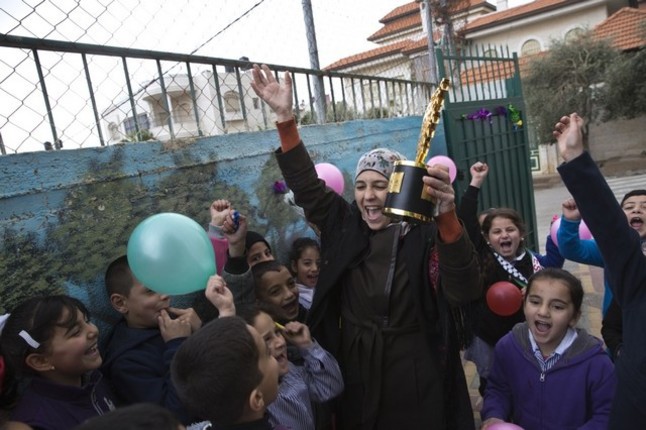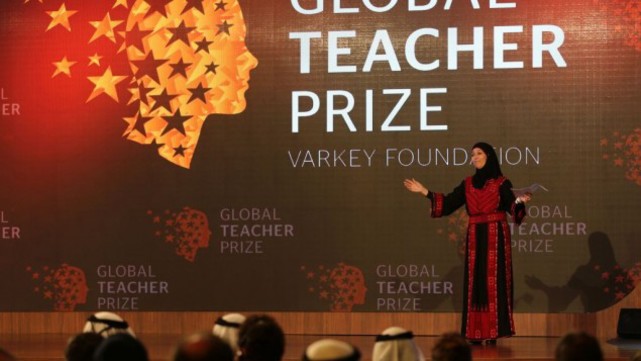
On 13 March 2016, Mrs Hanan Al Hroub from Palestine won the Global Teachers award. Of the 8000 who had applied from across the world, she walked away with $1 million as reward for teaching traumatized refugee children. Palestine was back on the map, this time for good reason, and amid all the applause and cheers, found much space in the media and acknowledgement from high and above as never before.
“Palestine won!” she exclaimed with triumphant joy, as her daughters watched, eyes suffused with tears for her victory. A huge crowd had gathered in Ramallah square to watch the star studded ceremony. And as the media focused on the ensuing celebration, their exultation seemed to be more than just mere joy. How would one feel to see someone from their own kind, a refugee population with decades of shared experience of perpetual exile, violence, abuse, humiliation, and injustice that is yet to be atoned for, an uprooted people that were bulldozed, driven out, denationalized, collectively victimized, orphaned, alienated, severely controlled by a ruthless army and refused to be heard, someone who herself survived the trauma of living in a refugee camp, of a deliberate Israeli shootout involving her husband and two daughters and illegal arrest, and despite all attempts by the occupying forces to subdue her, is now being recognized the world over? It’s unfathomable as is their unrelenting predicament. 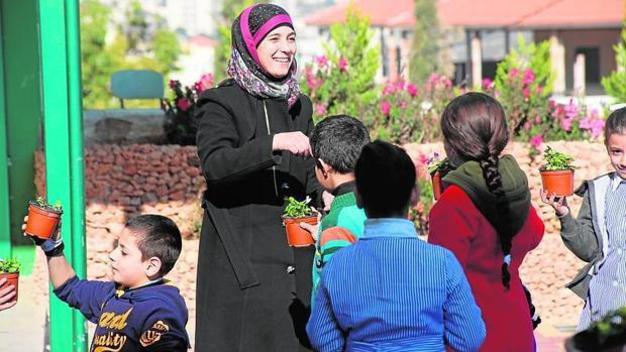
Largest Refugee Population
“We want our children to live peacefully, as all children of the world,” said Hroub in her acceptance speech. Palestinian refugees form the world’s largest, most vulnerable displaced population alongside the many more that have been internally displaced. What’s more regrettable is that the frequently traumatized among them account for the majority of the younger generation in the present occupied territories. Though Palestine boasts one of the highest literacy rates in the world, its education system has been severely impaired due to the siege. “Every day,” Hroub said, ” …we see the suffering in the eyes of our students and teachers caused by the Israeli occupations military checkpoints.” (Palestinian Ma’an news agency) It’s a very uncertain commute to school. Teachers and students walk to schools not knowing if they will return home alive. They suffer daily abuse from settlers, walk past barbed wire or face harassment and detainment by Israeli soldiers, which requires accompaniment by international volunteers or by teachers themselves. According to a research by the Badil Resource Centre, almost half the children in the occupied Palestinian territories (oPts) have watched their schools being besieged by Israeli military, have witnessed/experienced violent incidents against an immediate family member and other violence on a daily basis. It also documented students being shot by the IDF during class, or while standing in line in the school yards or stun grenades and gas canisters flying into school premises. These statistics were observed before Palestine was consumed in the recent war, meaning the numbers have escalated since.
In addition, Palestinian schools lack the much needed congenial atmosphere for enhancing children’s cognitive, emotional and social well-being. Most of the schools are operated by UNRWA, and report overcrowded classrooms, and lack of recreational space. UNRWA notes, 83% of elementary and 62% of preparatory schools are run on double shifts, sometimes even triple because of the restriction imposed by the Israeli government on constructing new schools. More than 90% of building permit applications have been rejected (in other words, never accepted) including those for new houses. Israel also holds a reputation for ‘record demolition’ of the already few existing Palestinian buildings. For instance, the recent demolition of the only primary school (Abu-Nawwar) in occupied Jerusalem, has left children to study outside in the open. It’s policies are clearly discriminatory, as residents of Susiya settlement, facing demolition orders for 170 structures, report that Israeli citizens in the same area enjoy ‘a swimming pool and playground’ but they are not even entitled to a share in the main electricity and public water supplies, let alone land to live on.
UNRWA reported, “The West Bank Barrier and other access restrictions are unfortunately not the only obstacles to a conducive learning environment for Palestinian children. In the month of August 2015- when children around the world were going back to school- 54 homes were demolished by Israeli authorities in the West Bank, including East Jerusalem, leaving 203 Palestinians, among them124 children, homeless in the extreme August heat…. in a one month-period…” Israel broke the record last month by razing another 41 Palestinian homes and a school in a period of one week. Some families are known to have experienced at least four displacements.
Being a child in a refugee camp
Having grown up in a refugee camp, Hroub says, “Children elsewhere can enjoy their childhood, but not Palestinian children. The games that we played were affected by the surroundings conditions. You grow up aware and informed about the politics and what’s happening around you.”
Without a safe haven, refugee children live in constant insecurity, discrimination, lack of freedom, and sense of self.
Without a safe haven, refugee children live in constant insecurity, discrimination, lack of freedom, and sense of self. When Grace Halsell wrote Journey to Jerusalem, she described the refugee camps as ‘medieval ghettos’. They are over-populated, made up of small, dingy, dismal houses with up to three generations living in cramped rooms and alleyways. With no adequate resources, children live in polluted air, garbage, insanitary open drainage, insect and rat infestations and candle light. These also house high poverty and unemployment rates, frequent violence, military invasions and restricted construction. The worst hit are the refugee camps in Lebanon, where they are denied over 70 professions, and are forced to remain unemployed. In 2000, URWA reported that 20% of refugee population in occupied territories was below poverty line, which increased to 80% in a span of less than ten years. Apparently, ‘there is not one young person in these camps who is not suffering from a form of Post-Traumatic Stress Disorder(PTSD),’ (Badil Resource Center) which is just another refined term used to refer to the severe mental and physical pain, that a civilian population is subjected to in a deliberate, well-planned war. Fathy Flefel, a Psychotherapist and Director of Palestine Red Crescent Society,
said, “Professionally, when we talk about PTSD, it’s something that begins and ends. Palestinian children live in trauma without end. It’s never calm here…”
While Gaza houses the largest refugee camp population, 70% of which accounts for children below 15 years of age, it also has the lowest annual water usage in the world, most of which does not even meet the minimum water quality standard owing to the destruction of the water and sewage systems by Israeli forces and the restriction imposed on entry of any constructing material even if funded by the UN. An interview with Dr. Mads Gilbert revealed how anemia, malnutrition and stunting(reduced physical and mental growth) are rampant in children in Gaza. He said, “Every third child is less developed than he or she should be. And stunting does not only affect growth. It also affects brain development and the ability to learn. This is a direct consequence of Malnutrition…a deliberate, man-made lack of food and water, imposed, planned, and executed in the most detailed way by the Israeli government. They even calculate how many calories to let into Gaza to avoid outright starvation but to ‘just’ cause malnutrition since that goes under the radar of human rights abuses.”
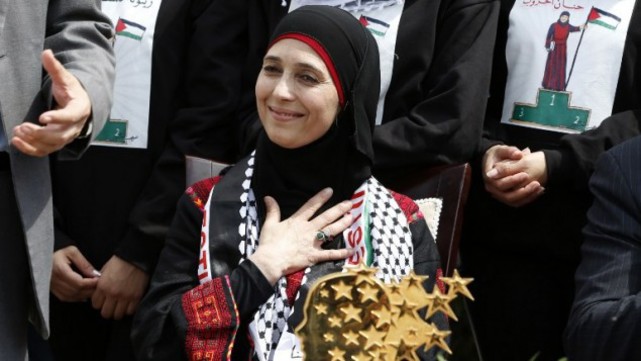
Racist Education
Hroub’s win brought in a spate of articles, the Israeli media of course focusing on her ‘terrorist’ husband (he’s a lawyer and so are their twin daughters), the ‘possible’ danger of letting a million dollars into Palestinian hands and questioned her teaching methods. But videos of this second-grade teacher in her class bust the much stereotyped view of ‘inciteful’ Palestinian education. When Dr. Wolfram Reiss from University of Rostock, Germany, studied Palestinian textbooks, he confessed that they not only ‘avoid hatred and incitement against the West, but foster very much Western values: democracy, human rights, the individual rights, the education for peace and tolerance of all religions, the rights of women and children, the civil society,… From a western perspective the…textbooks therefore have to be highly praised indeed.” Time and again, studies have revealed that the occupying government includes a number of ‘racist’ books in its school curricula with distasteful negative stereotyping of Arabs, blatant absence of Palestinian identity or the mass exile and extermination of Palestinians in 1948 by the Israeli military.
If there’s anything that grants Israel impunity for its crimes against Palestinian children, then it is the hypocritical show of solidarity by those vested with power. Take for instance, the recent abstention of the UK from a UN resolution on Israel, which alongside the USA, makes three bosom buddies with ‘strong’ business ties. It seems they are hell bent on making toothless denunciations while the occupying forces continue to oppress and wipe out a nation.
But even so, Palestine won. It beat the world this year.