

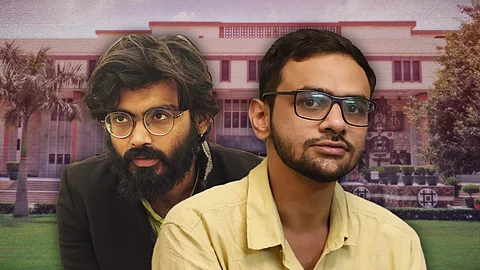
Umar Khalid has spent over five years in jail, while Sharjeel Imam will be approaching six years, since he was arrested earlier than the other accused, and yet the apex court was not persuaded that, on the present record, continued detention has crossed the threshold of constitutional impermissibility so as to override the statutory embargo under Section 43D(5) of the Unlawful Activities (Prevention) Act, 1967. Meaning thereby, as per the Supreme Court, over five years in jail, and when the trial is yet to begin in the conventional sense, are not enough to say that such long incarceration violates the constitutional liberty of the accused, because there exists a provision that allows such accused persons to remain in jail until proven innocent. Arguendo, even for that, the trial needs to begin at least, whereas the current status shows that the case proceedings are at the stage of framing of charges, the prosecution has filed 37 charge sheets, the case involves twenty accused persons, proposes to examine more than nine hundred witnesses, and relies upon voluminous documentary material which, at the current pace, might take decades to conclude.
Before we get into the reasoning on which the Supreme Court has relied while dealing with the bail applications of Umar Khalid, Sharjeel Imam, and the other accused in the larger conspiracy case, we need to understand that bail law in India has long followed the principle that “bail is the rule, jail is the exception,” grounded in the presumption of innocence and the fundamental right to life and personal liberty under Article 21 of the Indian Constitution, which values individual liberty to the core. However, there are some special provisions that specifically make bail law stringent for the accused. In this case, the relevant provision is Section 43D(5) of the UAPA, which overrides criminal law on bail and provides that no accused person under Chapters IV and VI of the UAPA, which relate to terrorism, shall be released on bail if the court believes that the accusation against such person is prima facie true. Denial of bail simply means that the court finds the prosecution’s case prima facie true against Umar Khalid and Sharjeel Imam.
It is pertinent to mention that the FIR at its inception included Sections 147, 148, 149, and 120B of the Indian Penal Code. Upon completion of the investigation, a chargesheet came to be filed alleging offences under Sections 120B read with Sections 109, 114, 124A, 147, 148, 149, 153A, 186, 201, 212, 295, 302, 307, 341, 353, 395, 420, 427, 435, 436, 452, 454, 468, 471, and 34 of the Indian Penal Code, as also under Sections 13, 16, 17, and 18 of the Unlawful Activities (Prevention) Act, 1967, Sections 25 and 27 of the Arms Act, and Sections 3 and 4 of the Prevention of Damage to Public Property Act, 1984.
The court, while denying bail to Umar Khalid and Sharjeel Imam, categorically differentiated them from the rest of the accused, thus creating a hierarchy among the accused and placing both of them at the highest level, as, according to the prosecution’s case, they are the masterminds of the entire alleged conspiracy, whereas the others were facilitating what Umar Khalid and Sharjeel Imam were directing and planning. Addressing the question of parity for Sharjeel Imam, as many accused had already been released on bail, the court, while dismissing the plea, observed in paragraph 172:
“The plea of parity, though pressed with emphasis, cannot override the statutory conclusion. Parity is not applied by numerical comparison. It is applied by similarity of role, similarity of attribution, and similarity of the material relied upon. The courts below have treated the appellant’s role as qualitatively distinct, and the material noticed above indicates why the prosecution alleges a foundational role at the early stage. In such circumstances, parity cannot be invoked mechanically to dilute the statutory embargo.”
The charges against accused are not of active involvement but of conspiracy related to riots in Delhi that took place on and around 22nd, 23rd, and 24th February 2020 in which as per the affidavit submitted to the Delhi high court by Delhi Police on July 13 2020, 77% of the civilians killed, 40 out of 53 were Muslims and that too when, on the said week neither Umar nor Imam were present at the site where deadly violence took place rather Imam was already in custody. Even this plea was not considered because in the story of prosecution they planned it months before and court accepting the narrative as it is, called it immaterial whether accused were present at the concerned site or not.
The Supreme Court left it to the trial court to determine the reliability and legality of the material relied upon by the prosecution, as at the bail stage all it was concerned with was whether there exists a chain in the material presented by the prosecution and whether, if taken at face value, it is coherent and reflects a real nexus with the offences alleged. On the argument that the prosecution was relying only on a speech of Imam, the Court rejected it by accepting the prosecution’s narrative of sequence at face value and observed that the role attributed to the accused in the charge-sheet narrative is not episodic. The prosecution seeks to place him at the inception of a mobilisation strategy and traces a continuing course of conduct from early December 2019 through January 2020. The charge-sheet refers, inter alia, to the creation of the WhatsApp group “Muslim Students of JNU” and its “core members,” to mobilisation through pamphlets distributed in specific localities, to participation in meetings, to the delivery of speeches at multiple places, and to efforts aimed at establishing or sustaining blockade-style protest sites.
What one cannot find is the link between the mentioned WhatsApp group, distributed pamphlets, calls for protests, and the unfortunate Delhi riots. This may be because the Court answered every ground raised by the applicants by invoking the material provided by the prosecution and left those grounds for the trial court to examine their reliability. When it was argued by Imam’s lawyer that his speeches promoted non-violence and love, the Court actively refuted it in paragraph 169:
“The Court is also mindful of the appellant’s reliance on the assertion that he opposed violence. Such an assertion does not, at the bail stage, neutralise an allegation of conspiracy and preparatory orchestration. A conspirator may outwardly couch the conduct in the language of non-violence while engaging in acts intended to create conditions of confrontation and escalation.”
The Court also rejected Imam’s argument that no weapons were recovered from him, that he did not participate in meetings where violence was planned, and that the prosecution case against him is substantially founded on speeches, pamphlets, and a WhatsApp group which, according to him, are already the subject matter of a separate FIR wherein bail has been granted with observations that the speeches do not contain a call for violence.
At paragraph 221, the apex court interestingly addresses Umar’s argument relating to his reliance on the Amravati speech, urging that it repeatedly invokes non-violence and constitutional protest. The Court observes that the prosecution contends that the speech forms part of a larger matrix of mobilisation and was delivered in temporal proximity to the culminating phase, and that at this stage the Court must refrain from committing two errors. The first is to criminalise speech merely because it is politically charged. The second is to immunise a continuing course of conduct merely because it contains the language of non-violence.
Even if the speech was politically charged and the trial court, after a decade, might find it to be so, how far-fetched would it be to link a speech of love that invokes the Constitution with an act of terror?
Section 15 of the UAPA defines what constitutes an act of terror for the purposes of the statute. The definition is structured around two essential elements. First, the act must be done with the intent to threaten, or be likely to threaten, the unity, integrity, security, including economic security, or sovereignty of India, or with the intent to strike terror in the people or any section thereof. Second, the act must be of such a nature as to cause, or be likely to cause, the consequences enumerated in the provision. The language of non-violence and the essential requirements of Section 15 are opposite in nature, but this was not all that the prosecution had against Umar. The prosecution relies on the testimony of protected witnesses who claim to have heard Umar differentiating between chakka jam and dharna; it also relies on a WhatsApp group which Umar denies having created, his marked location at different meetings that were already everywhere on social media, and his presence at protest sites where he was asking people to exercise their constitutional rights.
Though the Supreme Court was not convinced for the above two but to others it gave relief. While placing them lower in the hierarchy, it granted bail to Gulfisha Fatima, Meeran, Haider, Shifa Ur Rehman, Mohd. Saleem Khan, and Shadab Ahmed, but subject to compliance with strict eleven conditions. On the question of when next, the Court opined that Imam and Umar may renew their bail applications upon the completion of the examination of the protected witnesses relied upon by the prosecution, or upon the expiry of a period of one year from the date of the order, whichever is earlier. It is needless to mention again that the trial is yet to begin, which only means that they are barred from seeking bail for at least one year, and only thereafter may they approach the Court again to seek bail, to try their fate once more, and to see whether their additional years behind bars convince the learned Court that the total incarceration has, by then, crossed the threshold of constitutional impermissibility or a few more months, a few more years until then as Umar Khalid said, “Ab zindagi yahi hai”.